Asleep at the Wheel

You can’t have a government “of, by, and for the people” if the people don’t participate. When Americans are distracted from politics, avoid learning about politics, or think all politicians are dirty so there are no real choices among them, our government does not serve the people. It only serves those who participate.

In 2010, the Supreme Court decided in the Citizens United ruling that money equals speech. They argued that limiting campaign contributions is the same thing as limiting our right to free speech. This unbelievably harmful ruling ensures that big money rules our elections. The rich can spend so much on campaigns that they drown out whatever ordinary people are trying to say.

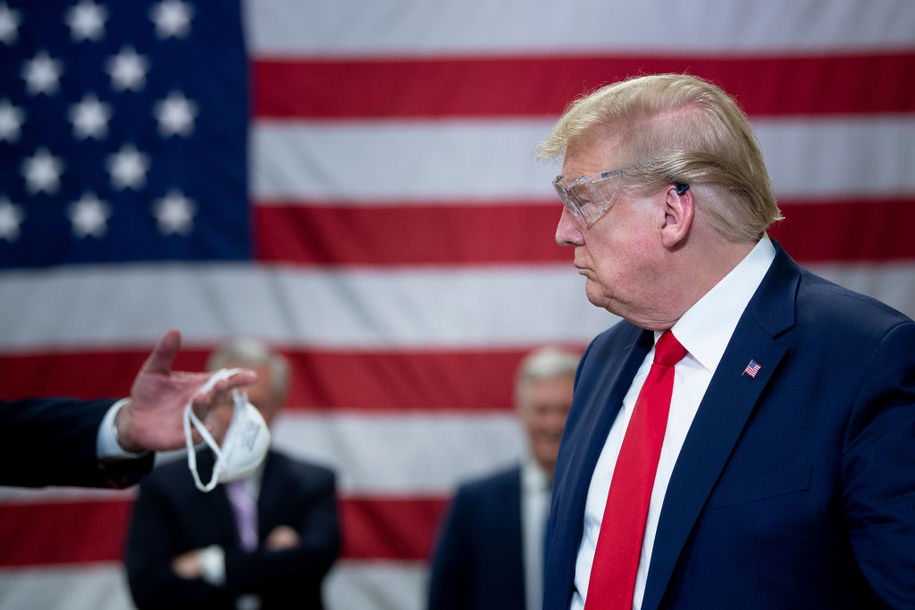
Trump and his billionaires are the end result of a process that has been going on for decades. Ordinary Americans should be driving this car, but most have been too distracted or too cynical to do the job. Instead, the very rich have pushed us aside. They have taken the wheel of American politics so that they can just keep on getting richer. The politicians they put in power are the ones who will do what they want. This means lower taxes for the rich, higher taxes for the rest of us, fewer regulations, and less oversight, so they can get away with more monkey business.

Now Trump’s administration is in the process of destroying the working parts of our government. They are not trying to throw out the bathwater and keep the baby. They’re throwing the baby out too. Education? Medical research? Food safety? Consumer protection? Environmental rules that fight climate change? The billionaires have decided we don’t need any of that.

It’s much easier to destroy things than to build them. It took a long time and a lot of work to get our government to help people in crisis, take care of the elderly, educate children with special needs, and keep industry from spoiling our air and water. Now all the structures that were so carefully put in place to help ordinary Americans are being torn down as fast as the billionaires can manage.

For a long time, Americans have allowed ourselves to believe that we don’t have to participate in politics. What difference does one vote make, after all? The problem is that if millions of people think this way, it makes a huge difference.

Trump and his billionaire besties are driving this car right over a cliff. His tariffs make everything we need more expensive, not cheaper. He is turning our allies into enemies, and making friends with dictators. He is leaving our country at the mercy of the next epidemic, in spite of all we learned from COVID. Instead of negotiating fair deals for the resources we need, he threatens to take them by force.

It won’t be easy to take the wheel back from the billionaire class that has grabbed it. They are ruthless, they own most of the media, and they don’t care whom they hurt. They will lie, cheat, and use violence to keep themselves in power.

But that car belongs to us, the people of the United States. We have a Constitution for a reason. For all the faults of that document, it does insist that the country belongs to the people who live here, not just the rich and powerful. If we pay attention, if we decide to participate, we can take this country back.

It is tempting to sleep through this era of loss and destruction. But the only way to rescue our country is to wake up to our power to change things. Too many of us have left the driving to others. We need to take the wheel and steer ourselves back toward peace, justice, and a sustainable future.

Stop Starving Gaza

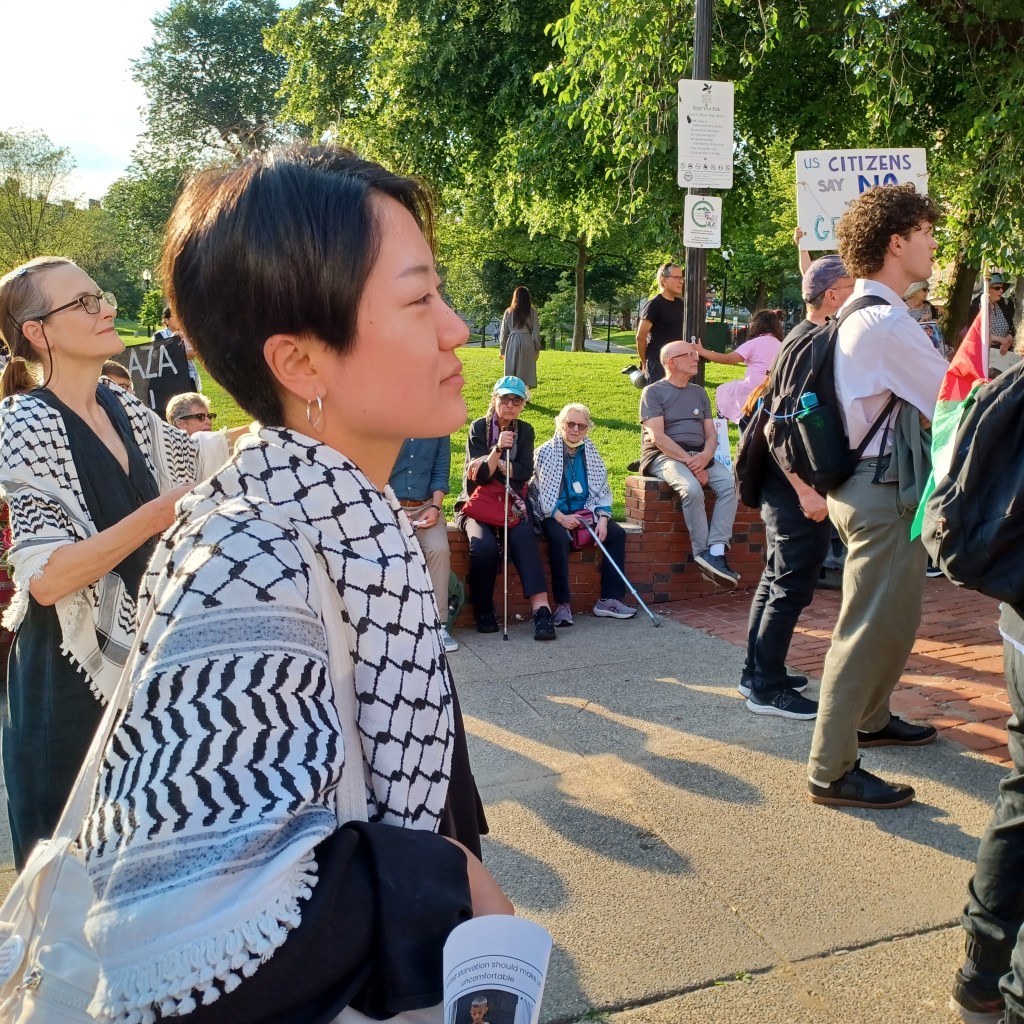
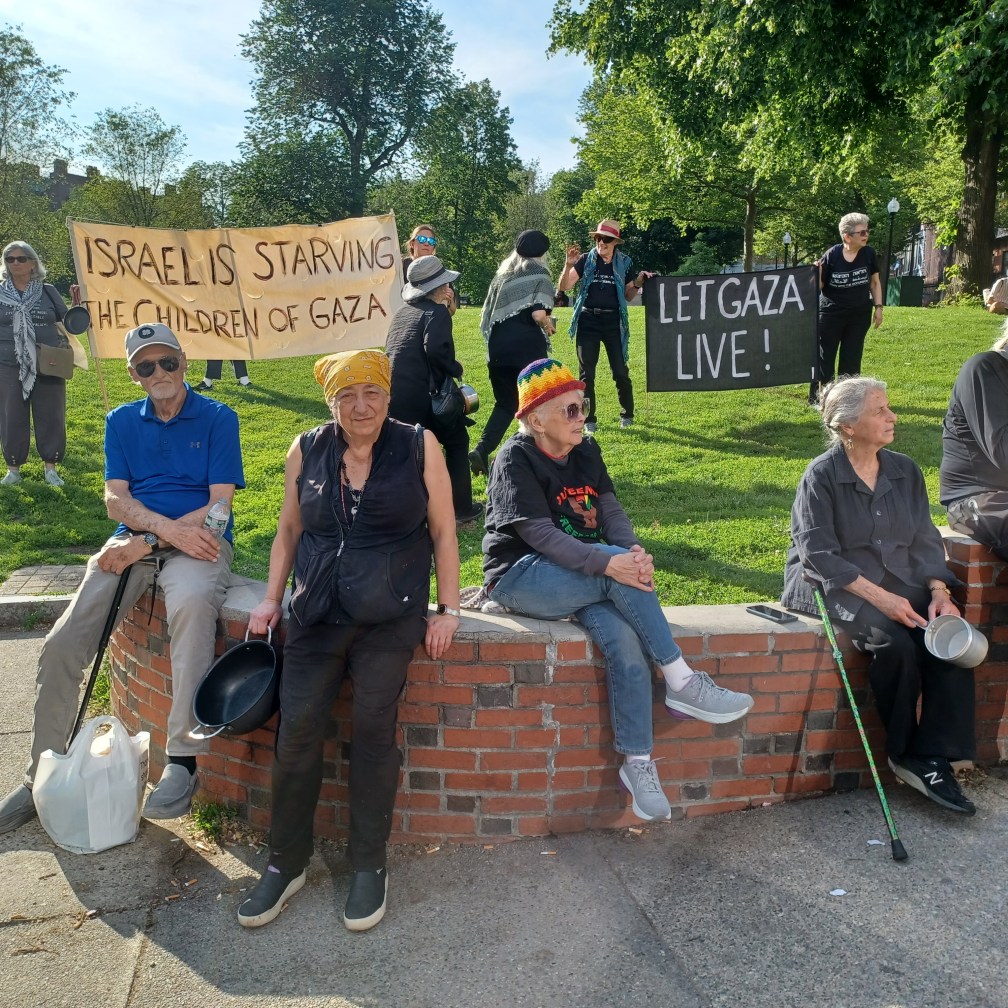
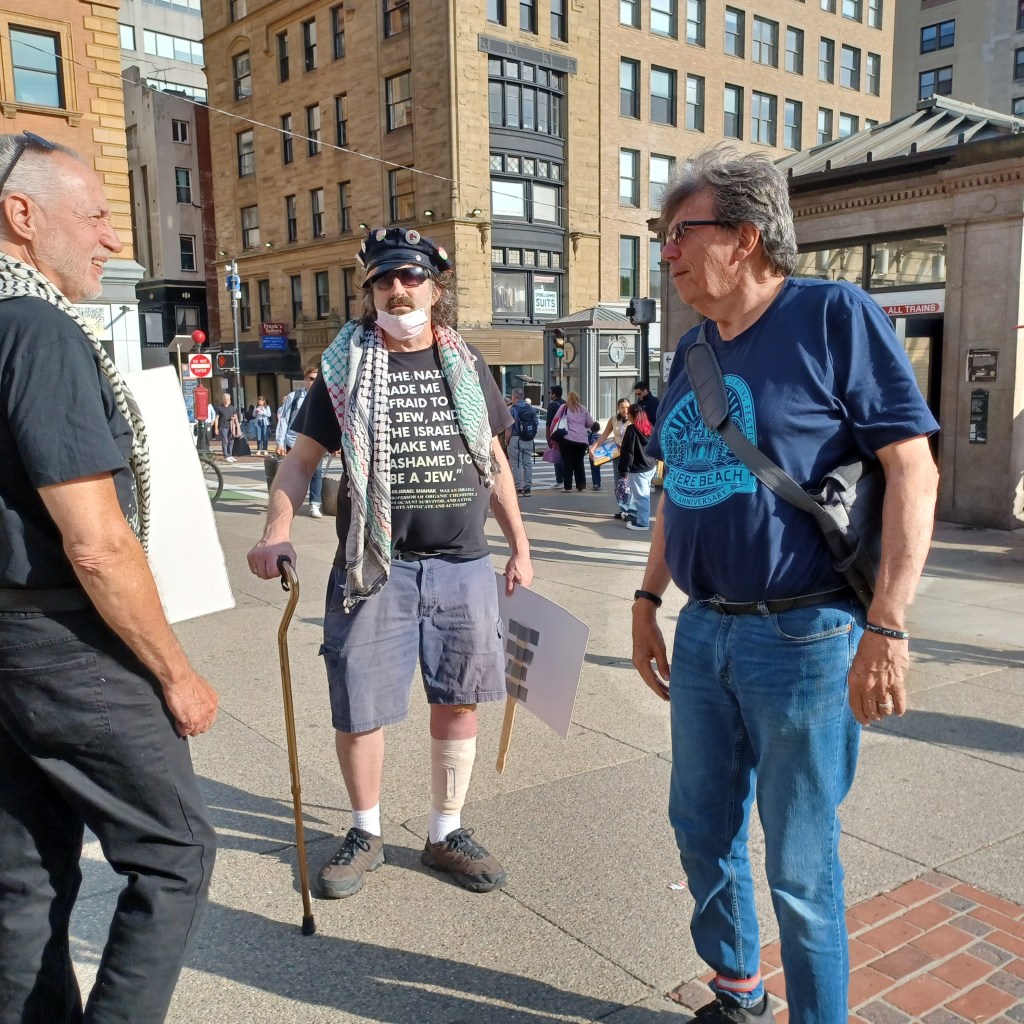
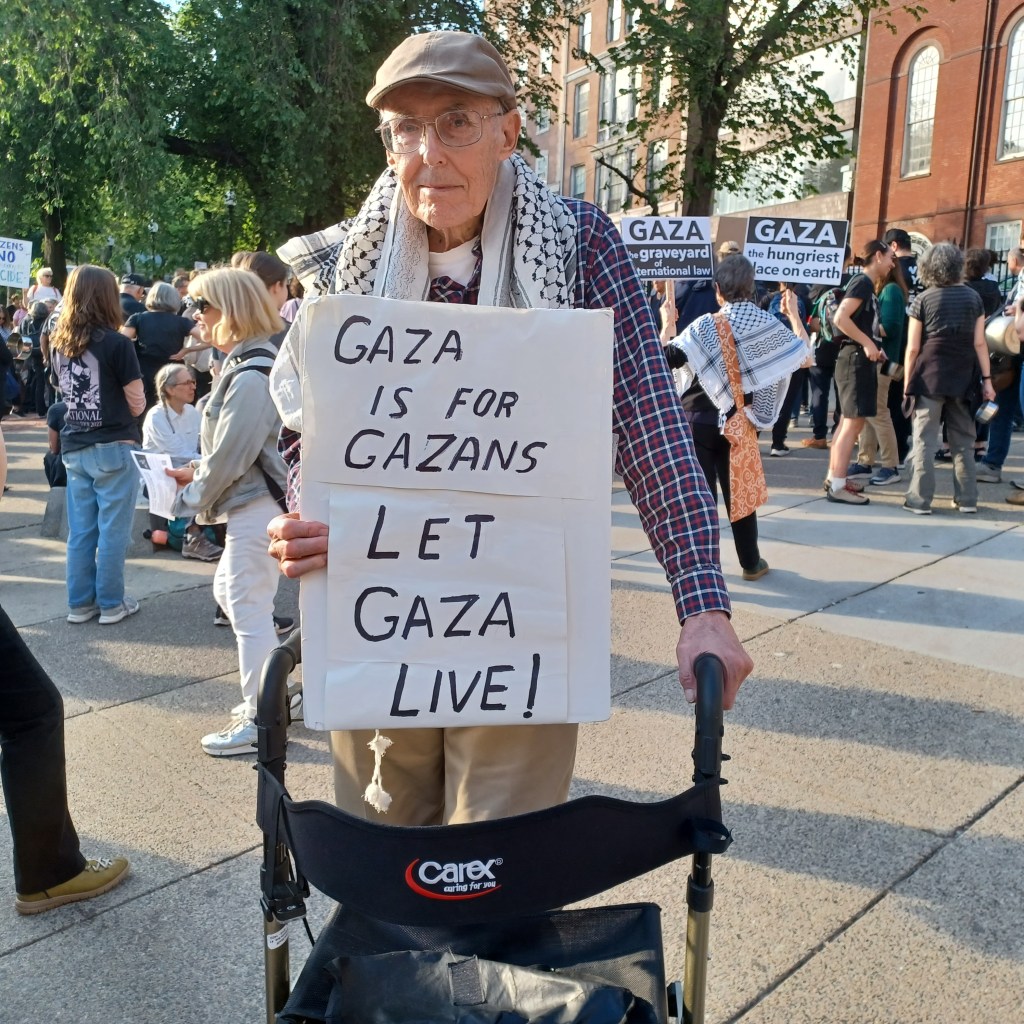
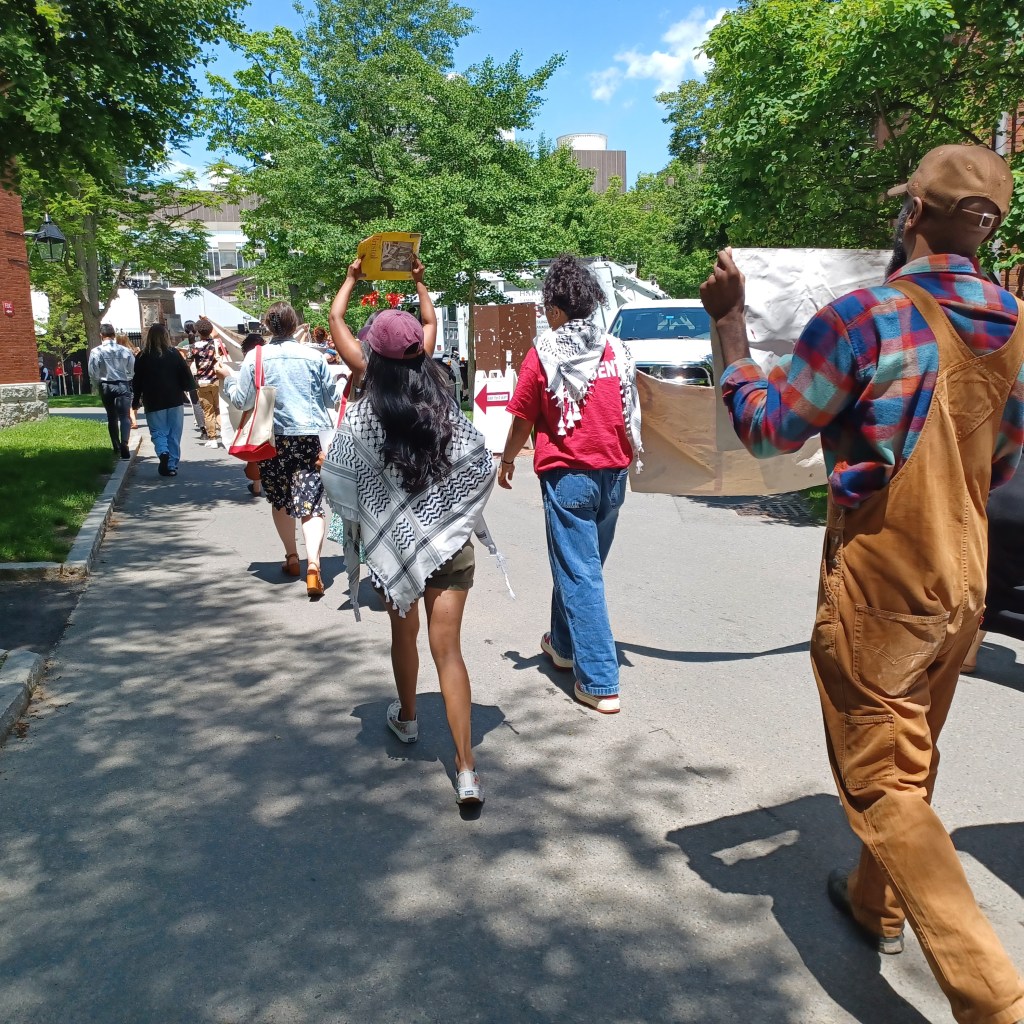
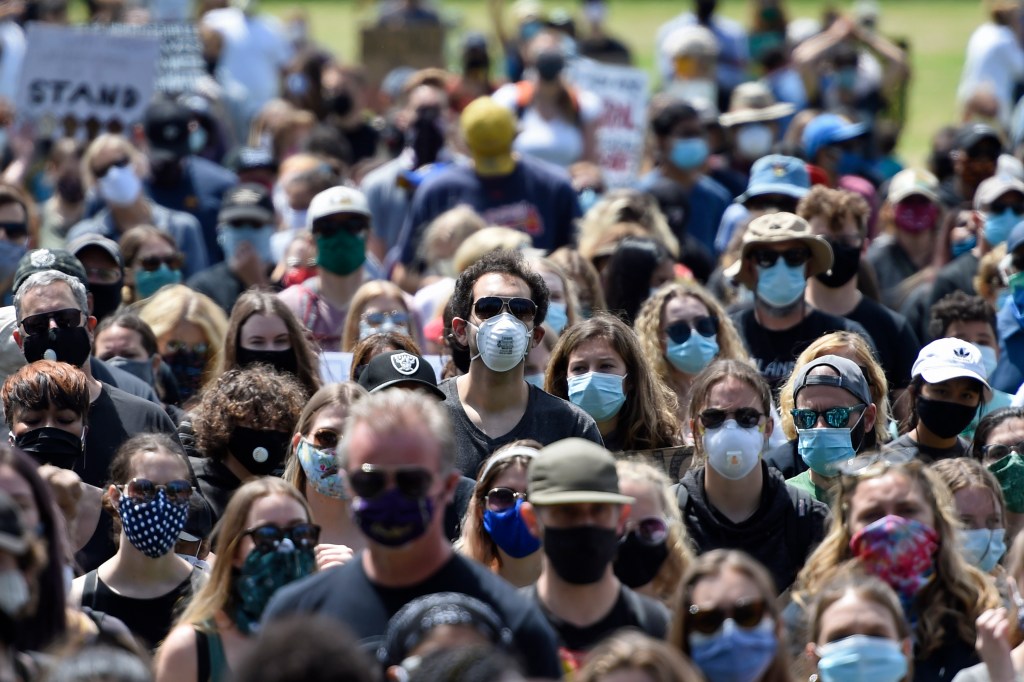
On Tuesday, June 3, I went downtown to a 5:30 demonstration against the current Israeli policy of starving the people of Gaza. There were only about 200 protesters, but then the event was poorly publicized. Most of the protesters were either quite old or quite young. Many were Jewish; some were people of color. One, a lovely young Asian woman, said it was the first time she could allow herself to be photographed without a mask at a protest. She had just become an American citizen. Now she doesn’t have to be afraid of deportation for protesting a war crime.

We had been asked to wear black and bring an empty pot. I understood the black: we were mourning tens of thousands of unnecessary deaths. The pots were to bang on, it turned out. The symbolism was wasted on passersby, and there was quite enough noise without the banging.

My protest buddy said she agreed with about 60% of what the speakers said. I agreed with about 80%. Some of them spoke about the 1400 medical workers killed in Gaza since the Hamas attack of October 7, the journalists killed, the international journalists prevented from reporting on the scene. One of them, the angriest, was the only speaker I’ve heard who seemed to support Hamas. He was listened to, but the crowd murmured, and didn’t bang on their pots when he finished.

Some of the signs: “Gaza Genocide: we can’t say we didn’t know.” “Let the children eat.” “Gaza: the graveyard of international law.” One tee shirt quoted George Carlin: “I have certain rules I live by. My first rule: I don’t believe anything the Government tells me.”

A man in a MAGA hat tried to ride his bicycle through the crowd. The monitors stopped him, politely, but he wanted to argue. “Now you’re behind me, and I’m feeling threatened!” he said, and added, “You judge me because I’m wearing a hat?” He kept getting louder. A youngish man stepped up, telling the guy he was going to change his mind. The monitors asked the two men to take their argument further away from the speakers, which they did.

For the next half hour, the two men continued their discussion to one side of the protest. The older man mentioned Dresden and Nagasaki as the kind of horrors that are sometimes necessary in war. He said he had seen videos of Hamas hijacking aid trucks. At one point I heard the younger man say, “I’m hearing a little too much dry drunk right now.” Finally they shook hands, and the MAGA guy rode away on his bike. I doubt his mind had been changed. But he clearly felt that he had been given a respectful hearing.

I remember, wistfully, an occasion nearly a year ago when I had a good conversation with a Zionist Jew on the Harvard campus. We disagreed on most things about this war, though we agreed on many other issues. We came up with the idea of the university holding a series of informal meetings on Gaza, to be called “Let’s Just Talk.” We parted amicably. But the last time we saw each other on opposite sides of a protest, he hissed at me, “So you support terrorism?!”

Our opposing sides are operating with two different data sets. Two different sets of photos, videos, eye witness accounts, casualty numbers: everything. We really, really need to just talk.

Strangers in a Strange Land

“You shall not oppress a stranger, for you know the heart of a stranger: You were strangers in the land of Egypt” (Exodus 23:9).

The Passover service reminds Jews that once we were slaves in Egypt. We also remember that not so long ago, millions of us were herded into concentration camps to be tortured, worked, or poisoned to death. These memories should encourage us to feel empathy for the people who are currently suffering under cruel regimes.

Most Americans are now aware that the Trump administration is a consistently cruel regime. Some of the meanest people Trump could find are running our government. Times are hard, and about to get harder, for anybody with little money. For immigrants, life has become not just hard but terrifying. Not much prevents ICE from disappearing any of them into some hellhole in El Salvador for no reason at all.

Jews left Egypt because Pharaoh had made life unbearable for us. But after our miraculous escape into the desert, some missed their old homes, especially the pomegranates and figs. We were free, but the migrant life brought us a new set of troubles. Few people leave home if they don’t have to. We love the landscapes, people, and communities where we grew up. If we can stay home and make a living in peace, that’s what most of us prefer to do. But if staying home means that our families are subject to violence, extreme poverty, or other forms of oppression, sometimes we have to leave.

According to the Economic Policy Institute, there were around 48 million immigrants in the USA in 2022. Some came because their relatives were here and could find jobs for them, or to study at our great universities. However, many of them were fleeing terrible conditions in their home countries. They had to leave. They crossed deserts, rivers, and mountain ranges to get to this country, where they hoped to be able to live in peace.

Immigrants look for work in sectors where there are labor gaps, in agriculture, health care, or construction. They include doctors and software engineers as well as farm workers and care providers. Together, they generated $4.6 trillion in economic output in 2022. Often they pay taxes without gaining the benefits citizens expect from the government. Without their youth and vigor, our country would not be able to support our aging population as it retires. We owe them a lot.

In addition to what US citizens gain in needed labor and new business ventures, we get a range of wonderful new food and music to enrich our lives. Anybody who visits a major city in the US can find and enjoy nearly every culture in the world. This has always been part of why most of us love this country: everybody is here. People from Iran and Iraq, China and Japan, Russia and Ukraine, manage to live together in America. Within a generation, they are as American as it gets.

Yet instead of welcoming these people who went through so much to get to our country, our government treats them like criminals. Democratic presidents have not done much better than Republicans in this regard. It’s easy to blame immigrants for situations that are clearly not their fault – like the American appetite for opioids, which has fed the growth of violent gangs worldwide. No American government wants to admit that our country’s cynical support for South and Central American dictators nurtured the drug trade and devastated the lives of their citizens. Yet we bear heavy responsibility for the brutal conditions that have made so many flee their homes.

The worst irony for many Jews this Passover is that another cruel regime causing tremendous suffering is the state of Israel. Jews who realize how badly Israel has treated Palestinians since the state was founded are struck with deep shame and horror. Most pro-Palestinian demonstrations include a strong showing of supportive Jews. We remember when we were the victims of cruel regimes. Now we must do whatever we can to stop the cruelty, even if the perpetrators of oppression and violence claim they’re doing it for our sake.

I would like to add two prayers to this year’s seder: May everyone in Israel/Palestine live together in peace someday. And may the United States learn to respect and protect all those strangers who honor us by coming to live here.

by Jane Collins
Please email me at janecollins1@gmail.com if you would like me to add you to my regular readers’ list.

More Jews for Justice

The People Speak

Ever since Trump and Musk began to take a chainsaw to the work of generations, I’ve been hearing, “Where is the outrage?” Go to a protest near you; you will find that outrage.

On Thursday, March 26, I went to Tufts for a rally against the abduction the day before of Rumeysa Ozturk, a Turkish doctoral student at the school. She was snatched by masked federal agents as she walked toward a friend’s house, handcuffed, and driven away in an unmarked car. Before a judge could order that the government not take her out of Massachusetts, she had already been spirited away to an ICE detention center in Louisiana.

Ozturk was grabbed without any form of due process. She was in the United States legally on a student visa. She had done nothing wrong. About a year ago, she objected to Tufts’s refusal to divest from Israel in an opinion piece in the student paper. Trump & company have decided that anyone who uses their freedom of speech in a way they don’t like is a threat to national security, maybe even a terrorist.

Outspoken international students are low-hanging fruit. Trump means to pick them and throw them somewhere to rot. He doesn’t have to abduct all of them, just enough to shut the rest of them up.

But students are not shutting up. Ozturk’s abduction, added to the equally outrageous detention of Mahmoud Khalil, a Columbia student, three weeks ago, and the rendition of  more than 250 Venezuelans to the worst prison in El Salvador with no proof that any of them were criminals or gang members, has pushed many into activism.

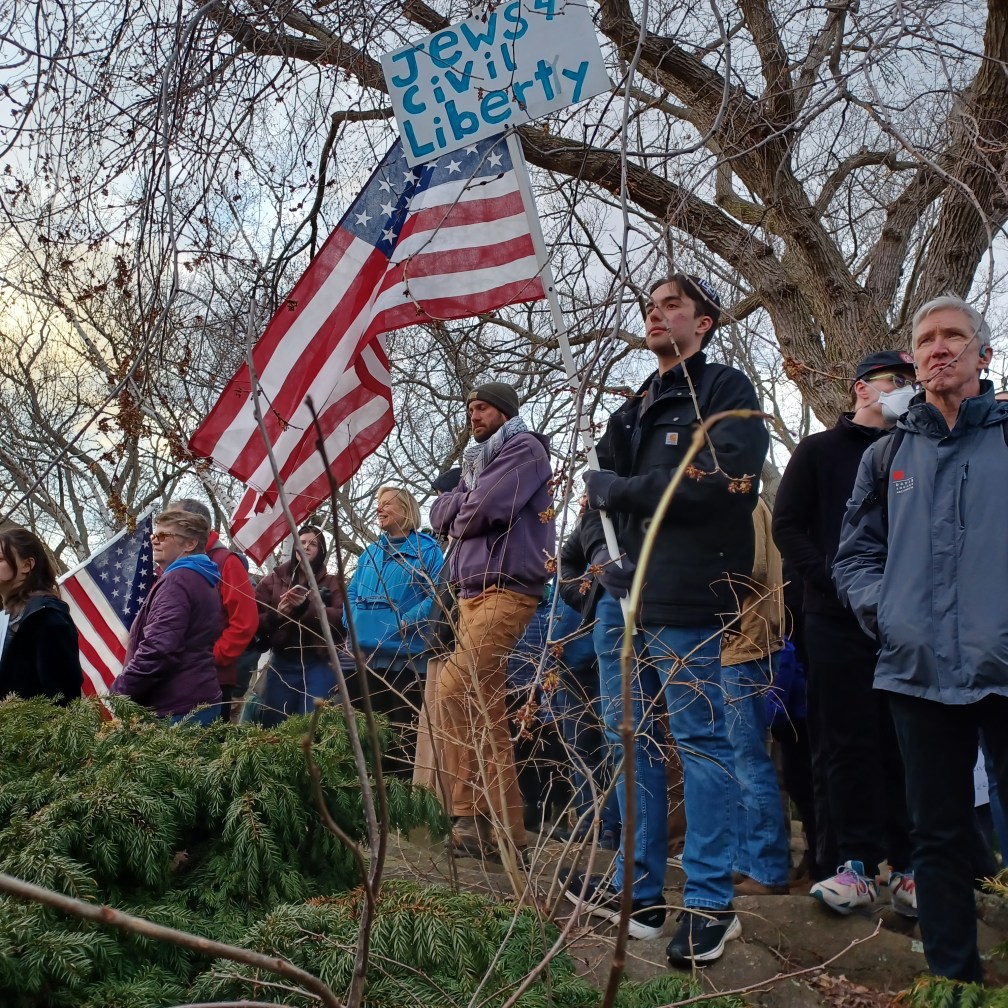
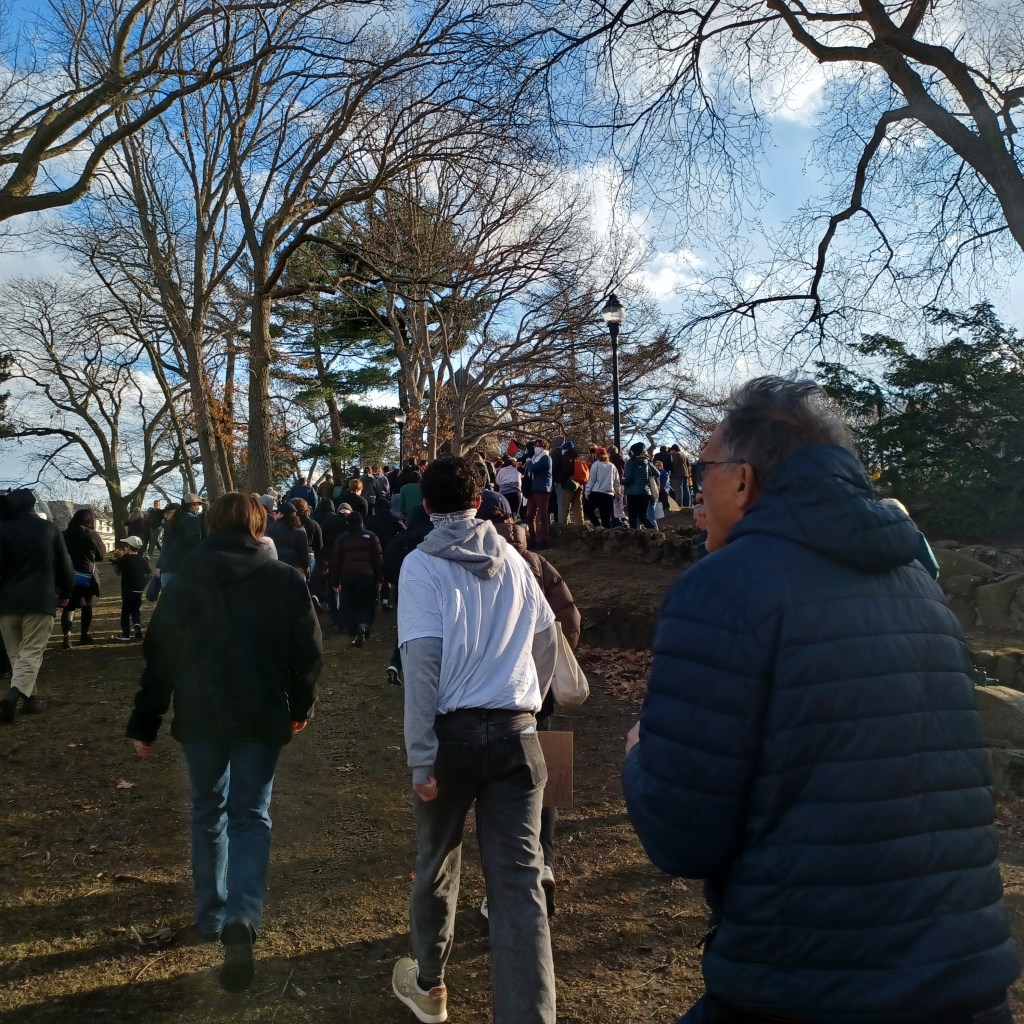
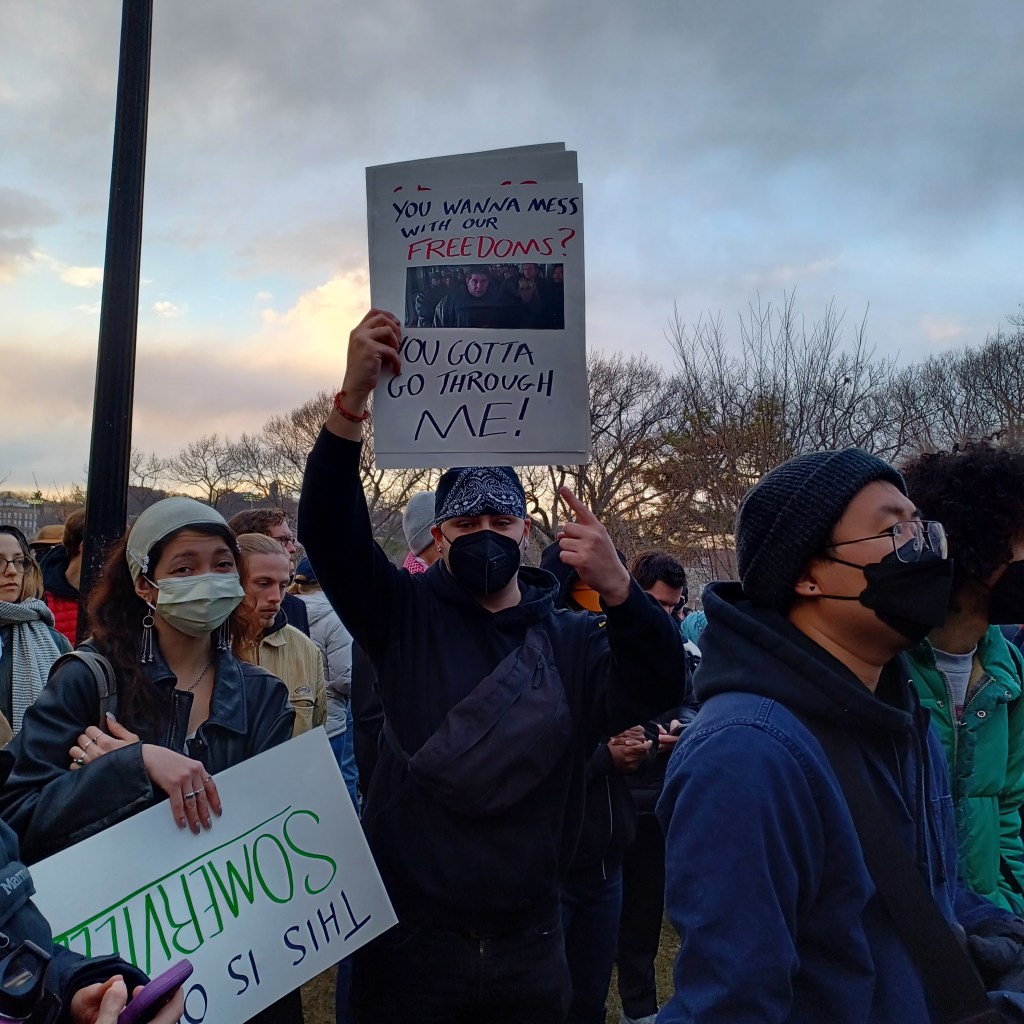
The Tufts rally comprised about 2000 people, most with handmade signs. Never mind the speakers, whom I couldn’t hear anyway. This is what their signs said:

An injury to one is an injury to all.
Free Rumeysa!
Democracy NOT deportation protects Jewish students
We will not be silenced!
Silencing dissent is the REAL cancel culture
If not fascism, then why fascism-shaped?
Democracy > Deportation
Release all prisoners of the secret police
Democracy is under attack!
Speak out against injustice or you’re gonna be silenced next
I love inclusion, equality, diversity
Stop doing evil shit
Abolish ICE
ICE out of our communities! Free Palestine!
Jews Against Deportation
This Tufts alum affirms the equal dignity and humanity of all people
Nice Jewish Students for Democracy
(a ten year old with a rainbow sign) RESIST!
Jewish Civil Liberty
Hands off our neighbors
Find courage/ find community/ fight fascism
They want us scared/ We’ll show them our strength
This is fucking insane
Free Rumeysa – Free speech
It starts with students!
You wanna mess with our freedoms? You gotta go through me!
Stop kidnapping students.
You can’t appease a dictator!
Show your face when you steal our students.
This is OUR Somerville.
Immigrants make us great.
Don’t sleepwalk through fascism.
Stand together.
Never normalize kidnapping.
Melt ICE
Silence is complicity.
When speech is silenced, Revolution speaks.
First they come for the scholars.
Against Genocide Anywhere.
(More signs from a small, poorly organized protest in Harvard Square the next day:)
In the name of humanity, we refuse to accept a fascist America
Hands off legal students and visitors
Stop the fascist assault
I(ncompetent) C(ruel) E(xpensive)
Due process rights for ALL people (see the 5th amendment)
Our tax dollars fund genocide
In the name of humanity, let in asylum seekers and refugees
Deport ICE not students
1st amendment? Hello???

Project 2025 indicates that it won’t be long before Trump uses the military against peaceful demonstrators. There will be tear gas, pepper spray, and water hoses, mass arrests, and eventually, rubber bullets or worse.

Meanwhile, Trump is damaging everything we love: our communities, education, alliances with other democracies, the environment, and most of all our rights. Democracy is clearly under attack. As Americans realize how much harm is being done, we get angrier, maybe even angry enough to get up off the couch and do something.

The protests are becoming more frequent, and the crowds keep getting bigger. If you’re not on the streets already, I hope you will join us soon. The homemade, passionate, outraged signs at every rally help me to believe that maybe we can save democracy. Not leaders or heroes, or the corporate-owned Democrats. We, the people. 

Prayer for the New Age

Children crying from hunger.
This is the age of cruelty.
It ends now.

People sleeping in doorways.
This is the age of poverty.
It ends now.

Styrofoam washing up on beaches.
This is the age of garbage.
It ends now.

Neighbors burn down neighbors’ houses.
This is the age of hatred.
It ends now.

People with no hope pick up guns.
This is the age of violence.
It ends now.

This is the age of new creation.
It begins with you.

By Jane Collins and Christina Starobin

Christina is the author of CORONA WILDFIRE & POEMS OF PROTEST, This Changes Everything, KALEIDOSCOPE CAFÉ, & A Human Being Is Not a Remote Control Device, the beginning of a series; all available through Cyberwit or Amazon.

Here Come the Clowns

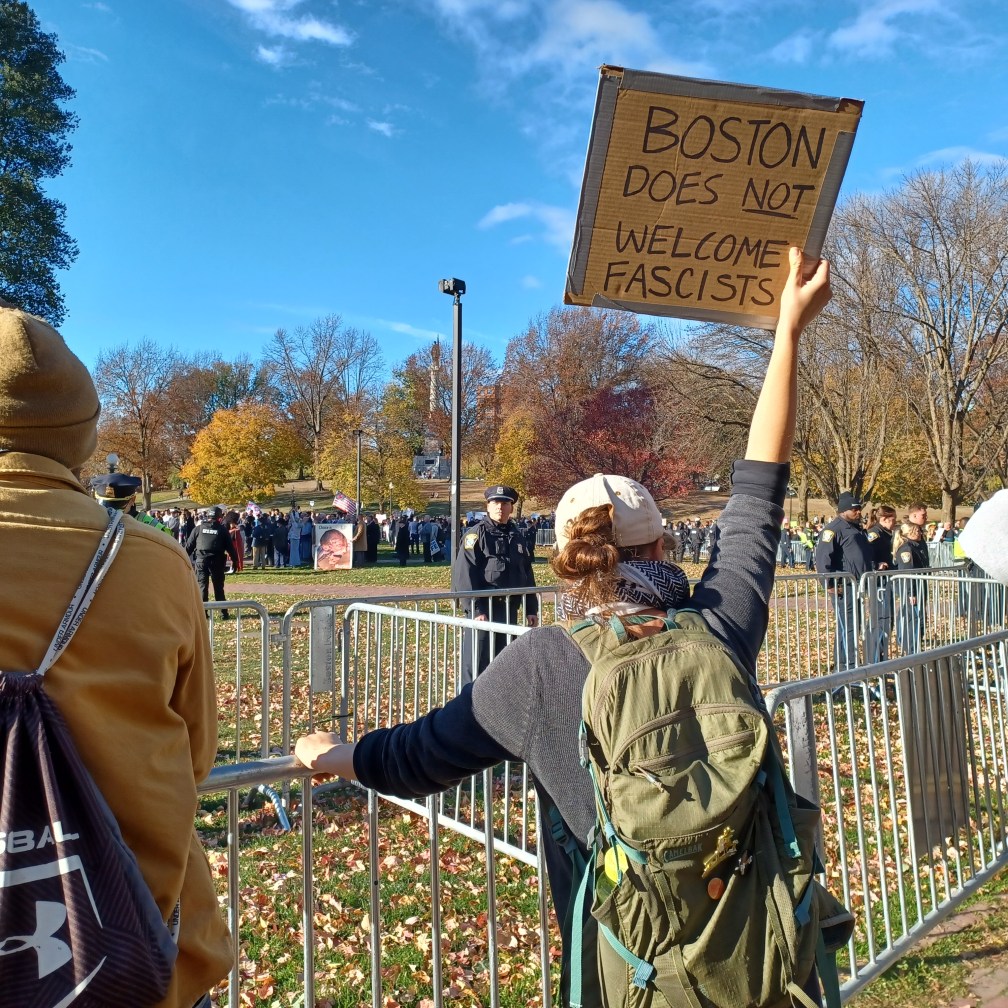
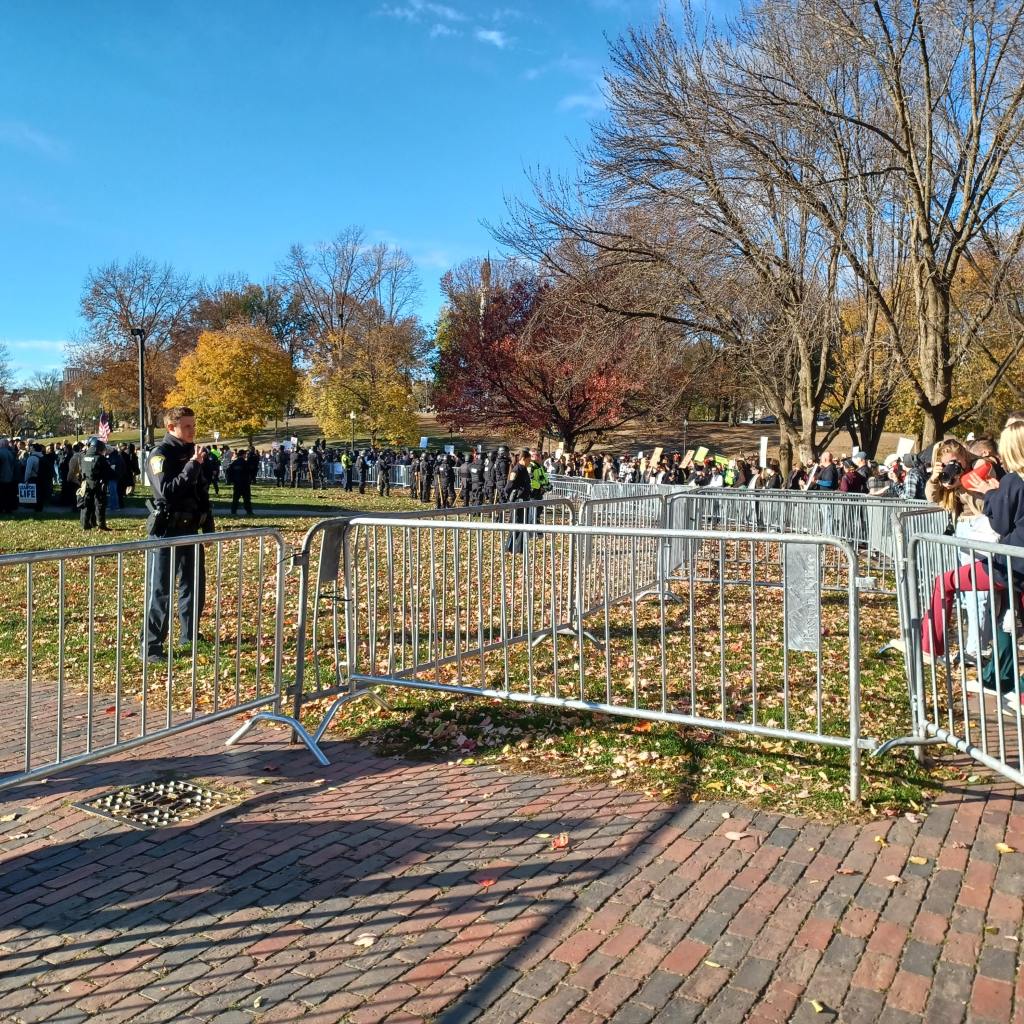
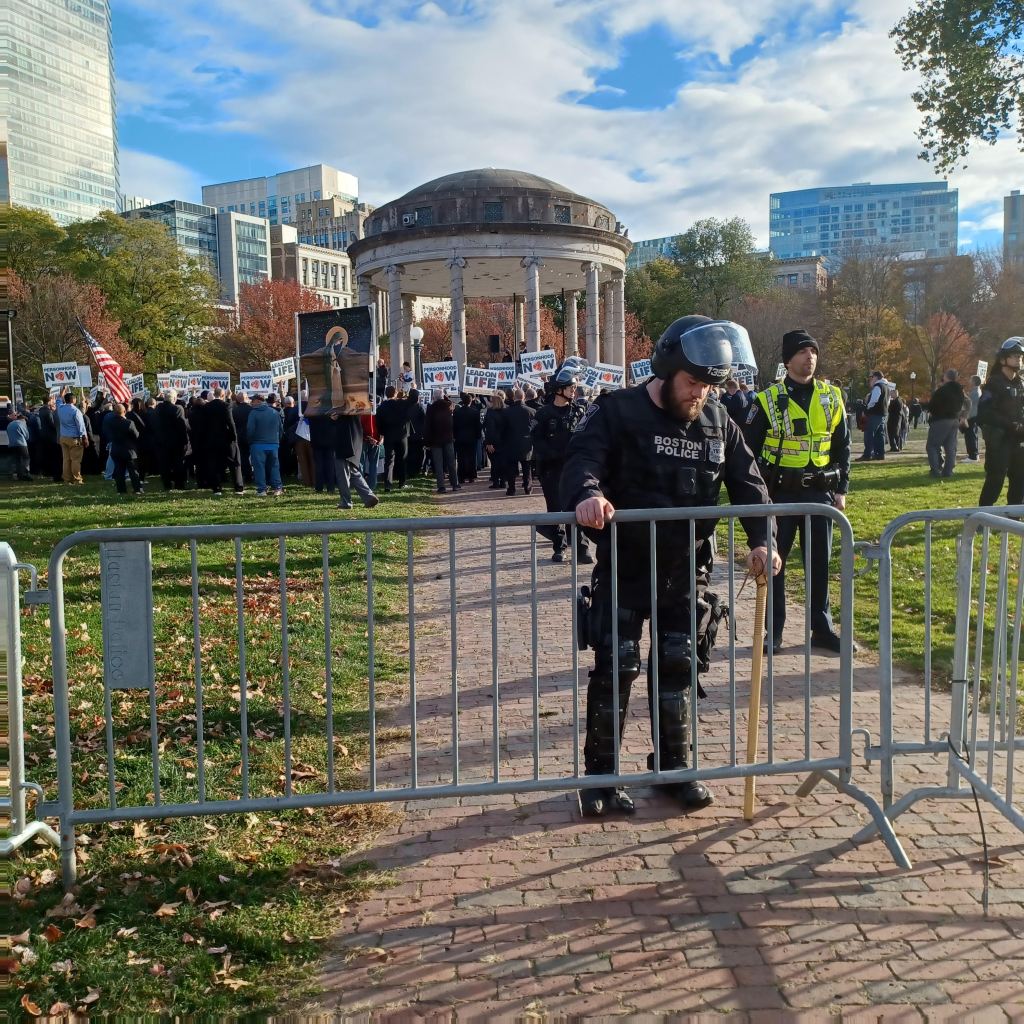
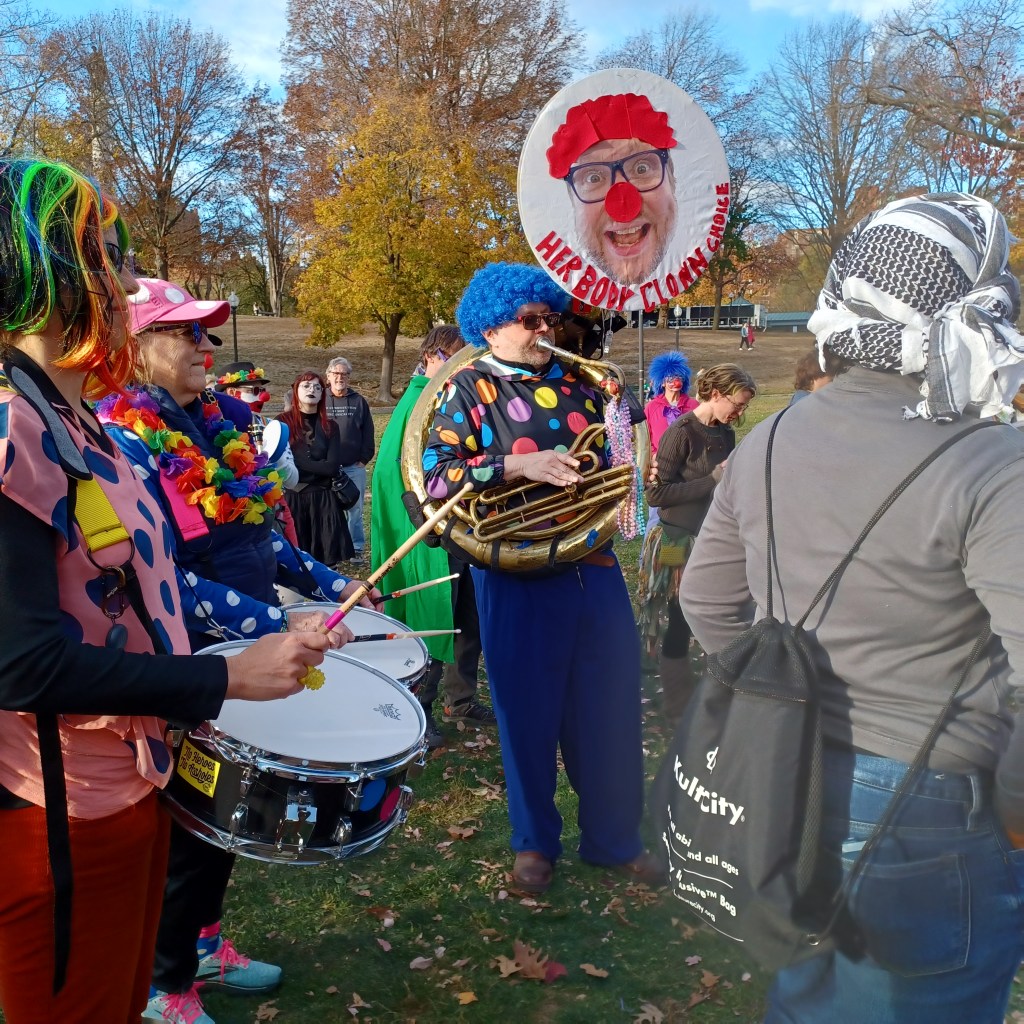
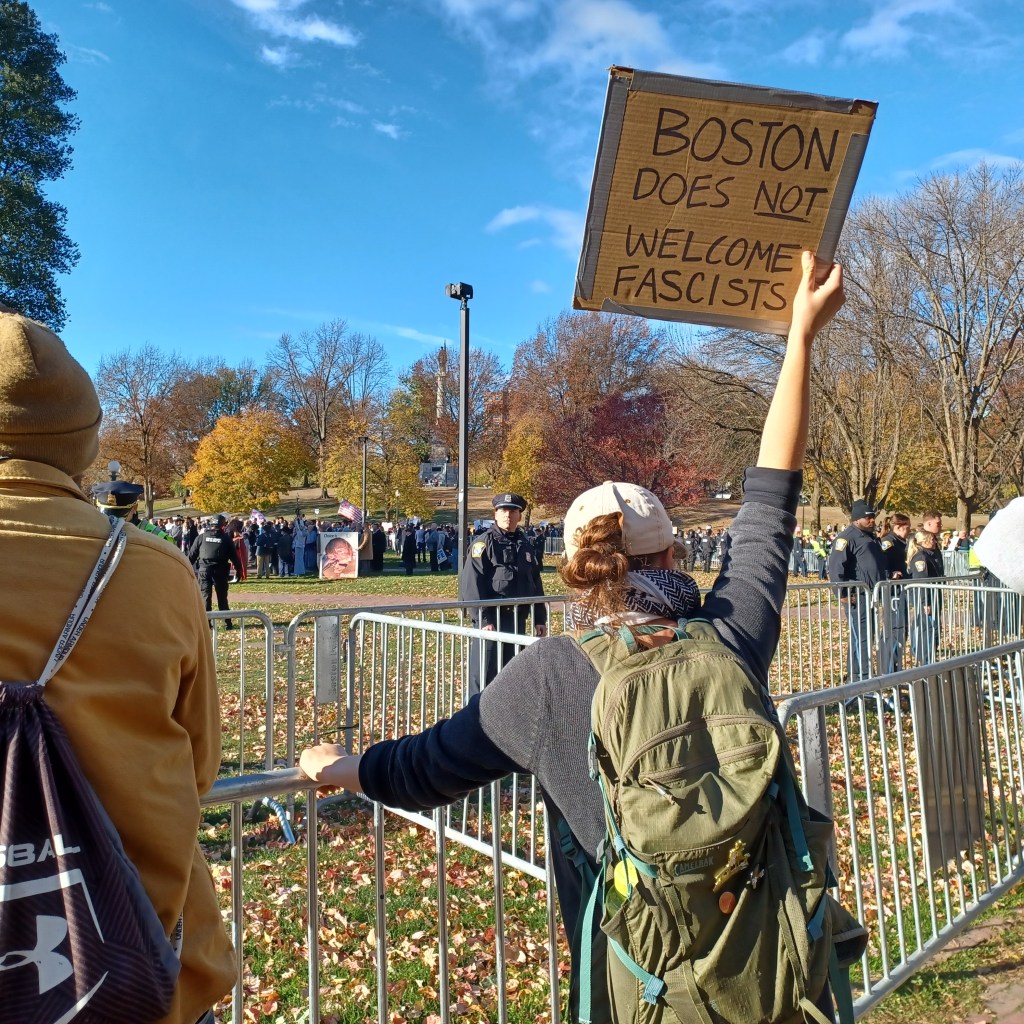
On November 16, around 150 people, nearly all white men, marched against abortion in Boston. I was proud of our city. The counter-protest was about ten times larger than the march. Approximately one in ten counter-protesters came dressed as clowns. There were a few Antifa people in black and a few communists with pamphlets and a bullhorn, whom everybody ignored.

It was a beautiful day, sunny and warm for the season. My son and I arrived late to the planned rally at the bandstand in the Boston Common. We thought we might have missed the whole thing. Then we saw a couple of cute young female clowns coming up the path. They told us the march was delayed but should be arriving any minute. Some student journalists from Emerson College, intrigued by his Veteran Healing sweatshirt, interviewed my son. Their questions boiled down to, Why are you here? His answer was, To fight fascism.

According to an NBC News report, police made nine arrests earlier in the “National Men’s March to Abolish Abortion and Rally for Personhood”. The report’s headline called it “a large anti-abortion march”, even though the only large crowd was the one that came out to oppose it. All the news reports I’ve seen feature many photos of the stern-looking men in black suits or priests’ clerical robes, and few photos of the much more colorful and numerous counter-protesters. There were almost as many police as marchers, some in full riot gear; the photographers liked them too.

The counter-protesters carried handmade signs: “Thomas Jefferson disagreed with you! He believed in the separation of church and state.” “Wealthiest Nation with highest Maternal Mortality.” “Life begins at ejaculation/ Mandate vasectomies.” “Letting men decide about women’s healthcare is like letting your dog make decisions about your car because he likes to ride in it sometimes.” And my favorite: “He who hath not a uterus should shut the fucketh up; Fallopians 19:73.”

Trying to drown out the speakers, people blew whistles and horns, rang cowbells, and shouted slogans like “Racists, sexists, anti-gay/ All you fascists, go away!” “Pray! You’ll need it! Your cause will be defeated!” “Pro life? That’s a lie/ You don’t care if people die.” Pleasanter noise came from the Clown Band, about two dozen musicians, heavy on the brass. When the Men Against Abortion entered the cordoned-off bandstand, the band greeted them with the Imperial March from Star Wars.

Some of the police looked ready to attack the clown-inflected protest crowd. Two cops, though, stood right in front of the anti-abortion folks’ worst sign. It was a huge blow-up of a dismembered full-term fetus, which if it was real at all must have been from the delivery of a stillborn child in a last-ditch effort to save the mother’s life. Maybe those cops didn’t mean anything by blocking that sign for a few minutes. Or maybe they were wishing they had taken a sick day.

When the rally was over, and the marchers left the Common behind walls of police and metal barricades, clowns and friends lined their route with middle finger salutes. Most of the men in black marched on with jutting chins, looking straight ahead, and the few male children with them seemed to share the smug arrogance of their fathers. But I saw two boys, probably eight and ten years old, who hung their heads and looked completely miserable. Those poor little ones might already have been wondering which marchers were the real clowns.

Clowns, 1: Fascists, 0

What we do now

There will be no way to avoid a succession of horrors in the coming four years. It’s no use waiting for the Democratic Party to tell us what to do. It has become a creature of corporate interests, out of touch with the needs of the non-rich. We have to tell the Party what to do.

The non-profit sector is a mess of single-issue organizations competing for attention and money. We are not single-issue people. Whether you are on a board or just a member, pressure your group to join other groups in as many coalitions as it can manage. All our issues are connected under the banner of peace, justice, and a survivable environment. Progress on any of our goals helps us to achieve all of them. Solidarity is key. We must stand up for one another.

More than changing institutions, we need to change minds. Leave your comfort zone. Don’t stick to preaching to the converted. If you can get access, go on Fox or  the bro podcasts. Wait in line for a call-in radio talk show. Try to reach new audiences. Don’t talk down; persuade. Explain what you believe, and be ready to back it up.

We need big change. That means our actions must be non-violent. Violence is not change; it’s just part of the same cruel culture that is wrecking our world. If you are part of a protest, do whatever you can to keep things civil, no matter the provocation.

Expand your social set. Meet people who are not like you. Listen to them with respect. Everyone has something to teach. You don’t have to leave the country to find whole new worlds to explore. Besides, we need you here.

Most of all, keep yourself and your friends from wallowing in despair. If we think there’s no hope, we’ll stop trying, and then there really won’t be any hope. 

I Believe in Magic

I’m 76 years old. I’ve been homeless, crazy, sick, lost people I love, seen good things turn to shit. And I still believe in magic.

I believe in the magic of loving kindness. I have seen it, felt it. Tried to practice it. And I’ve been watching a long time, and it works. I’ve seen it work.

I felt it in the streets in the ‘60s and at protests and vigils and marches ever since. For every useless war, every awful court decision, people come out in the street to say no together: No, please, not again.

I’ve felt that magical fellowship in congregations of many faiths, at neighborhood barbeques, at music and art events, parks, and beaches. I even felt it once in the Manhattan terminal of the Staten Island ferry, when a woman’s parrot got loose and many teams of strangers instantly formed to get it back.

The meek are everywhere. We take comfort in one another’s presence. We get along peacefully. We’re all colors, genders, religions. We exist in every country.

Some big ape starts hooting and beating his chest, and all the other big apes start hooting and beating their chests. Usually it’s just noise, and boys marking their territory, but sometimes it gets serious and leads to war.

This has nothing to do with protecting mothers and children. It’s anger, insecurity, arrogance, and pride, all the worst parts of our nature, roused up, encouraged. Feeling things are going their way, the big apes can strut their supremacy. They have the power now; they think it’s done. But this is not over.

We are the people of peace, and we must win. Magic lives in our hearts. The secret is to practice it together, in solidarity, across every issue, and to never give up.

Harvard Protest, part 5

The campers take their tents down a week before graduation, or Commencement in Harvard-speak. They believe there has been a peaceful resolution to their protest: no harm, no foul. They remove the tents without fuss so the University can proceed to set up its formal events. In return, their suspensions will be reversed so the seniors can graduate, and the rest can return to campus in the fall. President Garber has promised leniency, or so they think.

But has the University negotiated in bad faith? Although Garber’s May 14 email promises to expedite the protesters’ disciplinary cases, and he says he will ask all the Harvard schools to begin the reinstatement process for those put on involuntary leave, he never explicitly promises that they will be reinstated. And they are not. Instead, the Administrative Board — the College disciplinary body — suspends five students and puts more than 20 others on probation for participating in the 20-day encampment. This means that 13 seniors will not get their diplomas, including several Rhodes Scholars.

More than 1100 undergraduates sign a petition urging the College to overturn the sanctions. A majority of the professors present at a May 20 meeting of the Faculty of Arts and Sciences vote to overturn the sanctions, claiming that according to University statutes, the Administrative Board is “subject to the authority” of the Faculty. The next day, more than 500 faculty and staff sign an open letter asking for the sanctions to be reversed.

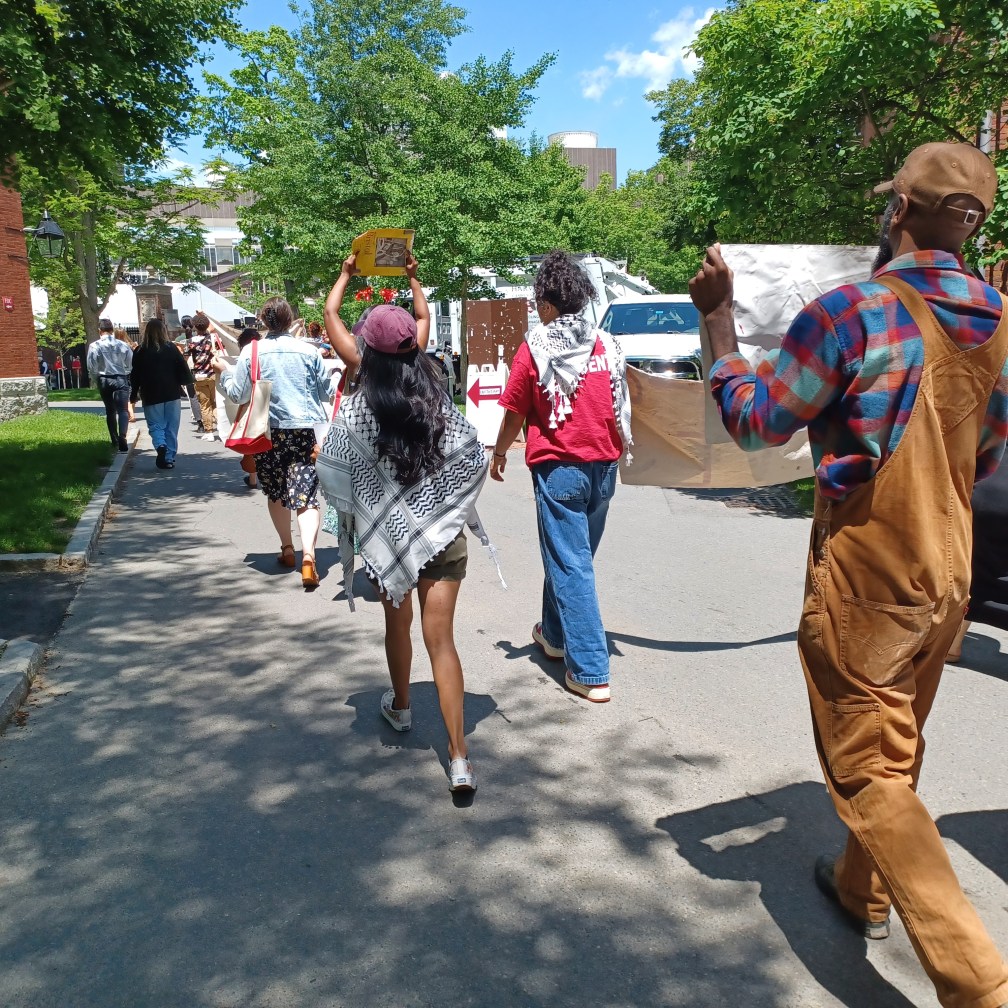
During the actual Commencement ceremony on May 23, more than 1,000 people stand up and walk out. Most walk across the Cambridge Common to the Harvard-Epworth Church for an alternative graduation ceremony.

At the formal ceremony, two student speakers go off-script to condemn the sanctions. The Senior English Address speaker, Shruthi Kumar, tells the audience she is “deeply disappointed by the intolerance for freedom of speech and the right to civil disobedience on campus.” But the Ad Board, led by College Dean Rakesh Khurana, refuses to change its decisions, and the University backs it up. Or perhaps the University sticks to its decisions and the Ad Board backs it up.

Harvard Yard has hosted protest encampments many times before. The most famous occurred in 1969, when the University called in city police to arrest students occupying University Hall to protest the Vietnam War. The brutality of those arrests prompted a University-wide student strike. In 1986, students built a “shantytown” protesting Harvard’s investments in apartheid South Africa. For three weeks in 2001, as part of the Living Wage campaign, students camped in around 100 tents in the Yard to support others occupying Massachusetts Hall, where the University President’s office is located. In 2011, tents went up for Occupy Harvard. In 2014 and 2015, students blockaded Mass Hall demanding divestment from fossil fuels. In 2016, they held a sit-in supporting a dining hall workers strike.

Since the 1969 catastrophe, aside from one arrest in 2014 and some three-week probations, no serious sanctions were imposed on such demonstrations until this protest. Protesters and their sympathizers call this unprecedented degree of punishment “the Palestine exception”.

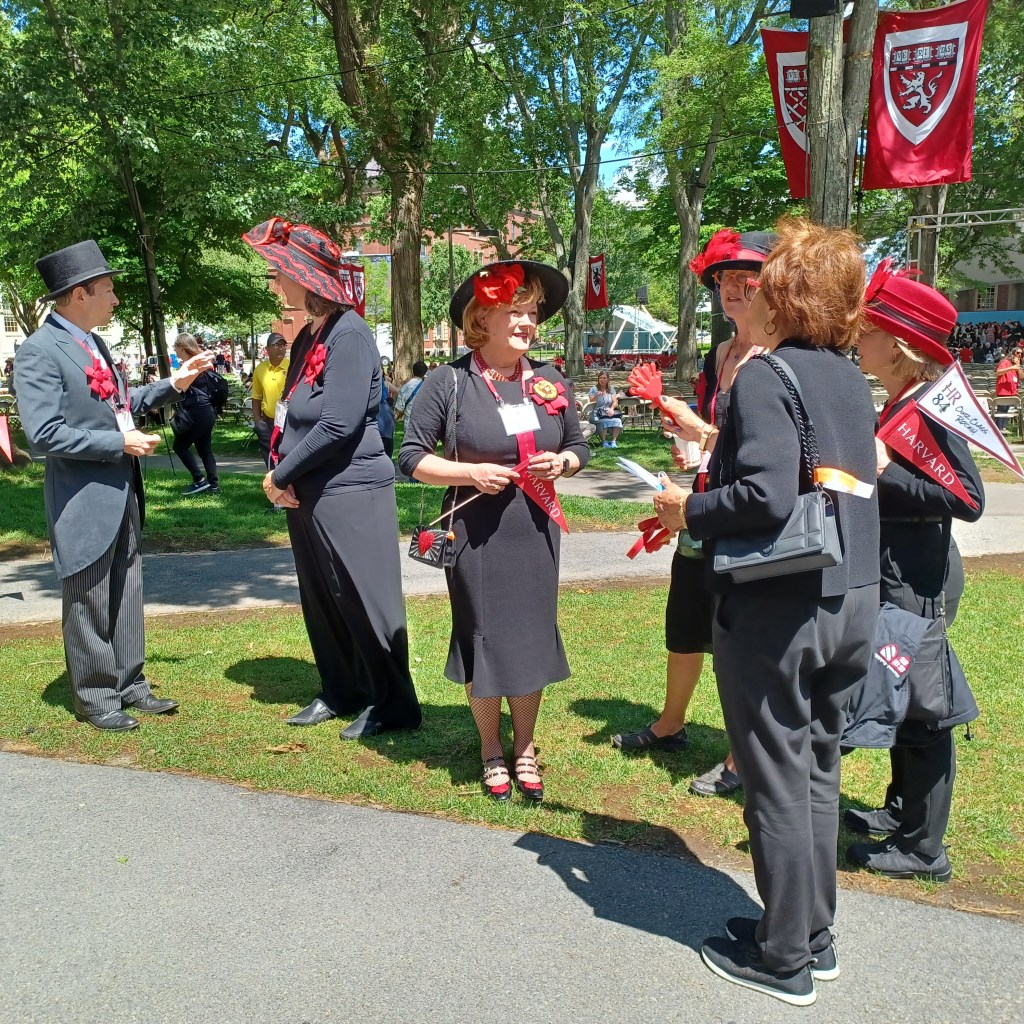
On Friday, May 31, the University holds the last of its large end-of-year events, Alumni Day. Hundreds of alumni used to form a procession on Commencement Day and march before the graduating seniors, but since COVID, alumni get our own day, a week after the students have all gone home. It’s a little odd to have such a grand procession with hardly anyone in the audience, a parade with no bystanders. Alumni are seated as we march in, filling the front rows and leaving most of the back rows nearly empty.

A friend says someone asked him why the alumni are having such trouble getting themselves into line. He answered, “Because everyone wants to be in front.”

Tiny bright green aphids rain out of the trees onto a multitude of crimson hats and gray heads. People wave red plastic clappers and flags, hold giant helium balloons, and wear red headbands with glittery pompoms on top, as though they had never worried about microplastics. My friend calls the excess of shields, banners, top hats and tails “Anglophilia”; a royal wedding would not seem out of place.

Just before President Garber stands up to speak, there is a commotion onstage. A young woman pours a vial of gold glitter onto his head, shouting “For the baby monkeys!” She is a member of PETA (People for the Ethical Treatment of Animals), unaffiliated with the University. She is arrested for assault and battery, trespassing, and disturbing a public assembly. Her cause has no connection to the movement against the Gaza War, except that it is also a cry against captivity, cruelty, and needless killing. When he begins to speak, Garber graciously tells the audience “I could use a little glitter,” and reaffirms the University’s commitment to free speech.

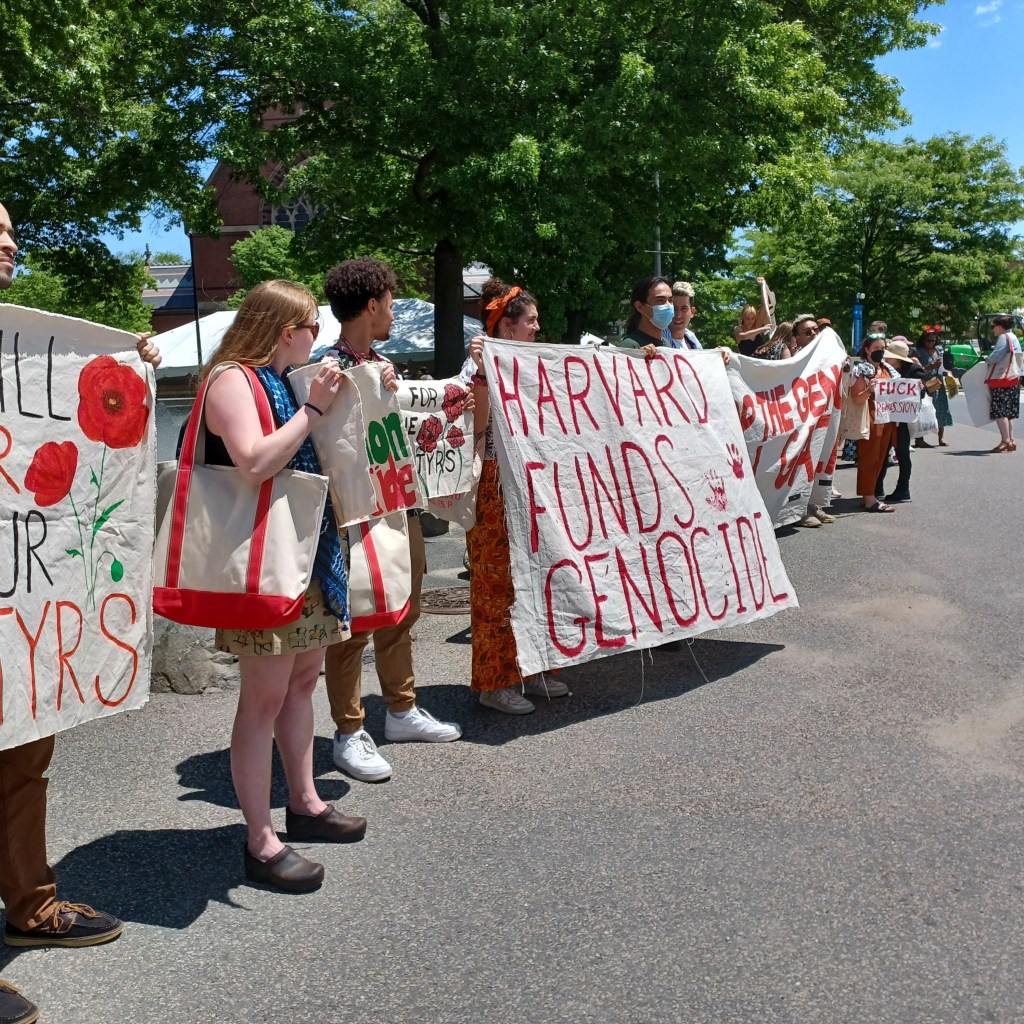
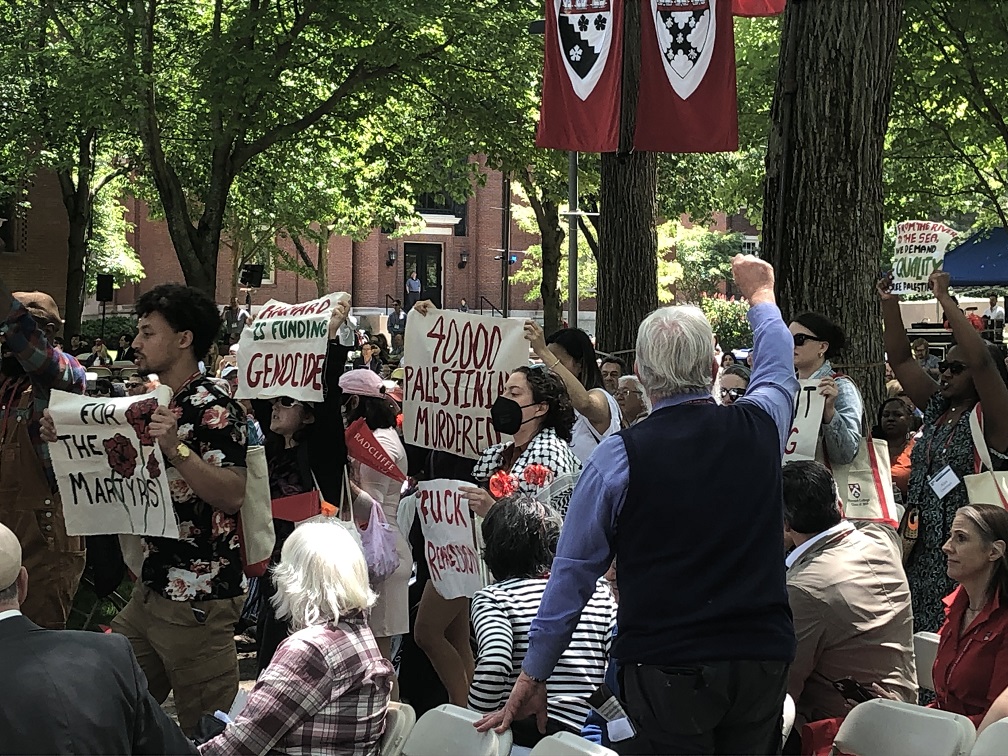
After that incident, the incursion of a couple of dozen pro-Palestine demonstrators is a bit anticlimactic. They walk up and down the aisles with banners and posters, but do not attempt to get on stage. They get loud boos and a scattering of applause. Nobody makes a move against them as they leave the Yard. I wonder if this demonstration was negotiated with the administration in advance, or if the security guards and admins simply know this group well enough by now to trust its commitment to nonviolence.

I run to catch up with the protesters. They stand in front of the Science Center for a while handing out pamphlets about the Gaza war and why Harvard should divest. Then they disperse. Nothing else seems to be happening. More student demonstrations will have to wait for this fall.

I go back to the Yard to get the free lunch.

Harvard Protest, part 4

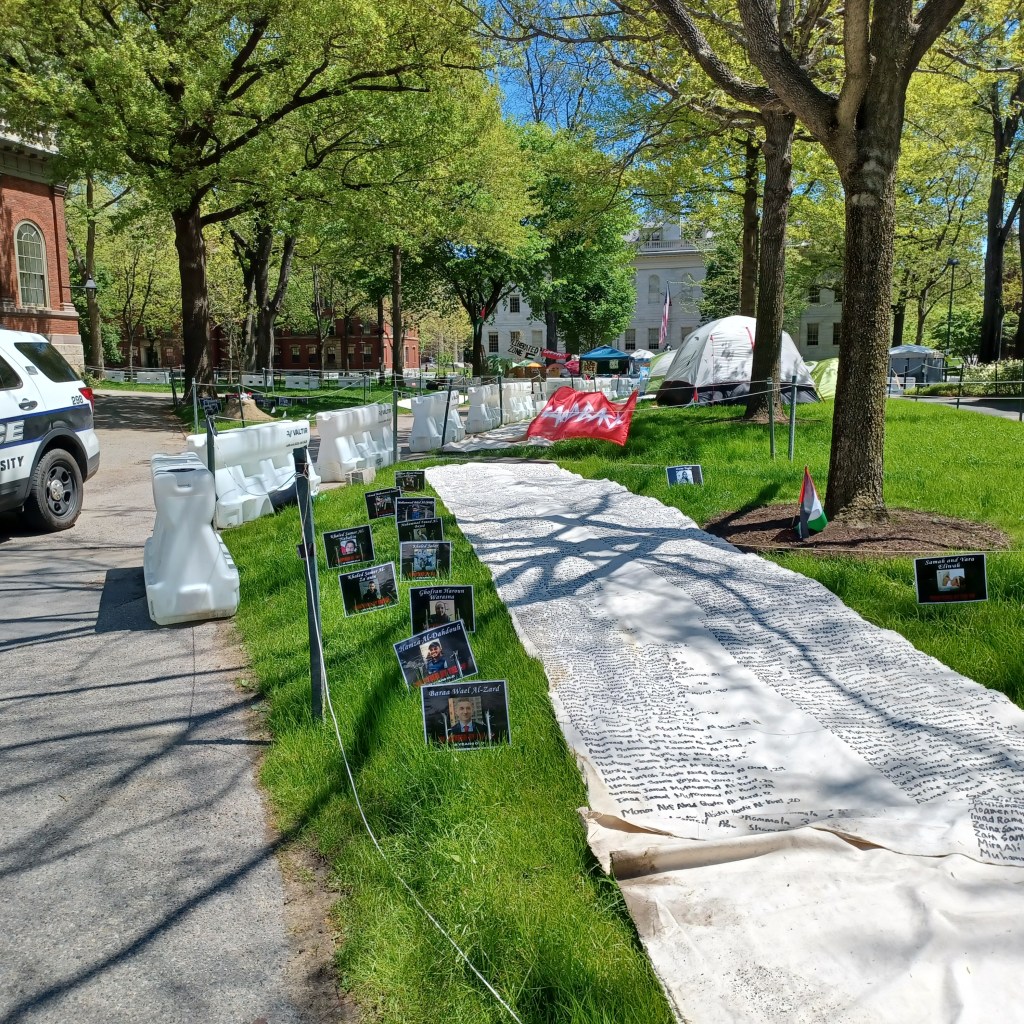
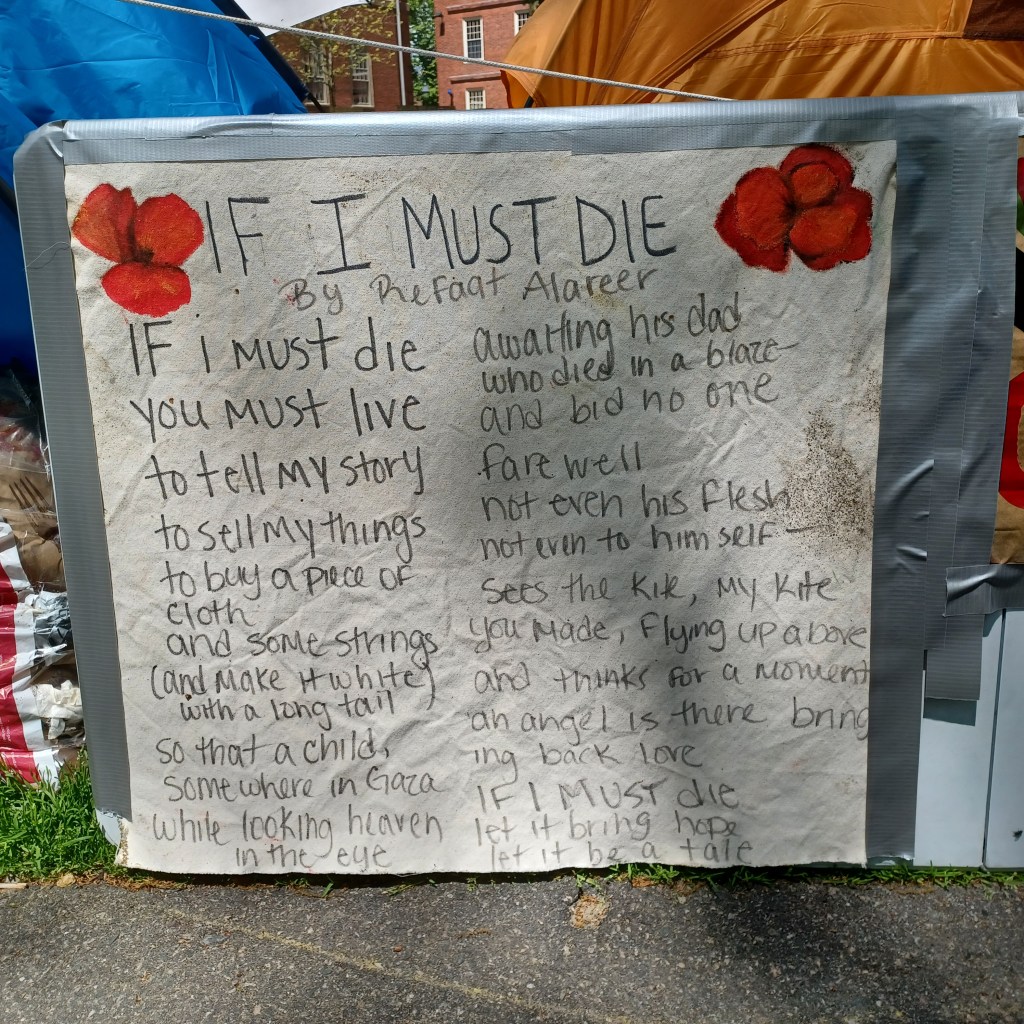
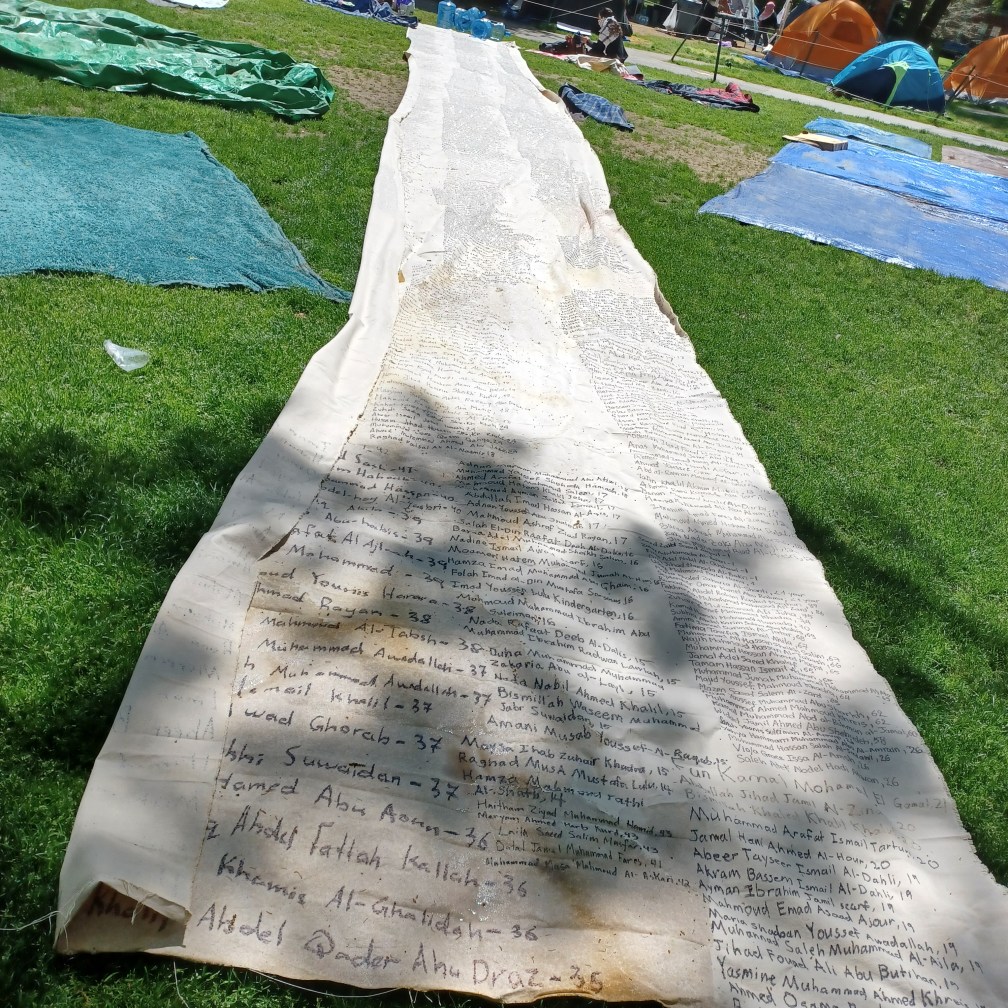
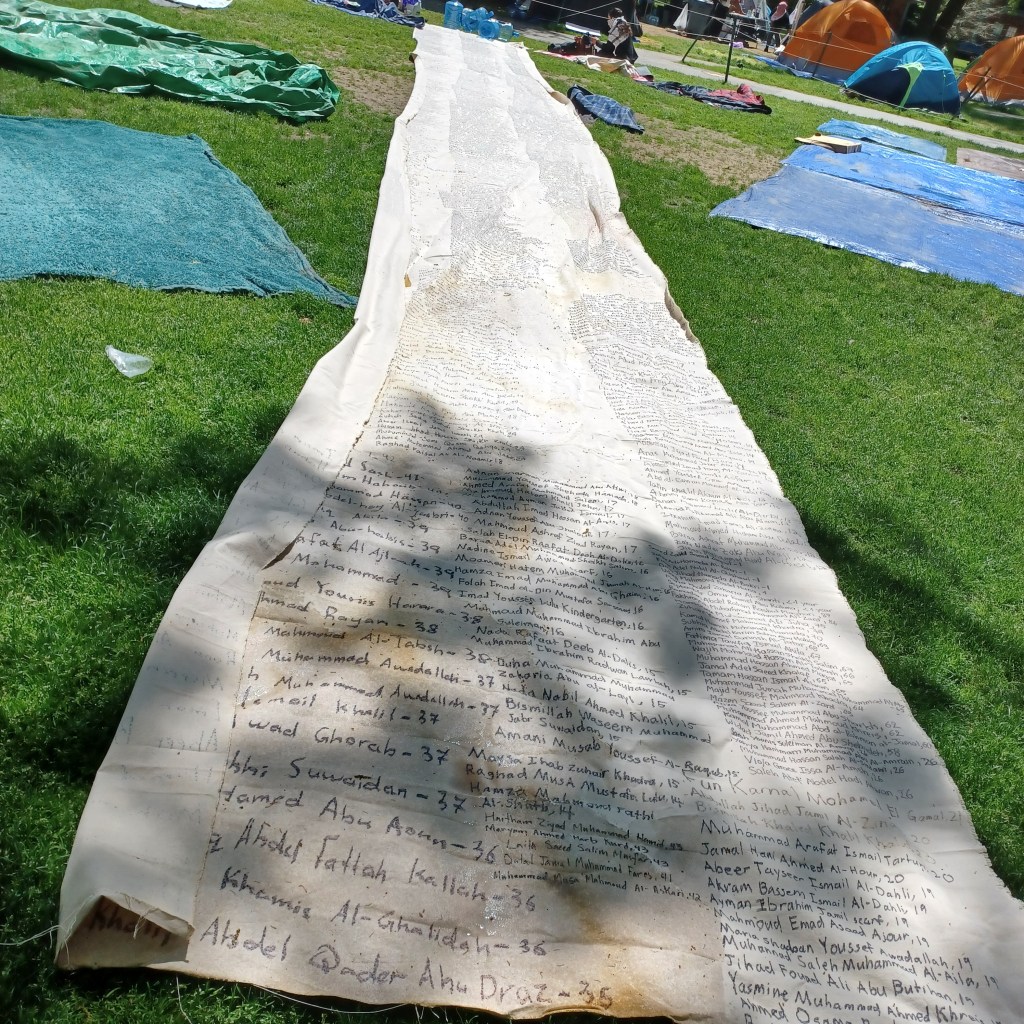
Yesterday, Mother’s Day Sunday, was the last move-out date for freshmen. Now the campus is eerily quiet. The only noise comes from riding lawn mowers, and a supporter of the protest – not obliged to follow its policies – who is standing outside the gates with a megaphone, shouting Free, free Palestine! He calls out the University for its complicity in war, fossil fuels, and Big Pharma. Spread out on the lawns near Johnston Gate are at least five very long scrolls of canvas with the names of the dead in Gaza.

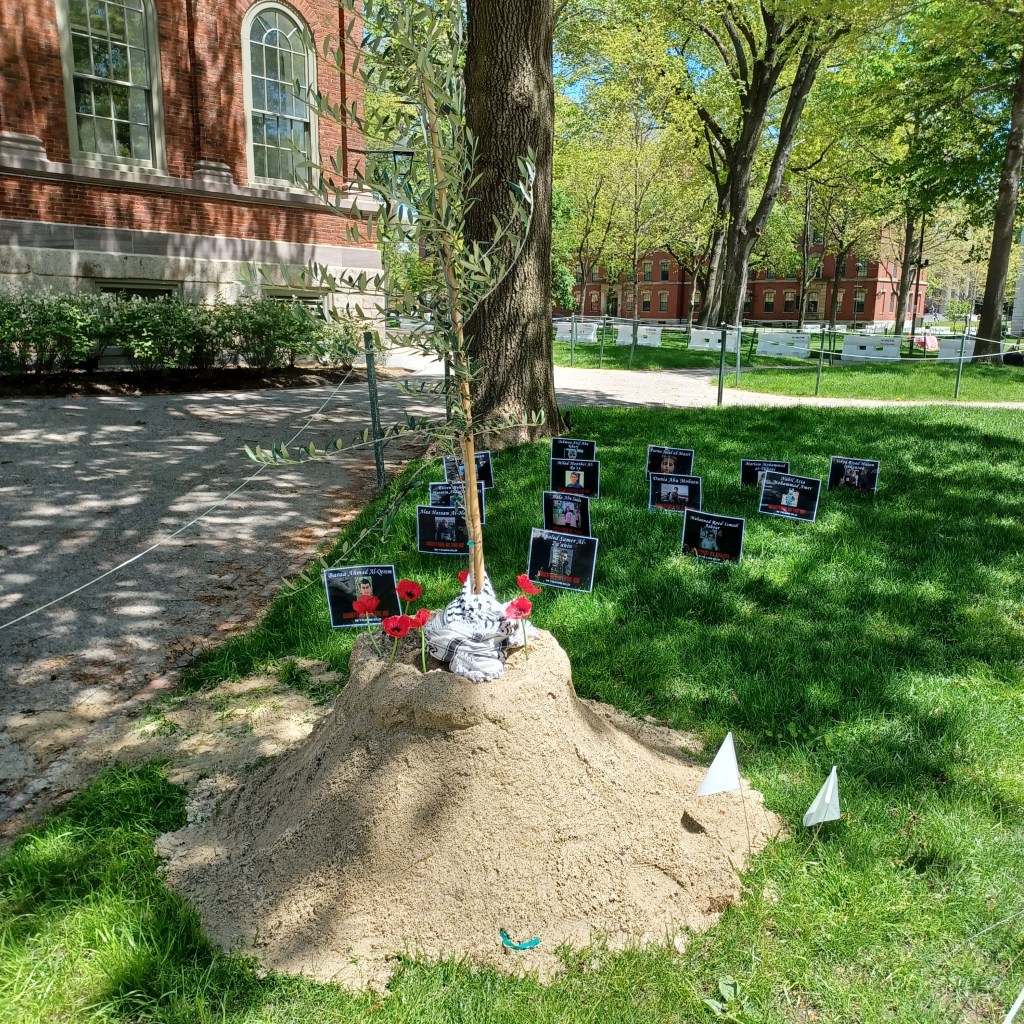
The protesters have planted an olive tree outside Harvard Hall, surrounded by placards bearing photos of people killed in Gaza, their names and ages, and the phrase “Martyred by the IDF” (Israeli Defense Forces). The placards bearing photos, names, and ages of people martyred in the October 7 Hamas attack that were in this area last week are no longer in view.

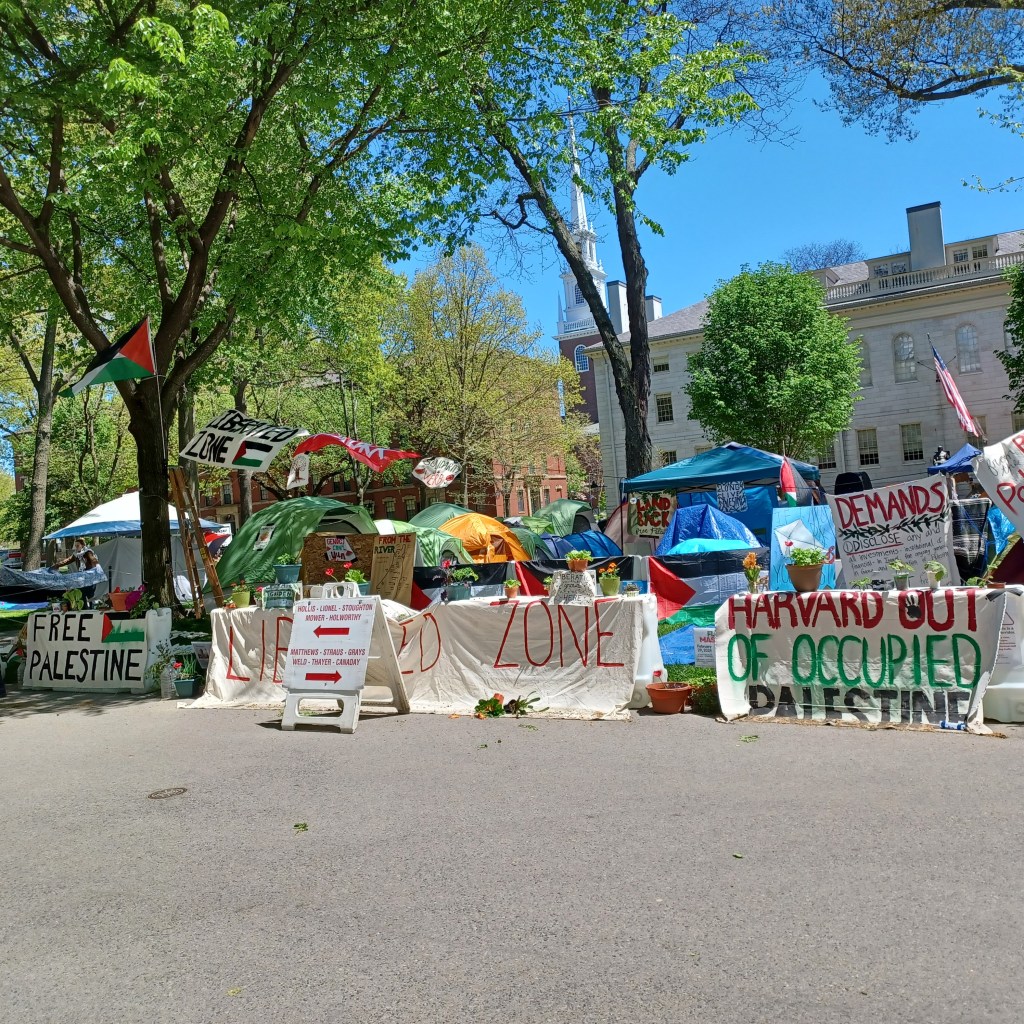
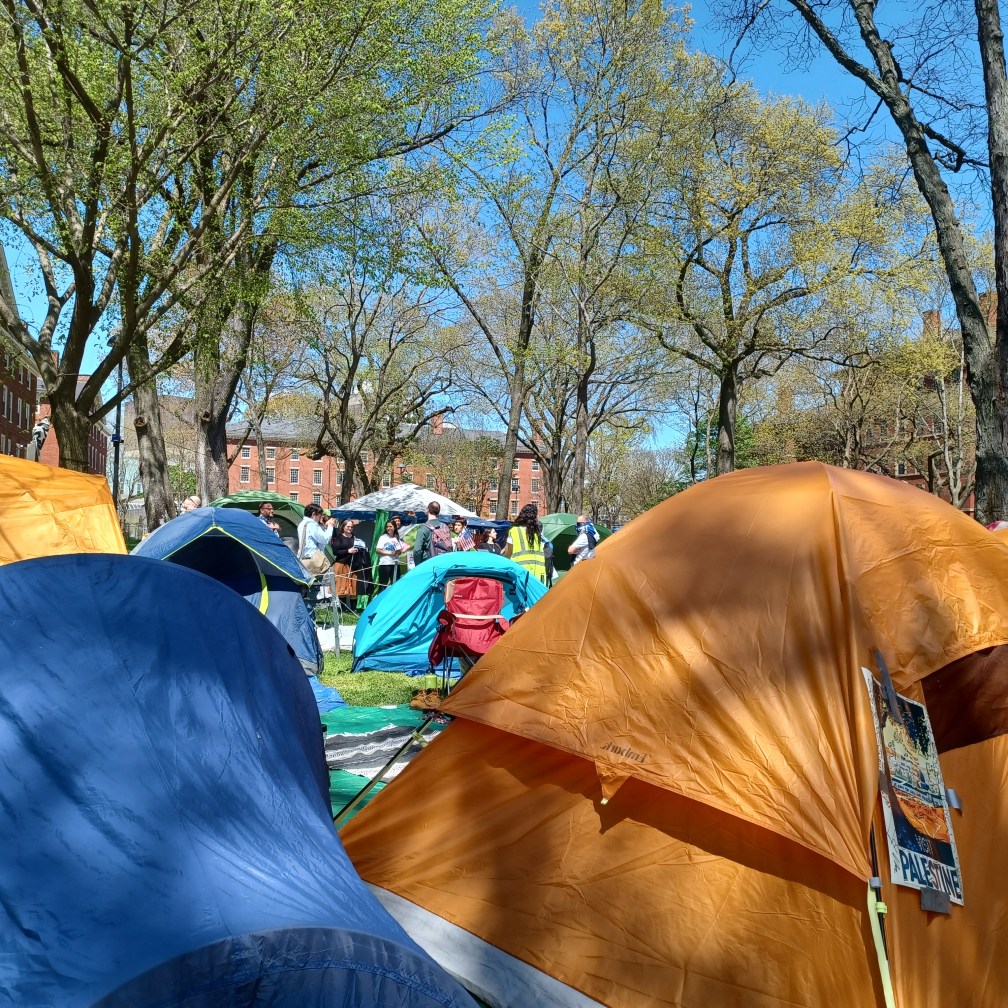
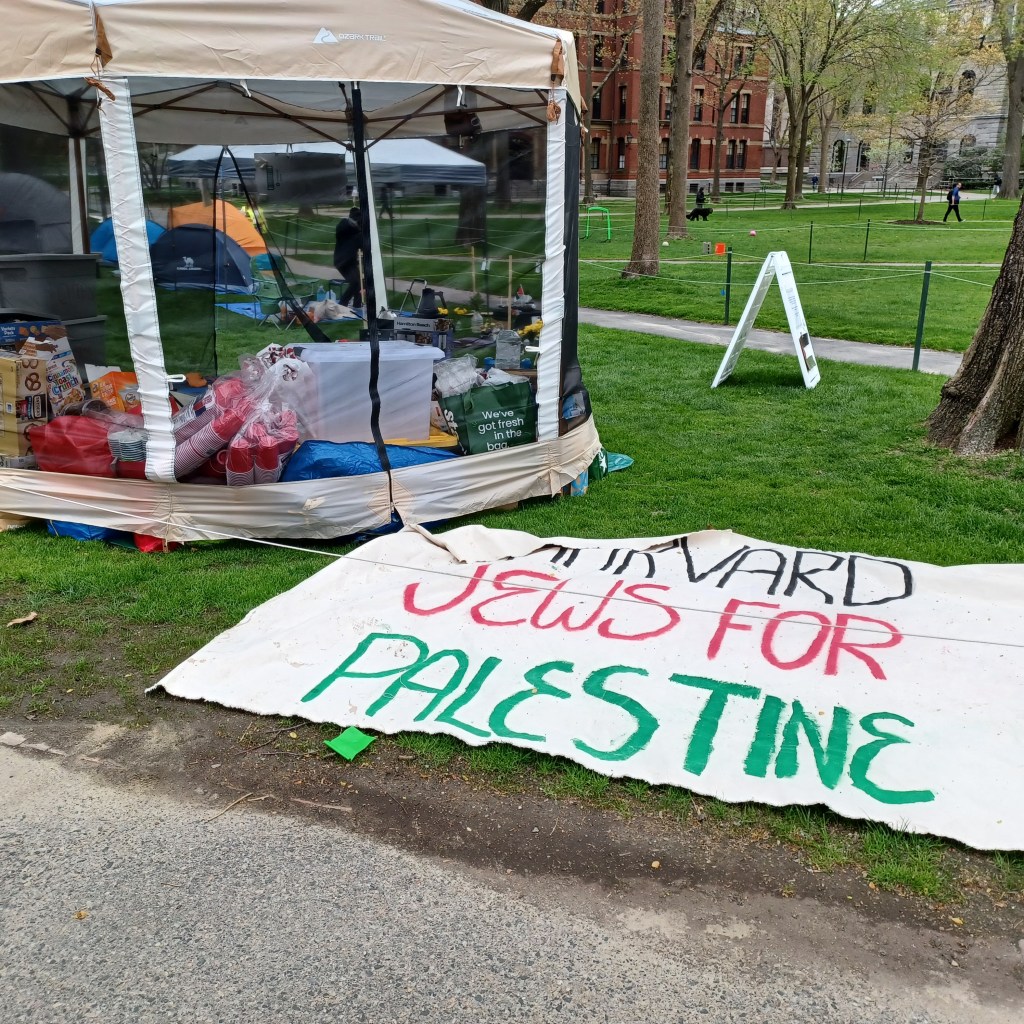
All the campers but one are talking inside a gazebo-style tent with one wall covered by the sign “Harvard Jews for Palestine.” A supporter tells me they are taking a “wellness day”. They’re discussing what to do next. The University is sure to dismantle the camp before Commencement, Harvard-speak for Graduation, which is coming up in ten days.

I missed a lot of excitement on Saturday. There were marches and rallies as scheduled, with about 200 people attending. There were also unplanned events. Some marchers sat down in Peabody Street, blocking traffic for ten minutes. They spent two minutes in silent meditation.

During all that commotion, somebody broke the big padlock on the main gate into the Yard. Evidently they decided to open up the Yard to outsiders with a bolt cutter. This too was not something the group had agreed upon. Nobody managed to get in, however, before security people installed a wire lock to close the gate again.

Now, while the students talk in the gazebo, about a dozen faculty and staff supporters form a circle outside the camp perimeter. A camper wanders by on his way to the tent. “Cookies? There are cookies?” A supporter has baked them in quantity. “Everyone needs cookies,” she says, with authority, “all the time.”

A student tells the group that Saturday was supposed to be more like a party, with music and food. But somehow, he says, “the plan ended up shifting for reasons I don’t know.” I think of the Paul Simon song “Peace Like a River,” about anti-Vietnam War protests: “And I remember misinformation followed us like a plague. Nobody knew from time to time if the plans had changed.”

The student also says that there has been a lot of struggle within the encampment, a lot of dissension, which has been exhausting for them all to deal with. The protesters include both Jews and Palestinians. I imagine that some are pushing for compromise and some for more radical action. However they continue to co-exist peacefully and collaborate in running a clean, quiet, protocol-following camp.

I read a few Crimson articles on recent developments. Wednesday night, protest representatives met with College Dean Khurana and HU President Garber, among others. The University offered to hold further conversations with the protesters and let them avoid disciplinary action if they disbanded the camp, an offer they declined. They had offered a lower bar than divestment from Israel, such as the establishment of a center for Palestine studies, but they felt the University had not come close to meeting it.

Then Garber met with the head of the Anti-Defamation League, Jonathan Greenblatt, to discuss anti-semitism. Greenblatt conflates anti-Zionism with anti-semitism, and praises Harvard for its unwillingness to entertain the protesters’ demands. Shortly after this meeting, the first round of 20 students were placed on involuntary leave. By now, more than 60 students are facing disciplinary action. The Harvard Out of Occupied Palestine Instagram page said this showed that Harvard had capitulated to outside agitators.

I sit in dappled shade with the faculty and staff group. One of them has made bookmarks with space for messages to the protesters. She says some could use a little “parental love,” since they’ve been having difficult conversations with their families. They’re stressed, unsurprisingly, and not sleeping well. A camper asks if anybody could help them charge some of their small generators. “We need power,” he says, to laughter.

Around 3:30, seven Harvard police and security guards circle and enter the camp, filming the students. One camper tells supporters on the steps, “They’re taking pictures without our consent. Hide your faces!” I don’t need to hide mine, so I smile and flash the peace sign.

I start to leave for the day, but then I hear a commotion outside the gates. It’s a pro-Israel demonstration; tonight is the start of Israel’s Independence Day. A wild-eyed man speaks to the small crowd through a megaphone. I learn later that this man is a Columbia Business School professor, Shai Davidai. He says, “What’s at stake here is American values, which are also Israeli values. Freedom, democracy, peace. Five US citizens are being held by Hamas, the same people that they [nodding toward the encampment] are cheering on.”

This is where I lose my self-control. I letter a sign on a leaf of my notebook: “Protest does NOT cheer on Hamas. We mourn all these needless deaths.” I stick it through the bars of the iron fence. Alex, from CAMERA (Committee for Accuracy in Middle East Reporting in America), holds a small Israeli flag in front of my sign, trying to hide it. He says I’m delusional. Some pro-Palestine protesters are standing on the curb, waving Palestinian flags and chanting. When the Israeli speaker starts to list names of Hamas victims, I wish they would stop chanting for a few minutes, but they probably don’t even hear what’s going on.

The pro-Israel group sings the Israeli and American national anthems. They wave Israeli and American flags. The speaker taunts the pro-Palestine group, which is chanting “USA, USA, how many kids did you kill today?” Why don’t you honor your own country’s flag, he asks. One student turns around and snaps a smart, ironic salute.

After the rally, Davidai speaks at length to a Crimson reporter, Frank Zhou. I hear him claim that Jews and Israelis are not safe around the encampment. I try to tell Frank that I have photos of a dozen pro-Israel demonstrators entering the middle of the camp, singing songs and chanting. Nobody bothered them. Frank seems distracted since Davidai does not stop talking at him. When his article appears in the Crimson, it reports what Davidai said, without investigating or refuting any of his claims. I certainly believe Jews have been experiencing anti-semitism on campus; unfortunately it is as endemic to our society as any other form of racism. The encampment, however, has not been practicing it.

When I go back to rest on the steps of University Hall with other camp supporters, a student comes over and delivers the gentlest possible rebuke, reminding us (not looking at me especially) not to engage with counter demonstrators. I am embarrassed. The students have shown tremendous discipline and self-restraint. I failed to show equal maturity, and egregiously violated camp protocol. I think most of them agree with what my sign said, but I had no right to speak for them.

Now I hear on the news that the students have agreed to dismantle their camp immediately, and the University has agreed to rescind their punishments. I feel proud of both the protesters and the University. Protests won’t end so long as the misery of Gaza continues. But Harvard and its students have managed to close this phase with a degree of dignity and mutual respect that few other universities have achieved. To this, I can only say, Shukran, and Mazel tov.

Harvard Protest part 3

Friday, May 10, is a cool, sunny day. Rising sophomores who lived in the Yard this year are carrying mattresses, couches, and huge cardboard boxes from their dorms. Parents have only 20 minutes to park in the Yard to receive them. The protest tents are not in the way, though so many gates are closed that there is some level of inconvenience for cars coming and going.

A few pro-Israel counter protesters play pop music on a radio very loudly, right next to the encampment, which is deep in discussion as usual. I don’t know why the music stops after a few minutes.

A protester asks friends on the steps of University Hall to help clean up the wet, dirty tarps on the “event space” next to the tents. Another remarks, laughing, “I haven’t had a shower in a week.”

People I knew from my campus labor union tell me that students who have been suspended or put on involuntary leave seem to have been chosen almost at random. They aren’t leaders or organizers, or even necessarily people who slept in the tents overnight. It’s more a matter of someone in the administration happening to see and recognize them, in spite of the masks or scarves many have been wearing.

Another press conference is scheduled for 2 pm. Most protesters go all the way around through the Science Center gates to get outside Johnston Gate where the press is gathering. I don’t want to walk that far, and I can’t hear the speakers anyway. Yard security and campus police are present, though not in great numbers; the tall bald guy who looks the most serious squats on his heels on a nearby path. The University’s president Garber comes out of Massachusetts Hall now and then, accompanied by a guard. I haven’t seen anyone else approach him.

Outside the gate, the crowd is chanting “Free free Palestine! Long live Palestine!” The Harvard protesters appear to have decided not to use the inflammatory chant of “From the river to the sea, Palestine will be free” or to call for an intifada, which means uprising or resistance.

I hear one woman, annoyed at not being allowed in, ask a guard about Askwith Hall, which is blocks away from the Yard at the Harvard Graduate School of Education. She is not happy with his answer, and says to her companion, “Okay, let’s go to the media.”

My union friends and a rainbow-haired woman from the Business School think Harvard is treating this protest more harshly than previous encampments. They call it “the Palestine exception.” A student worker wonders if they lose ID access to buildings because of the disciplinary process, will that be grievable through the union.

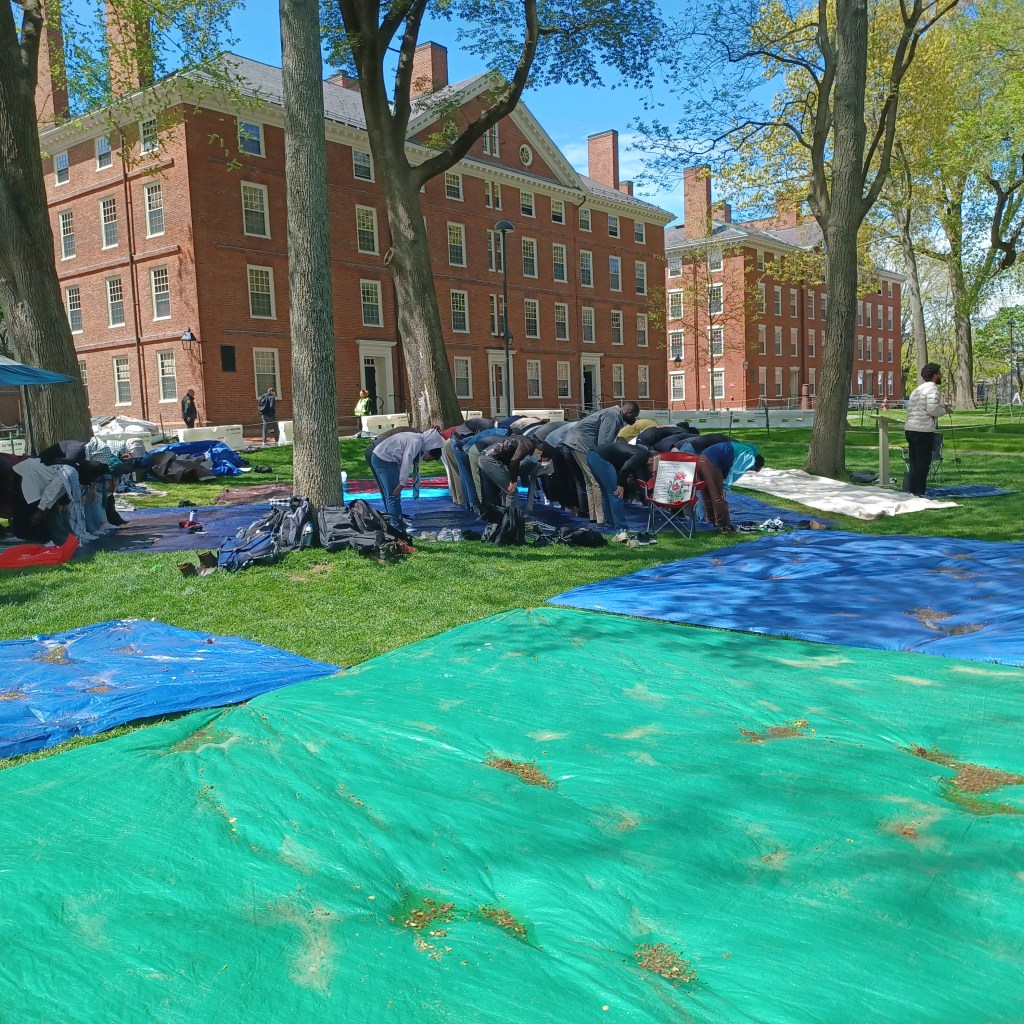
About 25 people attend a Muslim service in the “event space.” The young man leading the service often lapses into Arabic, but from what I can understand, he’s mostly talking about how we will return to the Creator after death. He talks about how many lives have been lost, and how many hospitals, homes, and schools turned to dust. He talks about “the dead earth” left behind, and “the will to destroy.” He says of the Israelis, “They built upon the imaginary [sic] that there was no one living in the land, that it was empty earth.”

The speaker says, “Somebody has taken the desires of their own heart as God,” taking for themselves the powers that should only belong to Allah. He notes that an Israeli real estate company is already trying to sell land for housing and luxury hotels in Gaza.

The most aggressive counter protester stands next to me. “Do you believe in this?” No, I say, I’m just listening. “You see they separate the women from the men.” So do orthodox Jews, I respond. “But this is 2024!” he says. Yes, I reply, and I don’t like it either, in any religion.

A helicopter hovers low overhead, evidently trying to disrupt the service. When the sermon ends and people bow and pray, I notice it sounds a lot like the davening during a Jewish service.

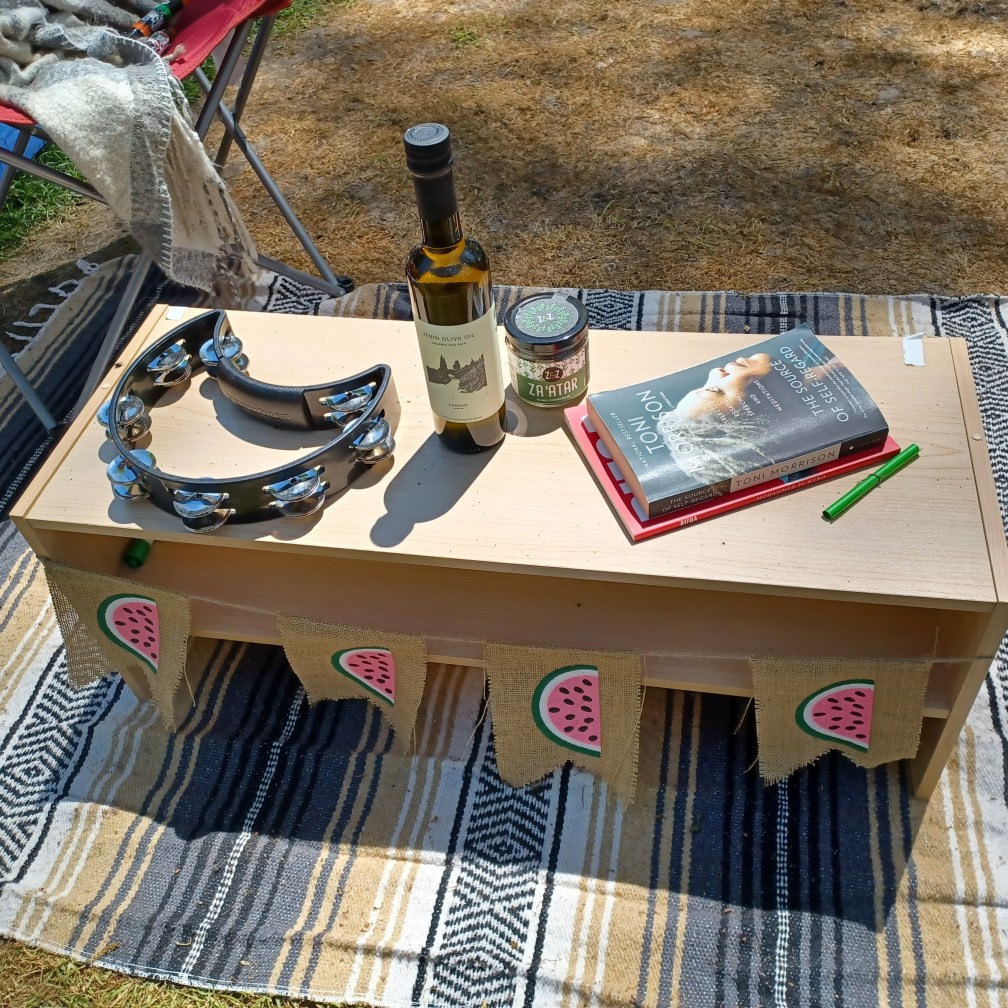
Supportive faculty and staff form a circle and hand out identifying pins, with the watermelon logo of these protests, and orange vests saying Faculty and Staff so they’re not taken for camp marshals. They expect the University to take the tents down soon, in the middle of the night.

A student who says he’s going to be “Ad Boarded” in a few minutes tells us about a supposedly secret meeting with President Garber. All the president did was tell the protesters how the endowment works. The student says 10 to 15 students were put on involuntary leave during the first raid this morning. Some never had their IDs checked at the protest, but most had been highly visible.

A student marshal in an orange vest speaks to a circle of others. “Don’t engage with police. Our job is to de-escalate.” She says some things I don’t understand. What is a stretchie, and how does it crack?

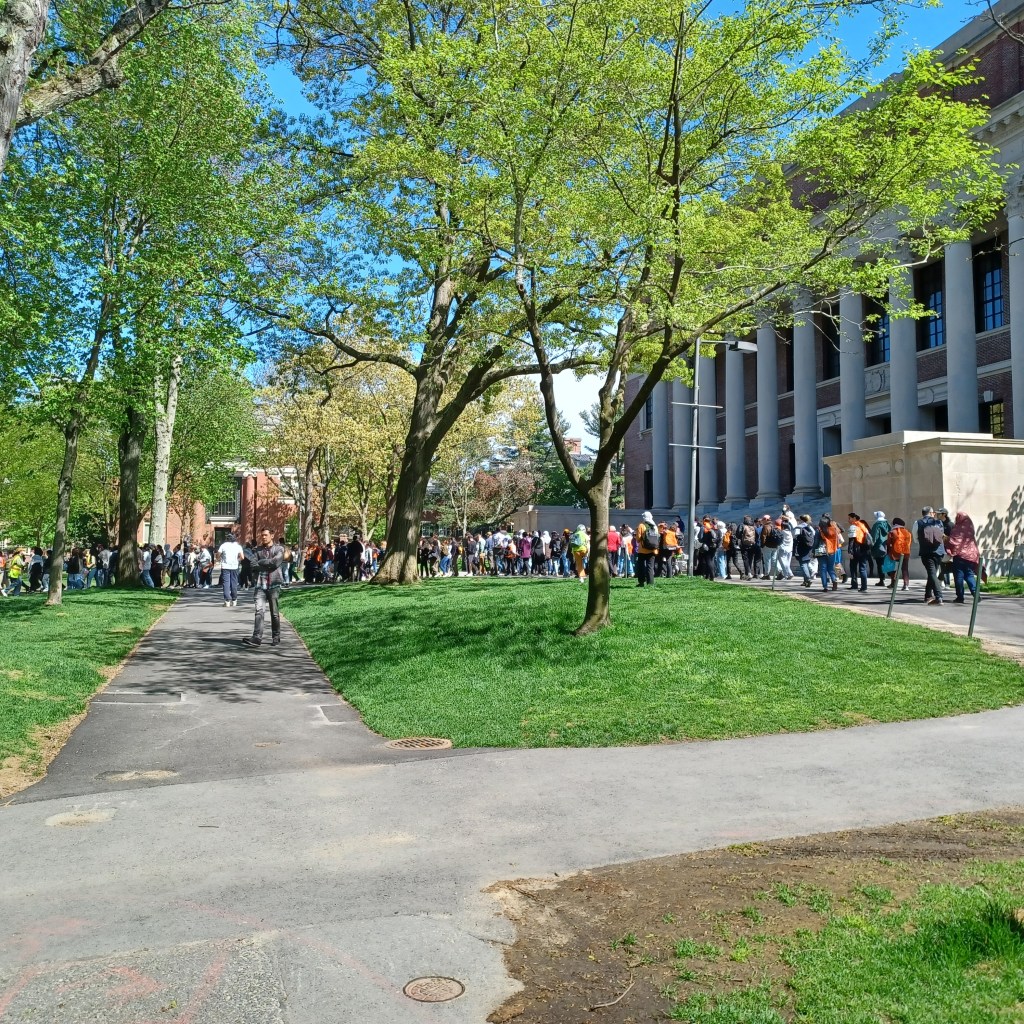
Later in the afternoon there’s a march and rally, attended by many more people than hang out in the camp. They go all around the Yard after surrounding Mass Hall for a while. I don’t go with them. I hate chants, and I’m tired.

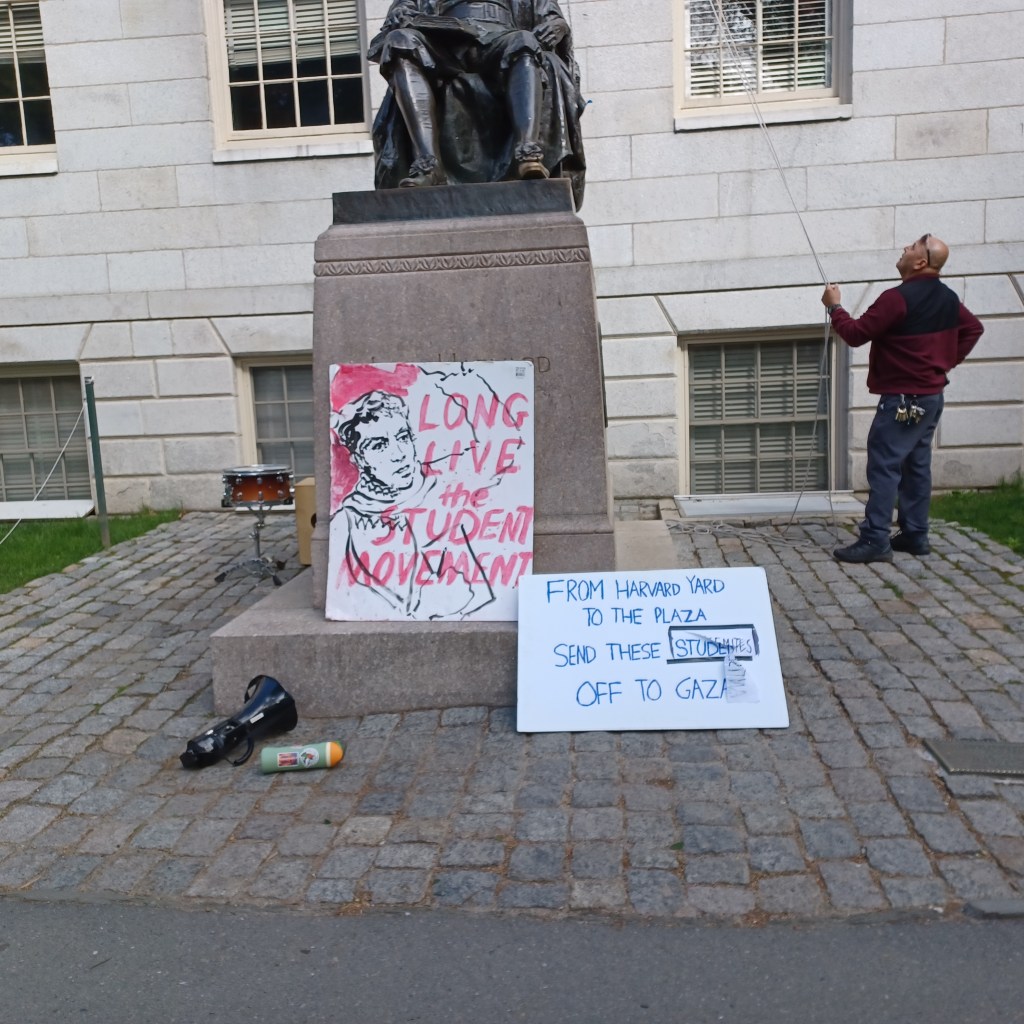
A counter protester accuses one of the protesters of removing his sign from the foot of the John Harvard statue. “Not cool!” he says. A protester points out that the sign is still there; the wind blew it over. “You’re just not looking.” The wind has strengthened so that while workers try to lower the big American flag over the statue, it twists around the pole so they have to raise it, shake it, and try lowering it again several times before they get it down.

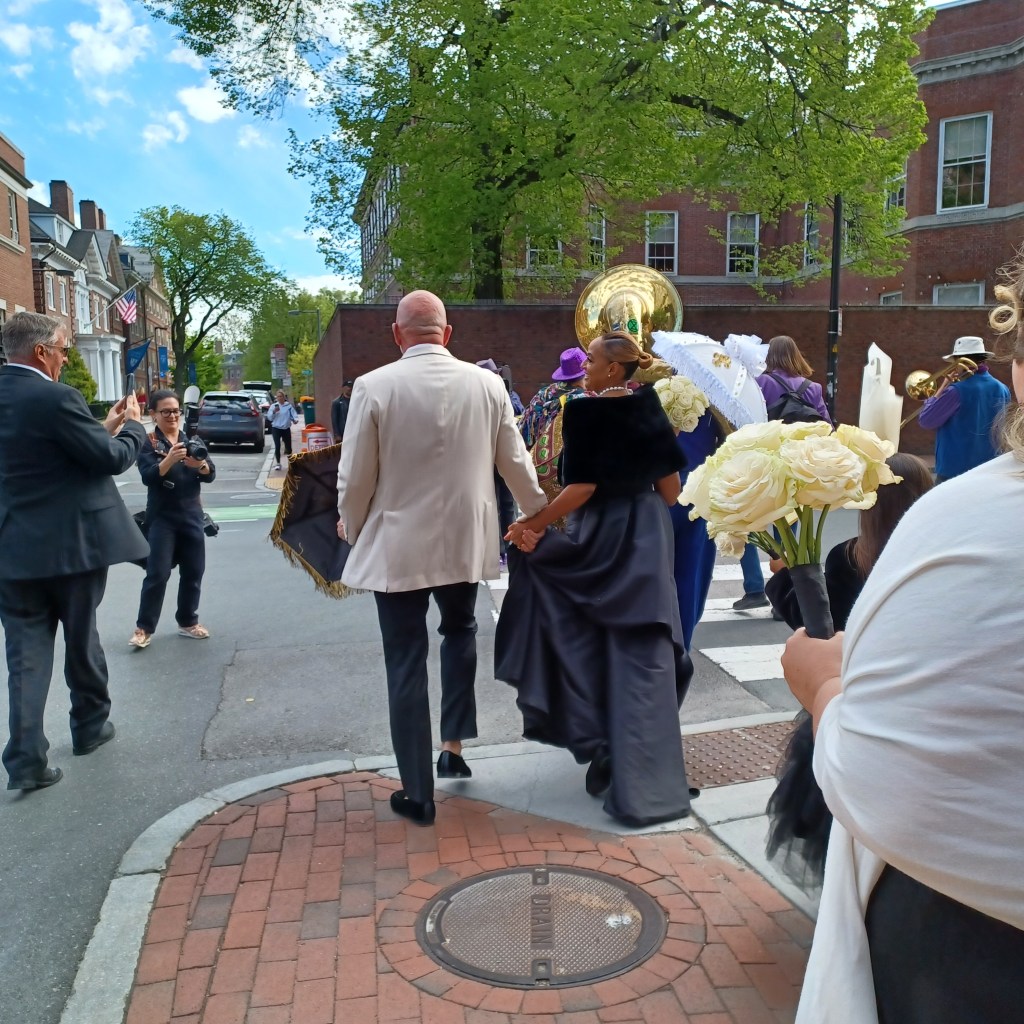
As I leave the Yard, I hear a brass band. Has somebody taken protest music to the next level? Then I spot a tuba over the head of a joyful line of people snaking down the Holyoke Street sidewalk, waving white kerchiefs. It’s not a protest. It’s a wedding. In the middle of all this difficulty and angst, life goes on.

Harvard Protest part 1

When I left Medford, it was a warm sunny day. In Harvard Square, it was chilly, damp, windy, and overcast. The mood of the encampment was equally gray. The students had just received a warning from the Ad Board that if they continued to camp outside University Hall they would face serious consequences. They were busy texting their family and friends, and possibly lawyers and media as well. I was there most of the afternoon from around noon until past 4 pm, and nobody was shouting, chanting, or using a bullhorn. There was one very interesting session on Palestinian textiles, especially the kaffiyeh and embroidery (tatreez), attended by half a dozen women.

If people are concerned about a kaffiyeh being draped over the John Harvard statue, I would remind them that it is an ancient Harvard custom for frat boys to piss on it.

I tried to respect the community norms. First I spoke with a nice young woman who was patrolling the perimeter of the camp, to find out with whom I should speak, as a friend of the camp and not a member of the media. She promised to find me a member of the outreach committee. Meanwhile I took photos, careful not to include anyone’s face.

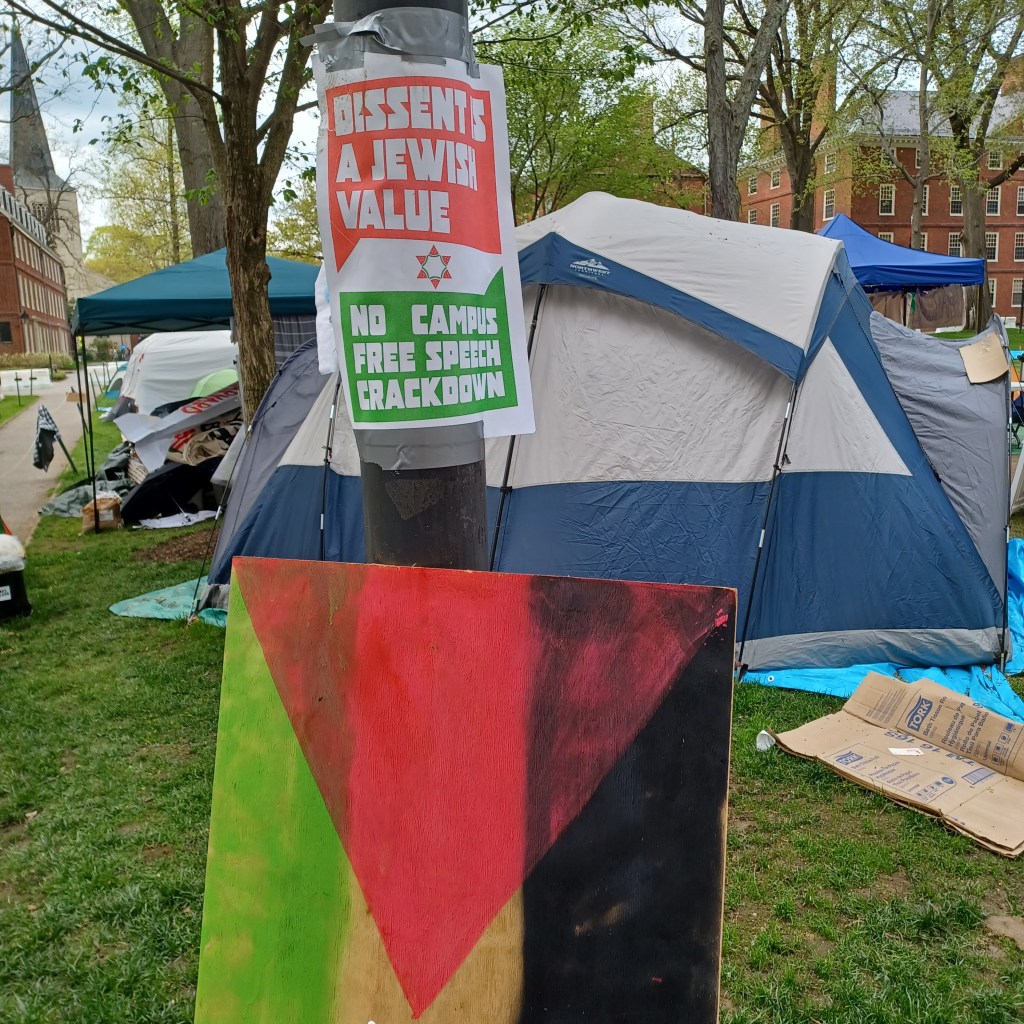
The signs outside the tents were hardly combative. Demands were posted, for HU to disclose and divest from its investments in Israel, and to drop all charges against students for their activism. I doubt any of the protesters expect these demands to be met. Other signs said: While you read, Gaza bleeds; Nationalism is Chametz (Hebrew for food prohibited on Passover); No Justice, No Peace, Palestine will never walk alone; Harvard invests in Palestinian death; and a big banner saying Harvard Jews for Palestine.

As for the slogan “From the river to the sea,” it first appeared in the original charter of Israel’s Likud party, where it did not refer to a hoped-for multi-ethnic democracy.

I chatted up several people while I waited. I asked if any administrators had opened a dialogue with them; they said not yet, but they were trying to negotiate something.

The students are risking their academic careers, and probably the wrath of their parents. As always with student protests, they are among the University’s most thoughtful, serious, and conscientious affiliates. They have a lot to lose and nothing to gain, on a personal level. What is the administration afraid of? Losing Zionist donations; and losing even more face than it has since it bumped its first Black president over…not much. Looks like somebody could go out with a handheld mic and just let people talk.

Finally I got to speak with one of the organizers, a Palestinian freshman named Mahmoud. He and many others have been protesting since Israel began its crazy over-reaction to the brutal Hamas attack in October. He said “The administration doesn’t understand that repression fuels us to fight harder.” The community is committed to non-violence, he told me.

As I started to leave, a man approached the camp wearing a kippah and a scarf with Stars of David on it. The perimeter-walker I first met was tailing him, much to his annoyance. She wouldn’t talk to him, which he thought was rude; I agreed, but I pointed out she was probably following camp protocol, and the idea was certainly to protect both him and the protesters. I made four or five rounds of the camp with this guy and the very determined young woman. She had probably never been called rude in her life. She couldn’t talk to the guy; he refused to tell me anything about himself or his opinions since he thought she was recording him; so I talked to him. As usual in such discussions, we got nowhere, but we parted on friendly terms. I walked him out the library gate.

5.2.2024

An old colleague of mine was gracious enough to meet with me for half an hour yesterday. She’s a very sweet, thoughtful person, and we were glad to see each other again. I asked her if the administration had established any dialog with the protesters. She couldn’t tell me details but said there were talks going on quietly in the background. She told me some students were feeling a lot of pressure from both peers and outside forces, and were afraid to speak out. We agreed on the nature of the encampment – nonviolent, disciplined, and committed – and on the need for the students to come up with some achievable goals.

The protesters’ three current demands, set by the national movement, can and will not be met. The University certainly will not disclose, much less divest itself of, its investments in Israel. It still hasn’t divested from fossil fuels, and many of us have been working on that for decades. It took forever to divest from South Africa during Apartheid. The third demand, for amnesty for student activists, can’t be met before they even go through the disciplinary process.

So I went back to the camp to tell them the little I had gleaned from talking with my colleague.

The weather was warm and sunny, and the mood seemed lighter accordingly. My perimeter-walking friend told me everybody was happy I had talked (and talked) with the counter-protester on my first visit, since their camp has agreed not to engage with provocateurs.

I tried to convince a few protesters to have the group consider setting goals the University might actually meet. Maybe teach-ins, or listening sessions, or moderated debates could be small steps toward spreading their understanding of the war in Gaza and the history of Israel/Palestine in general. While we were talking, I noticed Dean Khurana on the outskirts of the camp. The students said he’d visited before but wouldn’t talk with them.

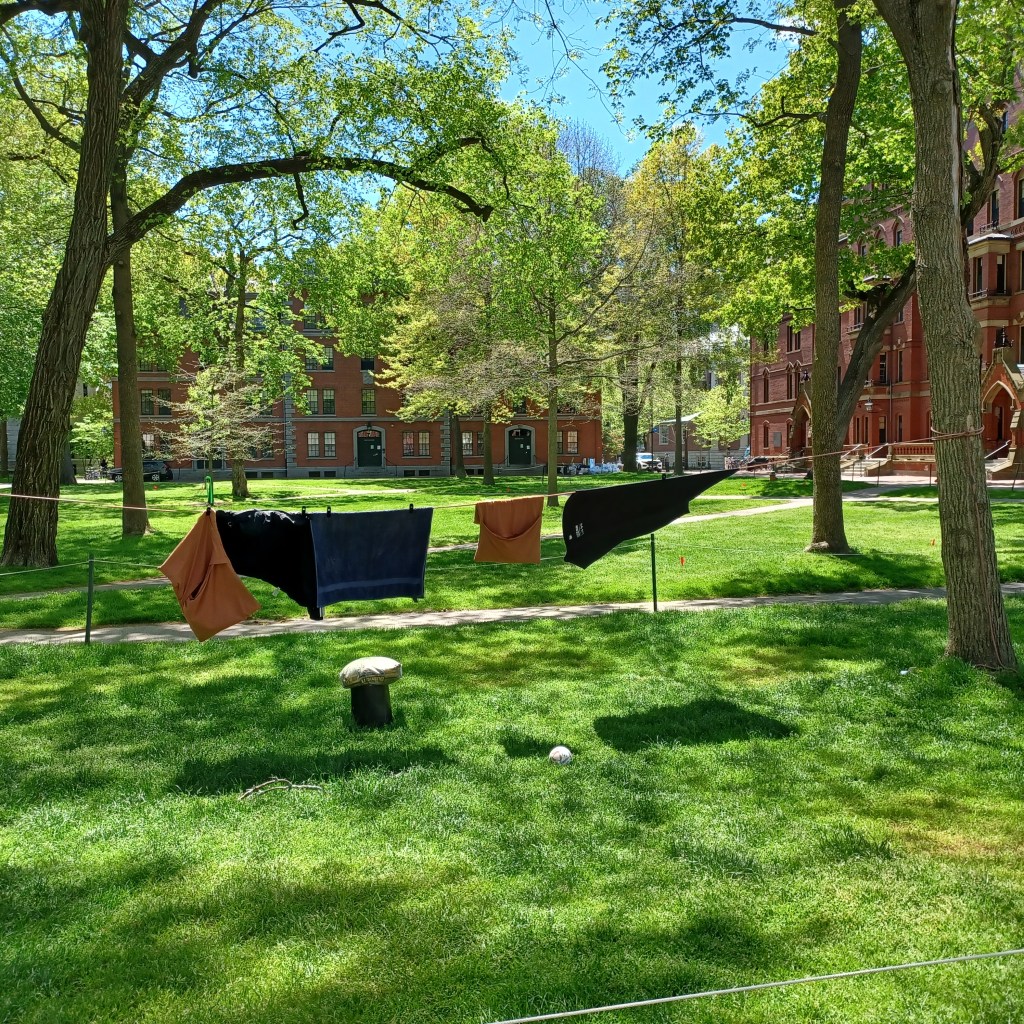
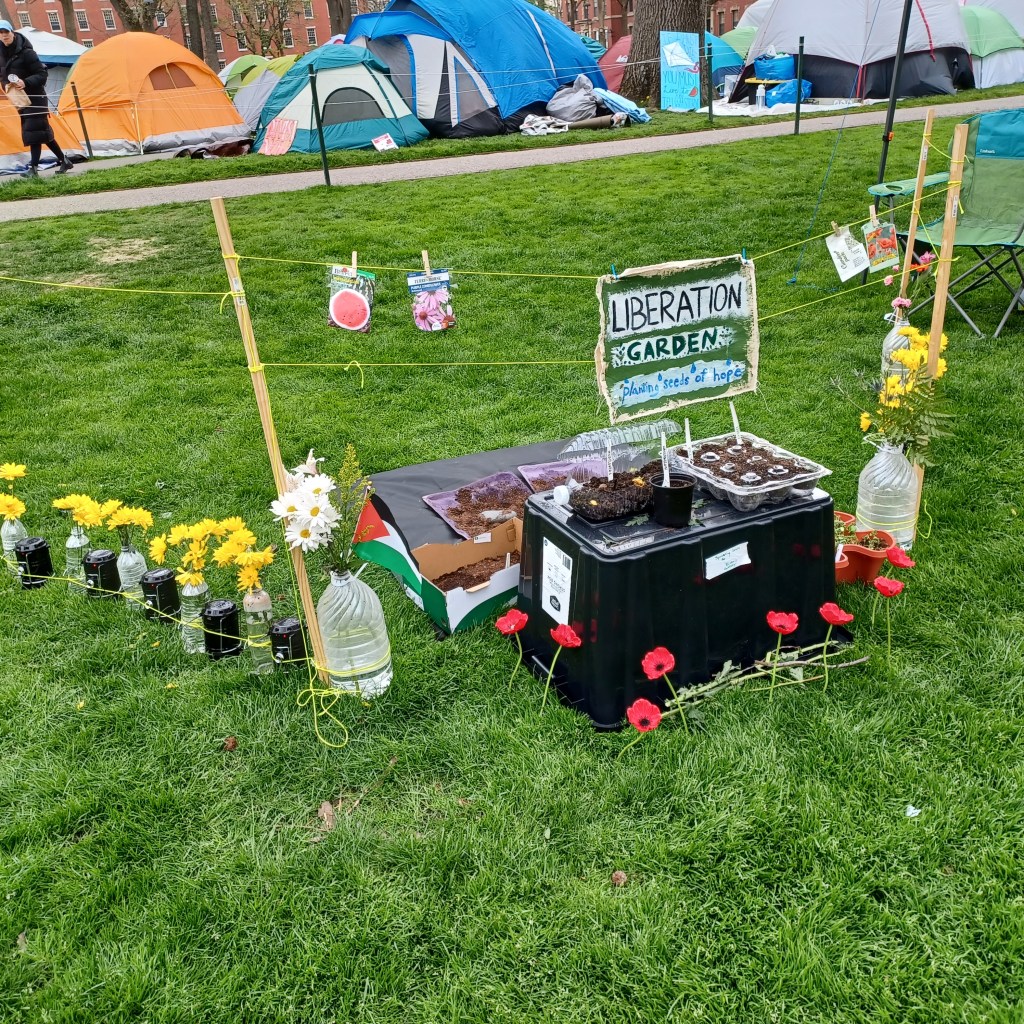
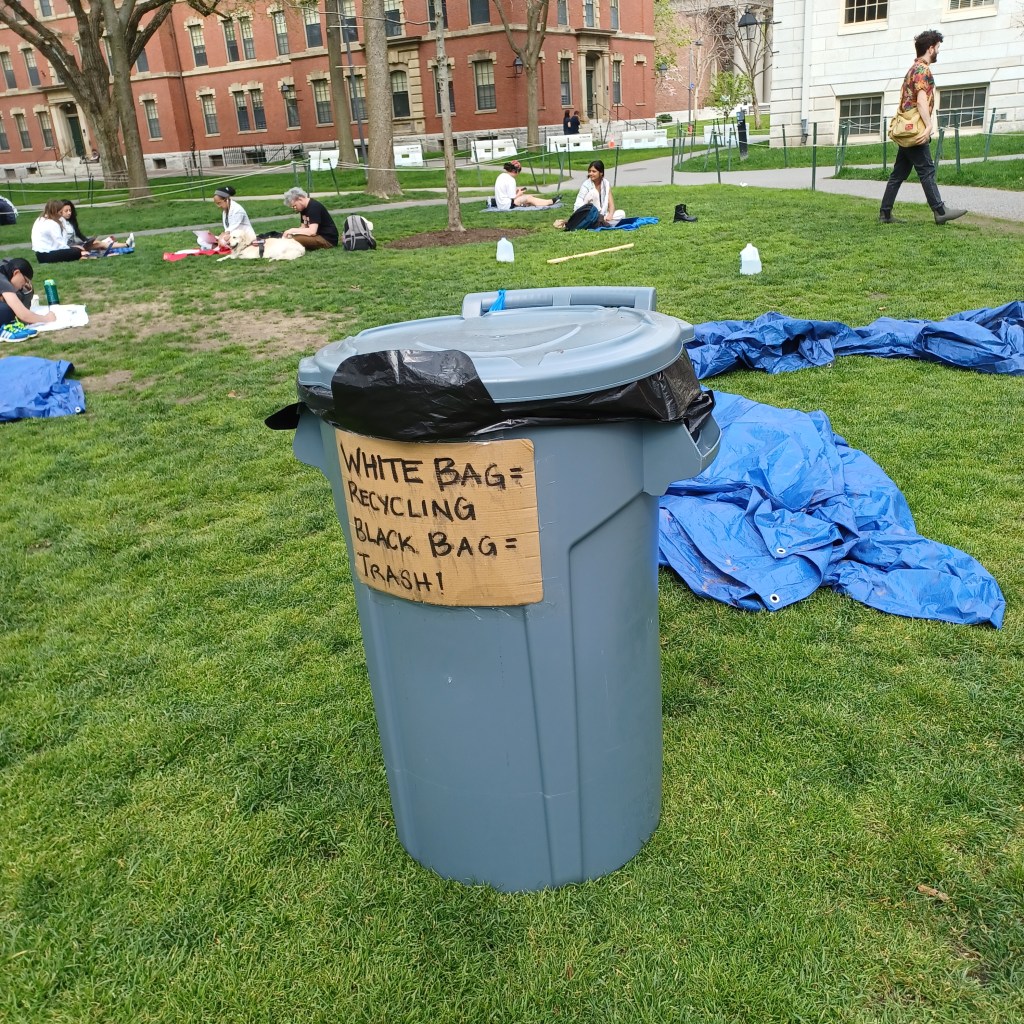
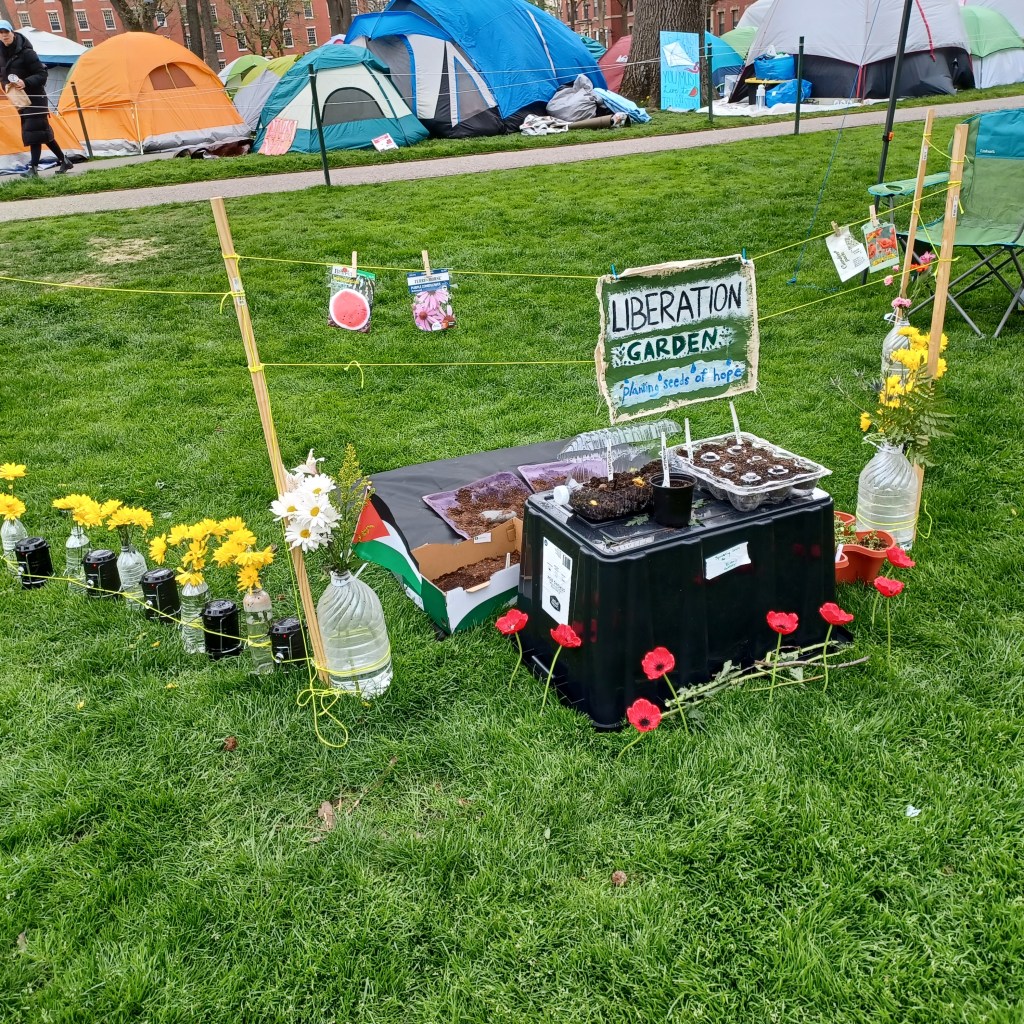
There are about 50 tents in the Yard, fewer than during the Living Wage campaign in 2001 but probably more than during Occupy Harvard in 2011. Like those encampments, this one is self-policing and keeps itself clean. Yesterday some clotheslines had been strung up between trees. Sleeping bags and coats were hung up to dry.

At this time, early afternoon, about a dozen counter-protesters showed up. I have to describe them as quite loud and aggressive. They marched right into the middle of the encampment, singing Hebrew songs, accompanied by a man with a guitar. Their signs quoted the very worst threats from Hamas (“October 7th was just the first time…”) and showed photos of some of the hostages. They stayed in the middle of the camp for around 15 or 20 minutes. The pro-Palestinian campers did not engage with them at all. While the singing and shouting was going on, the campers quietly rearranged the perimeter ropes so the Zionist group had its own little peninsula open to the paths.

The counter-protest moved out of the camp itself to the lawn outside Mass Hall, where it could be more easily seen and heard by the media outside the gates. One man shouted: “Jews on this campus will not be intimidated, and we will not be silent.” I noticed my walking buddy from Monday in the group, and waved to him; he smiled and waved back to me.

I overheard a counter-protester say “Stop them from using the name Harvard, it’s a violation of trademark rules. Call Meta.”

A man from CAMERA, the Committee for Accuracy in Middle East Reporting and Analysis, a decades-old pro-Israel group, told passersby that they had planted 1200 Israeli flags on the HLS campus. I didn’t go to see and can’t find any reports confirming this. He expected they would soon be taken out. He also told a Globe reporter hovering outside the gates that this encampment was an unprecedented disruption at Harvard. I joined their conversation to correct that statement. As for noise, the encampment schedule for some days lists about an hour at dinner time to “make noise for liberation.” I haven’t stayed late enough to determine just how much noise that comes to. Most of the time the camp seems extremely quiet.

The camp was treated to a show of more than 100 bare backsides late last night during the annual Primal Scream event. The Crimson asserts that the streaking was nonpartisan and nonpolitical. Nobody seems to object to the primal screaming.

Atheist’s Bible: Jonah

I was raised Jewish, so I learned the Old Testament. Much later, I studied the New Testament and became a Christian for a while. I tried and finally failed to believe in an afterlife and a Creator who cares about us individually. But various parts of the Bible have stuck with me.

The Bible is full of beautiful poetry, moving stories, and wise ideas. It’s also full of contradictions, nightmares, and ideas impossible to reconcile with science or human nature. It was written by many people over many years. Some insist that it’s all the Word of God, because the Bible says so. Those people act like the Bible belongs to them. But it has helped shape my world, so it belongs to me too.

Take, for example, the story of Jonah in the Old Testament. God told him to preach in the city of Ninevah. He didn’t want to, so he ran away on a ship. God sent a storm, the sailors figured out it was Jonah’s fault, and they threw Jonah into the sea as he instructed them. God sent the famous whale to rescue him from drowning. By the time he got vomited up on shore, he was ready to go preach in Ninevah.

Jonah told Ninevites that if they didn’t change their evil ways, God would destroy their city. He must have been pretty convincing. They changed. God let them off the hook. You’d think this would please Jonah, but he got angry with God for forgiving them. They had done wrong, and Jonah felt they should have been punished as God had threatened. He didn’t think they deserved to live. He stormed out of the city to sulk on a hillside under a little shelter he built. A gourd vine quickly grew up over the shelter, giving Jonah nice shade in which to pout.

But God wasn’t done teaching Jonah yet. He sent a worm to destroy the vine, leaving Jonah to broil in the Mediterranean sun. Knowing Jonah had anger issues, God asked him if he was mad about the vine dying. Jonah said yes. God pointed out that Jonah had not planted the vine, or helped it grow, yet he was upset it had been killed. So Jonah, God says, how do you think I feel about those 120,000 poor people in Ninevah who can’t even tell their right hand from their left, the people I created?

What I get from this story is that if we warn people to change their bad behavior, and they actually listen to the warnings and begin to do better, we might still not forgive them. We might still want them to suffer for what they did. When I see former Trump voters repent online, and liberals scorn them for their former politics, I think about Jonah. He’d be pissed at them too.

But these misguided former Trumpers are just as much children of God as any of us are, if any of us are. If they learn better, it’s cause for rejoicing, not resentment. We need to keep preaching. It might even work.

Good Guys, Inc.

Why can’t the good guys get our act together? So many people have been working hard on so many good things. But for 50 years, the progressive movement has been split into “special interests” by single-issue organizations. Environmentalists, social change activists, advocates for economic fairness, or for seniors, or children, or other species – all compete against one another for top billing on political agendas, media attention, and funding.

But if we’re going to build a world humans can survive in, we will need to do a wide spectrum of things. We have to stop fracking and using fossil fuels and nonbiodegradable plastic. We have to house the homeless and feed the hungry. We have to share the wealth to create economic justice. We have to educate our children, and protect our seniors. Most of us care about all these issues. Most nonprofit organizations only care about one.

If we support a single-issue group with our time or money, we should pressure it to work in coalition. This won’t be easy. Paid staff at these organizations have built their careers on “their” issue and will be reluctant to put that issue in context. For them, it’s about keeping such power as they have. In this way, we are poorly organized for survival.

That’s why it’s so important for progressives to take over the Democratic Party. That’s the only place where every issue is part of the agenda. The nonprofit sector in the US does a lot of good things, but it’s not only fractured internally, it’s on too small a scale to deal with huge national or international problems. And it is organized according to the whims of donors, i.e. people with money.

If we overcome all the cheating and manage to get Democrats in power again, poor Biden will have to deal with a mess on every level. No matter what we care about most, the Republicans under Trump (and before him too) have screwed it up. Everything we love is in danger.

We can’t keep fighting over which issue is most important. We have to make progress on all of them. Every single-issue organization has gathered data on that issue and knows how to educate people about it. If they work together – if we insist that they work together in order to win our continued support – they can each add a valuable piece to the puzzle of how to create a sustainable world.

Eventually this puzzle has to be worked out by all countries, not just the US. But if the good guys here manage to get it together, the US can once again offer some moral leadership to the rest of the world. This is not up to Biden, or any politician, my friends. It’s up to the American people.

Out of Balance

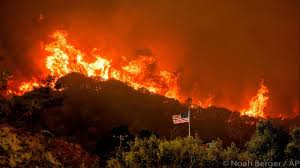
It’s the fall equinox today. Day and night are balanced. California and Oregon are burning. The earth is out of balance, and so is the United States.

The Awesome and Notorious RBG finally died, 45 days before the election. Trump will ram through some anti-abortion right-wing nutjob for the Supreme Court, and McConnell will rush them through the Senate confirmation.

Some people are still holding out hope that Susan Collins will vote no. They always hope she’ll do the right thing, and she never does.

There’s a reason people are almost as angry with establishment Democrats as with the completely corrupted and spineless GOP. Neither party has done much for working people in the last 40 years. Obamacare helped; but Obama was a negotiator, not a warrior. The Republicans stopped him cold two years in.

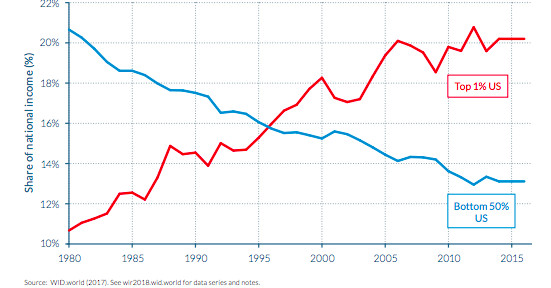
Meanwhile the rich have kept getting richer, and the rest of us have gotten poorer. The USA’s record concentration of wealth has been stolen from ordinary workers. We need a wealth tax to get it back.

Don’t expect Biden to give us what we need, if we’re lucky enough to have him win the election. The only way we’ll get health care, affordable housing, student debt forgiveness, a Green New Deal, and significant change to our policing and prison systems is if we insist on it. The American people must lead.

Make a sign. Write an email. Tweet your legislator. The real struggle starts after the election.

Elephants on Parade

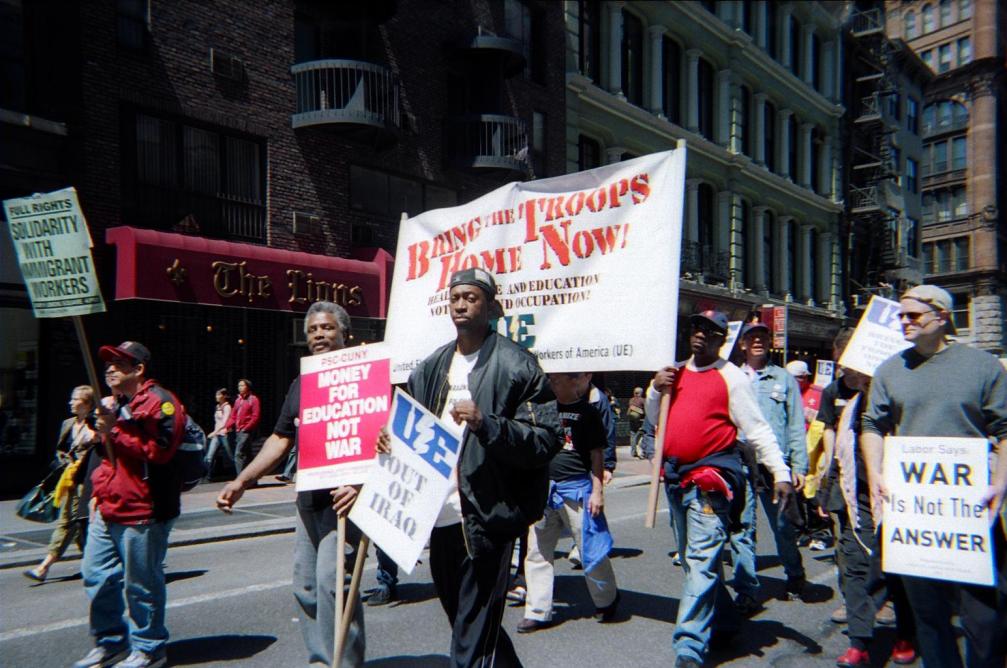
Protesters at the 2004 RNC in NYC
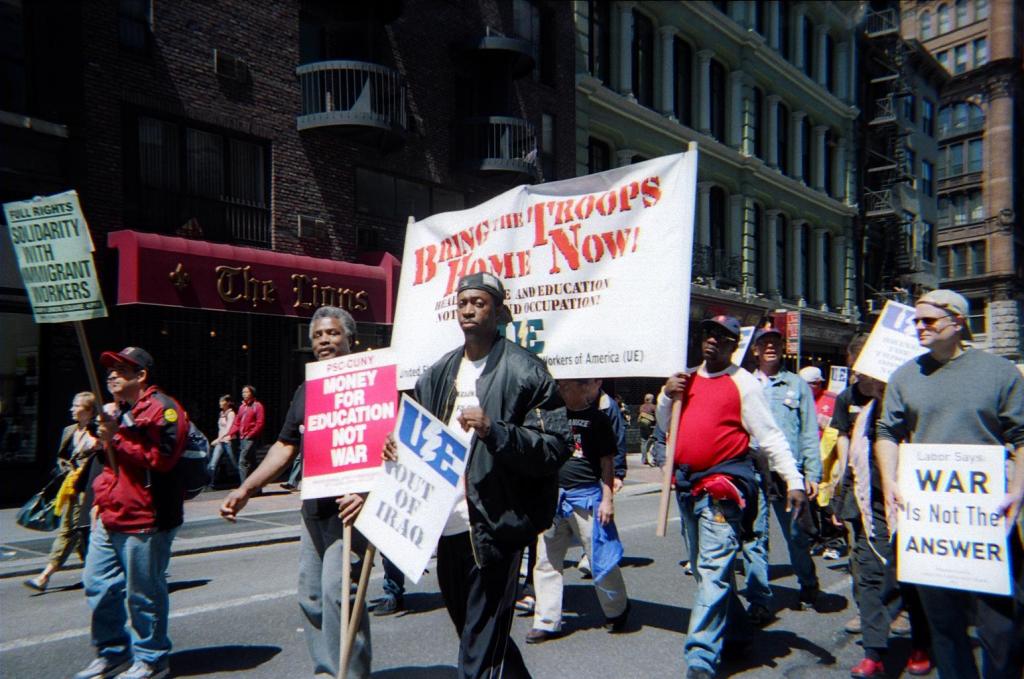
Definitely not Elephants: Protesters in the streets of NYC, 2004

Journal from the 2004 Republican National Convention in New York City

August 29, 2004, Sunday; around 6:30am.

Cool early morning of a hot day. It’s way too early to think about politics, or anything else for that matter, but 20 people are already waiting on the steps of the town hall.  At 7:00, a bus pulls up to take more than 50 of us to New York City for the big anti-Bush protest that’s supposed to start at noon today.

            I doze for the first part of the trip. After we make a fast food and bathroom stop, I wake up enough to talk with the nice man sitting next to me. Mark has a doctorate from Harvard in American Civilization.  He has been protesting the state of that civilization on and off since the early ‘70s.

            I ask Mark what upsets him most these days.  He says, “It’s a toss-up: pre-emptive war or incipient fascism.”

            Our conversation is interrupted by a balding, bearded young man whose boyfriend is traveling with him, wearing a skirt. I don’t care one way or the other about their sexuality but their communication style is awfully annoying. The young man shoves a song sheet at Mark as a pointed hint that we should be singing along with the folksinger and his little banjo in the aisle nearby, not talking.

            I resent being strong-armed into a hootenanny.

            Rumors fly up and down the aisle. People say no buses will be allowed into the city, and we’ll have to be dropped off at Shea Stadium in Queens and take the subway from there. Our bus driver, however, drives us all the way in.

            It’s a hot, humid, sunny day.  The march is dense and stretches for many city blocks. It’s impossible to see past the protesters immediately around you. Most people have homemade signs. The signs give a thousand reasons why people want Bush out.

            It feels like a big parade. The marchers are cheerful and excited.  All generations are represented but most of the crowd is young. The cops are out in their thousands.  They seem to be relaxed, not hostile.  People on the sidewalks wave the peace sign and shout their support.

            A random sampling of signs:

Send the Chicken-Hawks to Iraq (with a photo of Bush and Cheney)

Who Would Jesus Bomb?

Sick seniors, Sick children, Sick of Bush

Bush Lied, Thousands Died

The First Amendment is Not a Privilege, It’s a Right

Cure AIDS: Don’t Censor Science

November 3: Because Dumping Bush is Just the Beginning

Halliburton Thanks the GOP

I Support Our Troops and That’s Why I’m Here

Oppression Abroad, Oppression at Home: Stop the Bush War Machine.

End the War on Workers

(A man with a baby, with the baby’s photo on his sign): Save My Tush, Get Rid of Bush.

We Support Police, Fire and Teachers

            This last slogan makes an interesting contrast with the anti-Vietnam demonstrations of the ‘60s and ‘70s, when many protesters considered the police to be part of the “establishment” that created the war, and thus the enemy.  So many protesters called the police “pigs” that they might have helped turn that perception into fact.

            Today, protesters and police are not necessarily antagonists. The protesters see police as working people, with the same issues as the rest of us – health care, the looming deficit, education, the environment, the messes we’ve made in Afghanistan and Iraq.  The police are on the job and can’t express their political opinions.  There’s a lot of fellow feeling with the protesters though.  Police might have to protect the Republicans this week, but they don’t have to agree with them.

            I use my cell phone and run along the sidewalks to meet up with the Military Families Speak Out group, right in front of the march with the veterans of this and other wars.  The first member I speak with is Lorraine, whose brother is a Marine.  Their father died recently.  “What upset me was that they almost didn’t let him back for Dad’s funeral because things were getting too hectic in Iraq,” she says. “I guess getting rid of Saddam was a good thing, but I never supported this war.  Just the troops.”

            Sergeant Sherwood Baker was killed in Iraq this April.  His mother, father, and stepmother are all here at the march, carrying his likeness on posters with the date of his death.  They believe the war was unnecessary and no more of our troops should die for it.

            Larry is the father of two soldiers, Bryce and Branden, handsome young men whose photos are stapled to his sign.  He’s from Virginia and this is the first time he’s been to New York City. Larry’s enjoying protesting and sightseeing at the same time.

“I called my wife and said I was marching down Broadway and I hadn’t been arrested yet.”

            Around one-thirty, the front of the march reaches Union Square and settles down in the shade of the park trees.  Some native New Yorkers are sunbathing in the open spots, oblivious to the gathering masses of protesters.

            Mildred’s son has been in Iraq for six months. He’s an Army scout.  His unit has lost their lieutenant and one of her son’s good friends.  Two dead and two seriously wounded out of the 27 or 28 people in the platoon.

            Her son’s unit was terribly saddened by the deaths and injuries, Mildred says.  They had been told they’d be home by the end of the year. Now they’re being told by the end of February. “It doesn’t feel like much of a mission to him,” she says. But “he does what they’re ordered to do.”

            Mildred “thought the war was wrong from the beginning,” she says, but she’s only been protesting for the past six months or so. She told her son that joining the military was “something he should think about,” but felt it was his choice to make.

Mildred sends him macaroons.  She and Nancy, another military mom, trade tips on which cookies best survive the three-week trip to Iraq.  Nancy sends chocolate chip and homemade brownies, wrapped individually in plastic and then put in a tin so they don’t crumble.

            “Every aspect of this war has been mismanaged,” says Nancy.

            Some group, I think Bread Not Bombs, is handing out paper containers full of pasta salad, and free drinks.  I get plastic forks from a nearby deli.  People keep pouring into the square as the march winds down.

            The military families and veterans against the war are supposed to meet in Central Park around 4:00. Gilda, another military mom, and I get a ride there with Victor, a Vietnam vet.  He writes military histories.  He says he didn’t understand the Vietnam War until he got home and started reading Noam Chomsky and Howard Zinn. “They opened my eyes,” he says.

            Gilda has had a tough day. She came in from Washington DC.  She was setting her dog’s dishes inside and left her purse near them when her cab came.  She ran out with the rest of her stuff and didn’t miss the purse until they got to the bus and she couldn’t pay the cabdriver. The cab took her back home, and then to the train station since she thought the bus would be gone by then.

            There were three buses going to the demo at the station, however.  She doesn’t know who chartered them, but one of them got her here.  But they were late, and she started at the end of the march and had to run through the crowds to march at the head with the military families and vets.

            Gilda’s son Alex is leaving for Iraq on September 9.  He’s been trained in surveillance.  She hopes they spent so much on his training “that they won’t just throw him away.” [Note from years later: Tragically, Alex was killed on duty in Iraq.] 

            Victor, Gilda and I wander around the Great Lawn area of Central Park looking for our group.  The Lawn is surrounded by hundreds of police, though the line of cops keeps to the shady spots.  The protest could only get a legal permit for the march.  The city decided not to allow a rally in the park, saying it would be too hard on the grass.  As a result, many people took off after marching, and the several thousand who came to the park anyway are just milling around. 

Word was spread through the protest web sites that since there was no permit to gather at the Park, people should say they’re going there for a picnic.  The picnic is short on food baskets and long on banners and posters.  I heard the satirical group Billionaires for Bush were going to play some croquet on the Great Lawn, but we don’t see any sign of their thrift-store tuxes and ball gowns.

            Finally our cell phones bring us directions to the vets’ gathering place, a shady, stony little hill called Summit Rock.  One Vietnam vet is telling another about the Desert Storm troops: “They saw some bad stuff on the Highway of Death.”  He advises the other vet to brush up on his history if he wants to protest effectively.

            An Iraq War veteran speaks of the mental trauma troops suffer from the casualties they inflict as well as the ones they sustain.  “When we left Iraq last year,” he says, “they brought in a couple of psychologists, and got all the Marines not on duty, around 50 of us, in a room.  They gave us kind of a debrief.  You’re not gonna get a bunch of Marines in front of their buddies to say, Yeah, I’m upset.  They’re just doing it to say they did it [post-trauma counseling].  It was so stupid.  I just put my  head down. It’s just a formality.”

            Joe is a Vietnam vet from Philadelphia. He says “I’m filled with happiness and hope” at the recent founding of Iraq Veterans Against the War (IVAW).  “Never again shall one generation of soldiers abandon another,” he vows.

            A big guy in green camo says “I served with Kerry.  Back him up! You’re doing the right thing!” A Marine in the small audience yells “Booyah!”

            Mike is one of the people who founded IVAW in Boston, just a month ago.  He says “Today I had five guys walk up out of the blue and say they want to be part of this.” He tells the crowd, “It’s most important to let people know that people who shed their blood and tears are saying, Bring them home now! No more VA closures, no more cutting veterans’ benefits! Never again!”

            Rob, another member of IVAW, says “During the war, my mom was with Military Families Speak Out. I’m fighting, my mom’s over there protesting.  We agreed to disagree about some things. Then I came home, and said I wished I could meet some other guys to talk to.  I saw Mike on the MFSO website. Then Mike calls me, says we’re going national.  We got to get our buddies home.”

            Tim’s from California. “Almost weekly, we’re seeing headlines: Marines dying.  We went live on MSNBC today.  Our ranks are growing tremendously. We’re gonna take this to the administration.”

            Bryan’s a Marine from New Palz, New York. “This war is wrong. We were all lied to. We need to defeat George Bush and kick him out of the White House.”

            David served in Iraq as part of the New York National Guard.  He came home to VA cuts. “Guys can’t support their families,” he says. “This war is perpetuating poverty.”

            Chris is a first lieutenant with the Army Reserve. “I knew this war was going to be unjust.  When you’ve outlived your usefulness, they’ll drop you like a hot potato…Thank you all for trying to set things right, so we can have the America we want it to be rather than a place just for the rich.”

            The mother of a soldier now in jail for desertion speaks, in Spanish, and her sister translates. “He isn’t being punished because he deserted, but because he denounced the war….It’s important to know there’s a network.”

            Steve has been active in organizing that network on line. “Frankly I liked the 1971 version of John Kerry much better than in 2004.  But I’m working for him anyway.” He’s wearing a green beret, sunglasses, and an anti-Bush t-shirt. “Let’s hope we emerge and sink the Swift Boat Vets.”

            I don’t get the name of the man who tells us, “Job One: Get Kerry elected.  Job Two: If  he is, get our boots up his ass to stop the war.” He gestures with his hands out. “Who better than those who fought a war to tell people to stop it?”

            The vets and military families pose for a group photograph, the Vietnam vets in front, the Iraq vets  in back.  They break into song: “When you’re a vet, you’re a vet all the way, from your first cigarette to your last dying day” – to the West Side Story tune; then a chant: “Hey, hey, Uncle Sam, We remember Vietnam. We don’t want your Iraq War. Bring our troops back to our shore!”

            Victor looks in vain for his Screaming Eagles platoon banner, which he lent to some vets for the march earlier today.  Now it’s somebody else’s souvenir.

Sunday night.  I watch Fox news this evening.  They say the marchers went by “in the tens of thousands” although hundreds of thousands would have been more accurate.  The photos don’t give a sense of the crowd’s size either. Surely some of the helicopters overhead all day took pictures that would show all the packed streets of the parade route, but there are no such views on Fox. 

Fox also keeps showing footage of the little papier mâché dragon float some anarchists set afire.  That wasn’t cool but it also wasn’t typical.  Fox says “This was only one of many scenes in the march,” implying that there were many more instances of uncivil behavior.  Anybody who actually saw that march had to marvel at how peaceful and well-behaved people were, but you wouldn’t know it from Fox news.

I take the ferry from Manhattan to Staten Island tonight, to stay with a friend. A huge yellow full moon is rising over the city as we passed the Statue of Liberty.  It was a good day for democracy, I think.

August 30, Monday.  

At the Republican National Convention, as at the Democratic convention a month ago, security guards look through everyone’s bags before they can enter.  Next to the box of confiscated umbrellas, I notice a box of foodstuffs forbidden entry, including many big beautiful apples.  Security won’t let me take a picture of it.

            Unlike the DNC, the RNC is giving special treatment to members of the press.  You get a goody bag when you pick up your ID tags.  There’s a handsome cloth briefcase with the RNC logo, and inside are some useful things, like a notebook, a disposable camera, and a tiny flashlight; some fun things, like red white and blue M&Ms; some odd things like a large hardcover children’s book; and some things that are beyond odd, like the box of macaroni and cheese.

            If you get here early enough and sign up, a member of the media can get a massage or a haircut.  I could use both, but I pass.

 I sit in the nosebleed seats of Madison Square Garden to watch the early, non-prime-time speakers on this first day of the convention.  One speaker gets a big hand for saying “America is stronger when we support traditional moral values.”  I suspect they’re thinking about gay marriage more than, say, honesty or kindness.

            A black speaker running for Congress says “The foundation of our nation is Christianity and a firm belief in Jesus Christ.”  Wild applause. I check the printed text of his speech that was given out to press at the media information center.  Those words do not appear in it.

            All the speakers refer to the estate tax as “the death tax”.  Nobody mentions that this tax is levied on less than 2% of estates, affecting only the very richest families, and that there are exemptions for family farms.

            Behind the speaker podium is a huge screen that often shows stars on a blue background.  The stars keep shifting as though they’re afloat.  It makes me a bit queasy to watch them too long.

            In the signage under the major media boxes, Al Jazeera appears along with ABC and CNN.  I give the Republicans points for this.  The Dems didn’t allow the excellent Arab news organization to display its name.

            Lower taxes is a big theme here.  People keep talking about “ownership” but nobody acknowledges that the American people own our government.  No speaker here will admit that taxes pay for any services the American people might need.     

            I talk with Shirley, a delegate from Kentucky, and her husband Larry.  “We’re most interested in the security of our country,” Shirley tells me when I ask her which issues she cares about.  In the next breath, though, she says that she and Larry own and operate several skilled nursing facilities, “and with all the cuts, they’re closing everywhere.  We read in the press that nursing homes are getting rich, but that’s not true.  We’re barely breaking even.  I’m not a great proponent of government intervening, but in the case of the elderly, we can’t abandon our older individuals.  Wives and husbands work.  What will happen to their parents?”

            So even though I assume they share their party’s desire for lower taxes, Shirley and Larry want more government spending.  I ask Shirley what she thought about the protests yesterday. She says she pays them no attention.

            When I meet Marva, an alternate delegate from Ohio, she is sitting in her wheelchair outside the Garden, waiting for her hotel bus.  She says “the morality of America” is her big issue.  “One nation under God, not one nation under Gay – that’s what we’ll be if Bush loses.” 

            Marva is most concerned about “the absence of faith.  If we lose all our values, everything’s lost.” She’s written a book titled “It Takes a Church to Raise a Village”.  In it she argues that government can’t solve social problems; she supports Bush’s “faith-based initiatives” to encourage religious organizations to deliver services rather than government agencies.

            I ask Marva if she thinks the war in Iraq was justified.  “There are always mistakes in war,” she says, but adds dismissively, “I’m not an expert on war.”

While the convention takes a break before the evening session, I go looking for some of the protests scheduled for this afternoon.  The Hip Hop rally was supposed to start at Union Square and then join a poor people’s march to the convention, or as close as the police will let them come.

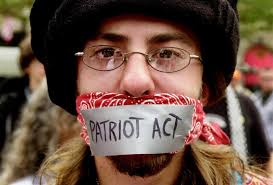
            The only representatives I see of hip hop culture are two young men named KC and Shaun at the front of the march.  Evidently that rally didn’t continue onto the street.  “We’re the last of the black people,” jokes KC.  I ask what issues move them. “I’m angry about George Bush trying to be a dictator,” KC says.  “The Patriot Act is an infringement on our civil liberties.”

            Shaun says, “I’m mad that we went to war for no apparent reason. I have friends that went over and got killed in Iraq.”

            They warm to the subject. “Our president has no humanity or humility,” says KC. “It’s his way or the highway.  You can’t have a president like that!  And I’m mad the cops are out here acting like we’re the enemy.  There’s more cops in NYC today than I’ve ever seen.”

            Shaun adds, “Five million a day extra for cops – out of our tax dollars!”

            As we’re talking, we wander away from the poor people’s march, which meanwhile the police have stopped behind us.  We turn around and look, and there’s the protest back half a block.  When they catch up to us, Shaun and KC melt into the crowd, hoping to meet some girls.

            The poor people’s march has fallen in behind a banner reading “Still We Rise”.  Some signs from this protest: Homeless are Casualties of War. Cure AIDS: Vote! A Better World is Possible. War: What is it Good For? Vote Bush for the Destruction of Humanity. Expose the 9-11 Coverup. W: Worst President Ever!  Schools Not Jails. Stop the War on the Poor. Free Palestine. Who Profits – Who Dies?

            And my favorite: 1 Stealth Bomber = 58,000 teachers’ salaries

            It’s a much smaller crowd than yesterday, but there are several thousand people here, maybe tens of thousands.  I eat a late lunch in a Cuban-Chinese restaurant, because it’s New York, and I can.  Ten policemen sit at one table and two policewomen sit at another.  The sound system is playing John Lennon’s “Imagine”.

            When I go back to the Garden for the evening’s festivities, I find some isolated protesters sitting across the street, with their backs against the wall of a convenience store.  Juan and Andrew wear Chicken Hawk t-shirts and bandanas, as does another friend who ignores me. They have no street addresses and no computers, they say.  I ask them what I ask everybody: What gets you steamed?

            Andrew says the war.  “That’s a pretty big one.  Hearing vets say they’re being misled.  Now they’re using Ground Zero as a backdrop for the campaign.  It’s all exploitation.  People don’t understand, lives are being destroyed.”

            Juan says, “With the minimum wage, you can’t afford to live.”  Andrew adds, “Health care.”  He paid $6500 of his own money when he had a kidney stone because he couldn’t afford insurance.  He knows people who work in halfway houses and nursing homes who are struggling to get by: “People who care for people…you can’t pay the rent.”

            Christine, a suburban-looking woman from Long Island, is standing on the sidewalk handing out copies of an anti-war poem written by her 14-year-old son.  “He’s an A-plus, not just an A student,” she tells me proudly.  “We went to the Million Mom March together on Mother’s Day.” Christine says “a lot of New Yorkers feel the Republicans only came to promote themselves through 9-11.  I don’t think Bush did a lot to prevent 9-11 so I don’t appreciate him promoting himself with it.”

            A young man named Chris is wearing a homemade t-shirt with a picture of Jesus on the front under the word “Liberal”.  He’s “pretty much a lifelong leftie, across the board”.  He teaches in the Bronx, where, according to Chris, “there are no resources”. “If we’re gonna get blown up, we might as well protest and have some fun,” he says.  He spent the summer listening to right-wing radio, noticing how often they boasted about their Christianity.  “I got to thinking, wasn’t Jesus a liberal?”

            The back of Chris’s shirt ticks off his reasons for this conclusion: “1) Fed the poor. 2) Healed the sick. 3) Turned the cheeck [sic]. 4) GOT CRUCIFIED!”  I ask him what kind of responses he gets to the t-shirt. “Most people I go up to just drop their eyes.”

            Chris thinks “some of             the ‘60s energy is back again.  I even heard some cops saying, kinda fondly, Wow, it’s just like the ‘sixties.” He especially likes seeing so many young people in the streets.

            A young woman named Monika holds a sign reading “G.O.P. We are forever in your debt. Thanks Trillions!” An older woman stands nearby.  “This country is becoming like a police state,” says Esperanza, who lived in Spain under Franco and knows something about police states. “Everybody has to get searched. Everybody wearing IDs. So much police. It’s not like a democracy anymore.”

            A policeman tells Monika to move along: “This is a frozen zone. No protest.” She argues but eventually moves on. 

            Mimi, buxom and dark-haired, and grey-bearded Arnie are handing out flyers that say “RNC Alert #3.” It makes several pointed statements in a true/false format, though both answer columns read “true”.  One statement, in part: “Every Republican you see in this city believes in and represents this repressive and illegal regime.” The note at the bottom says “Any Republican actually from New York City should be escorted to a mental hospital immediately.”

            Mimi and Arnie are both social workers.  Arnie is the radical.  Mimi is tagging along, highly amused at Arnie’s antics.  Arnie is frustrated with people who still believe what the Bush administration tells them.  “The same person who finally realized you were right about [there being no] WMDs [Weapons of Mass Destruction], they hear the next lie and forget the last.”

            Arnie doesn’t understand why any social worker wouldn’t blame Bush for “funding cutbacks to programs. They don’t connect anything with politics.”

            He gets in the face of the group of police right in front of the Garden’s main entrance, demanding to know why they’re stopping people from exercising their freedom of speech.  Most of the police in that knot fade back, letting a pretty black woman and a white man with a mustache and a friendly look respond to Arnie’s provocations.

            Thus begins a twenty minute conversation punctuated by hand-waving and laughter on all sides.  When Arnie tells the woman, “I know what you’re doing,” she responds, “You can’t figure ME out.” She tells him, “I had a flag on my car and somebody says, you’re a black woman and you have a flag on your car? First of all, fuck you.  That’s MY car.  Then, I believe in free speech.”

            The cop with the mustache tells Arnie he’s lucky he hasn’t been arrested, because he “violated our first rule”.  What’s that, Arnie asks.  The cop deadpans, “You’re wearing orange socks.”

            At one point both cops and Arnie pause to hassle a young passerby about quitting smoking.  The policewoman says she just quit herself.  Arnie says he quit when he was eleven.  The policewoman learns that he and Mimi are social workers, and launches into a fervant appreciation of the work they do.

            Arnie, Mimi and the policewoman trade stories for a while of awful apartments they’ve been in.

            I take a photo of this odd little party.  But when I ask the policewoman her name, she rolls her eyes and says something about risking her career, so I don’t press the matter.  But if the NYPD knows what it’s doing, she’ll be handling protests from now on.

Arnie, Mimi and I have dinner together at a place a dozen blocks down 8th Avenue.  While we’re eating, Mimi spots a protest march coming up the street outside, and Arnie and I run out to watch. It looks like several thousand people.  I check my protest schedule: this must be the one that started at the U.N. late this afternoon.

            After dinner I walk back toward the Garden, and find that police have barricaded some of the protesters in between 29th and 30th Streets on 8th Avenue, about two blocks away from the Garden.  It looks like they’ve been here a while already.  Many marchers are now lying down on the street, resting on their backpacks or on somebody else.  Others sit in circles, talking or playing music.

            There are swarms of press people here, lighting the darkness with flash bulbs.  The police seem uneasy, the first time I’ve seen them tighten up. 

There are two sides to the story of why the marchers have been blocked.  The police say that protesters kicked a cop off his scooter, and when other cops came to help him the marchers threw a barricade at them.  The protesters say it was nothing like that.  They claim the cops were picking people off one by one all along the march route, then started moving the barricades.

            Olin, a protester who was trained to be a medic for this event, is angry with the  police.  “I think it’s intimidation tactics.  Showing people they’re in charge with an overwhelming show of force.  Why let three-quarters of the group go through, then cut off the last fourth?”

            Some people are still holding up their signs.  One huge banner displays the entire Bill of Rights, written in white on a black background.  People have this one right up front near the thickest line of police, and a few people are haranguing the cops about their First Amendment right to freedom of speech.  With most protesters being so carefully kept out of sight of the Republicans, this seems a relevant discussion to have.

            I join a small circle listening to Pete, from Salt Lake City, Utah, as he plays his guitar and sings. I catch a few lines: “Plastic people with stucco faces/ We’re killing people in far-off places/ Wiping out those wicked races…Killing, blindly filling shopping malls/ We should have taken the time to figure out all the messes that we made…”

            It seems like something more will happen here eventually, but my feet hurt so much from walking for two days straight that I blow the protesters a kiss and head back to the convention, floating through all barriers with my magic press pass.

A man in back of me in the nosebleed seats is on his cell phone.  “Having a wonderful time.  Met a wonderful guy.  He’s full of money.  We’re gonna go out and spend some of it.”

            Below us, the Texas delegates look like a marching band in matching blue shirts and white cowboy hats. They have choreographed moves, too, waving their arms in unison, bouncing and swaying together.

            After the “W” video where Bush talks about his “vision,” I swear the band plays the opening bars of “Another One Bites the Dust”.  But then the tune mutates to “We Are Family,” with the words now “We are for George Bush”.  The Texans do their moves.

            Senator Graham’s speech drones by me until I hear the phrase “There will be no class warfare in this hall tonight.” This idea bears no relation to anything before or after it. Did the Senator spot a poor person in the arena?  I don’t think I’ve seen any.  The Republicans are all dressed extremely well – though of course conservatively.

            The man on the cell phone in back of me yells “Yeah!” so loudly and so often at the most jingoistic statements that people turn around to look at him.  He’s a lean, white-haired man with one of the sourest faces I’ve ever seen.

McCain’s speech reminds me that it is possible to be a reasonable person and still belong to the Republican party.  He urges people to acknowledge the patriotism of the opposing party and to welcome dissent as a healthy part of democracy.  Applause for these ideas is lukewarm at best. 

            As the prime-time speeches wind down, I leave the Garden and walk back to the block where the protesters were a couple hours ago.  No one is there but a few police.  When I ask one where everybody went, she tells me, “They just kind of trickled away, one by one.”

I skip the convention and the protests entirely on Tuesday, visiting friends and relatives around town.  Tuesday, I learn afterwards, is the day when the police decide to make their quota of RNC-related arrests by sweeping over a thousand people into detention, whether or not they have actually broken any laws.  These arrests are so indiscriminate that old ladies trying to cross the street and other random pedestrians find themselves detained along with a few real troublemakers and a lot of people who just showed up for the protest and never bothered a soul.

            I can’t help thinking that when Sunday’s big protest ended with only a couple of hundred arrests, somebody high up must have insisted that the huge security costs for convention week had to be justified by many more arrests.  The smaller protest events during this week, after most demonstrators have gone back to their homes and jobs, make it easy for police to surround and capture participants.  And, while they’re at it, innocent bystanders.

            From the accounts I’ve heard, the police are not generally hostile or brutal in making these arrests.  They have orders, and they’re carrying those orders out. Many of the detainees are released after a few days, the charges dismissed by a judge who scolds the police for over-reacting.

            I watch Arnold’s speech on my friend’s television.  For the first time, I have the horrifying feeling that Bush is going to win this election.  Arnold’s speech is a masterpiece of “true lies”: little pieces of the truth that are blown up and spotlighted to cast the much larger truths into the shadows.

            Arnold grew up under a mild socialist regime in a prosperous, peaceful country.  Yet he manages to give the impression he escaped from Soviet tanks.  He talks about widely-shared American values, and then says if you believe in them, “You are a Republican.”

            A scan of the crowd shows an older black woman in the upper right-hand quadrant of the screen. Everyone around her is grinning and clapping. She sits quietly with a troubled look on her face.

            This is the hard sell.  This is how garbage is always sold to the American people – in this case it’s junk politics instead of junk food.  Without any real accomplishments by the Bush administration to talk about, there is no steak, but they can still sell people the sizzle. 

September 1, Wednesday

I hear on the news that Bush has described the invasion of Iraq as a “catastrophic success”.  For once I think he has spoken the truth.  The same could be said of his tax cuts and environmental policies.

            In Union Square, the American Friends Service Committee has set up the same display of boots, one pair for every American soldier killed in Iraq, that appeared during the Democratic National Convention in Boston’s Copley Square.  Only now there are over a thousand pairs of  boots.

            There is also a memorial display honoring those American troops who have committed suicide during active duty in the Iraq War, twenty-six so far.  Two of these men were from Massachusetts, one from Deerfield, one from Belchertown.

            On the street outside the Convention, a woman with a silver missile attached to her belt tells me, “I’m here to make sure we get four more years of George Bush and this wonderful war!”

            Tonight I was going to trade my press pass in for a temporary floor pass so I could mingle with the delegates, but security has tightened up a notch.  Now only those with delegate or guest passes are allowed on the floor of the arena.  Everybody else is supposed to be in their assigned seats.  If you wander in the halls or linger too long at the railings, security comes up, asks what you’re doing, and politely but firmly points you to the seating area noted on your tags.

            My area is below the nosebleed section, and above the good media seats with their red, white and blue bunting.  This is supposed to be a periodical press seating area, but it’s full of Bush partisans.  They applaud fiercely, yell and pump their fists, and raise signs praising the president.

            I remember one of the security people from the Democratic National Convention in Boston last month, an angry-looking grey-haired man in a nice suit.  He’s the one who kicked a disability-rights activist and reporter out of the press area, where at the time there were plenty of available seats.  He doesn’t seem to recognize me.  I try to avoid his searching gaze.

            From the speeches tonight, you’d think more Americans died from terrorist attacks every year than from domestic violence, reckless driving, and smoking combined.  They present Bush as the father figure who will protect the rest of us from all harm while we continue with our usual activities —  in other words, go shopping.

            And the lies about Kerry keep piling up.  In Congress, the same legislation can go through any number of changes before it finally passes or gets voted down.  Kerry voted for a package of Iraq war funding, for example, that would have made some of it a loan, repayable by the sale of Iraqi oil.  He voted against a version that paid for the whole $87 billion package with American dollars.  The Bush campaign portrays this as a “flip flop” when it’s nothing of the kind.

            Feeling discouraged, I leave before the speeches are over.  Outside the Garden there’s a row of buses waiting to take delegates back to their hotels.  A lone protester walks up and down on the sidewalk.  Her sign reads: “Your integrity is even smaller than your heart.”

            Nazgol is a pretty girl with short dark hair and enormous dark eyes, a little slip of a thing.  A policeman tells her “Your boyfriend should be out here with you.” “He’s in jail,” replies Nazgol. “Do you want to arrest me?” Clearly the officer does not.

            A fat man in a well-cut suit standing nearby begins to laugh, loudly, while Nazgol argues with the police about her right to protest here.  I go over and ask him what he’s laughing at.  “Everybody,” he says.  I fail to see the humor in this situation.  He looks like he has a permanent smirk.

            Two policemen fall in beside Nazgol to make sure she keeps walking. The black cop tells her he’s just doing his job: “I’m not here to like or dislike.”  Delegates already on the buses avert their faces when she waves the sign at them.

            Yesterday, Nazgol says, she had a banner that read “Pro-life? Stop the Killing in Iraq”.  A lobbyist thanked her for making that statement, saying that it made her wonder whether she was part of the problem. Nazgol also tells me that the population in mental hospitals has spiked during this convention. 

            As delegates trickle up the street to the buses, Nazgol shouts at them: “17,000 Iraqis dead! Shame on you!”  A very tall, muscular young man says “Bitch” in a loud flat voice.  When a news photographer approaches and tries to take her picture, this man blocks the shot.  He has tags around his neck but hides them and refuses to tell me his name or official capacity.

            A policeman halts Nazgol in her progress down the sidewalk.  “How many times I see you tonight?” he asks.  She replies, smiling, “Forty or fifty.”  “Too many times,” he says. “I like you.  I like your sign.  But I’ve seen too much of you tonight.” “I’m going home now,” says Nazgol, and she does.

September 2, Thursday, the last day of the RNC

I can’t just keep listening to the convention and quietly taking notes.  It feels too much like a hate rally.  Hoping that maybe even a small disruption can break the spell the Republicans are casting, I buy a large sheet of thin paper and magic markers and spend part of the day lettering a sign.

            The sign folds up small.  I slip it inside the folds of a convention magazine and put it in the outside back pocket of my backpack, which checkpoint security has never opened.  Sure enough, they let me in without looking into that pocket, though a guard breaks off the little file on my nail clippers before she’ll let me through.

            I hear one convention worker tell another, “Everybody else is very calm, but the Texans are out of control.”

            A black woman is cleaning the rest room.  A beautifully dressed and made-up white woman points wordlessly at an unflushed toilet and passes on.  The worker mutters angrily, “I’m not your maid.”

            On the big-screen TV in the media info area, I watch a blonde woman from Ohio get interviewed while a large man on her right jiggles and dances in place.  He has no rhythm or grace whatsoever.  I bet the Republicans wish he’d quit jiggling like that.

            Once again, security is preventing free movement in the halls and no one is getting access to the main floor.  In my assigned area of press seats, a man in the first row holds up a sign that reads: “Cheney and Bush.  Get use to it.” I wonder which periodical has hired this illiterate.

            If I can hold up my sign, I figure it will be like one of those bucking bronco events: a short, wild ride and a rough dismount.

            I find a seat in the middle of a row, as far as I can get from the enthusiastic partisans I noticed the other night.  Succumbing to racial stereotype, I sit in front of three Asian-Americans, hoping they’ll be too polite to actually push me over.

            Pataki, the Governor of New York, goes on at length about September 11 and then smoothly segues to the war on Iraq, as though the two events are cause and effect.  The second time he starts praising Bush for his strength as a war-time leader, I unfold my sign.

            The top word of the sign is “Strong” so nobody bothers me until I shake out the rest of the paper and hold it as high as I can.  I hear people in back of me reading it out loud.  “Strong but Wrong.”  When the people in front of me hear that, they turn around.           The man to my right grabs the nearest corner of the sign and yanks at it.  I yank it back away.  On his second grab, the corner tears off.

            The older man directly in front of me pulls the bottom of the sign with both hands and crumples it in his lap.  I lean over and snatch it back, saying “That’s mine!” and hold it up again. It’s ragged on the bottom now but the words are all still there.

            By now a security guard has gotten the people at the end of the row to move so he can get next to me.  “Come with me, ma’am,” he says.  He waits while I pick up my bag and waits again while I fasten it.  People are shouting at me but I can’t make out the words.

            The guard is joined by several other security people (not, I’m happy to see, including that nasty guy from the DNC) while they hustle me out into the hall.  Somebody thrusts a large black object in my direction, which at the time I think is a camera, so I smile and flash the peace sign at it.  Later I realize it was probably a microphone with a sound baffle, and feel like a complete moron.  Why didn’t I speak?  I must have been more frightened than I thought.

            In the hall, I’m at the center of a growing knot of more than a dozen security, police, and secret service men.  I swear they’re all over 6 feet tall.  They argue for a while about what to do with me.  The first security guy lets go of my arm.  I ask the two giants next to me, “Did you need your tallest people for this?”

            A short black cop comes to stand by me.  I tell him I’m happy to have someone there I can look in the eye without getting a crick in my neck.  He smiles.

            They take my backpack and press tag.  The short policeman, another cop and the guard who first came for me escort me down several floors to the Tactical Operations Center, where the guard goes into another room.  While we wait, I say to the cops, “I guess they didn’t like my sign.” The short one laughs.

            A new guy, probably secret service, comes in to the small lobby. I hand over my driver’s license when asked, and tell him how I got my press credentials.

            I find out later that a few women from the group Code Pink managed to get onto the floor of the Garden to protest during Bush’s speech later tonight.  They had valid guest passes.  The way they got them was to dress up nicely and hang around upscale bars in the delegate hotels, trolling for young male Republicans.  The pickup line of choice was “I can get you a guest pass for the convention…”

            Anyway, security finally decides I’m not a threat.  Since I was only exercising my First Amendment right and others in my area were holding up signs too, there’s nothing to arrest me for.  The two policemen who’ve been hanging around with me escort me out of the building in a leisurely and peaceful fashion.  They point me toward the correct subway line and tell me not to come back, because I will be arrested.

            I feel jubilant on the way out.  The dismount was easier than I expected, and I’m relieved not to be arrested. 

            But I soon crash.  Why didn’t I wait for Bush’s speech?  Why didn’t I yell LIAR, LIAR, LIAR – You lie about Iraq, about the economy, about school reform, about tolerance?  I go from feeling like a hero to feeling like a wimp.

            My seat was so far back in the huge arena that there’s no way I could have been seen or heard from the floor or by the major networks, so it really doesn’t make any difference except to my pride.

            I didn’t want to let Nazgol down.

           The train ride home is peaceful and I talk with no one. I take a cab from the station.  My driver is from Brazil.  He listened to some of the Republican speeches.  “These people talk about morality, and God, and Christianity,” he says. “But they’re not talking about love, are they.”

            That pretty well sums it up.

Alice in Donkeyland: A journal from the 2004 DNC

Monday, July 26, 2004

Thirty-one police motorcycles are parked in front of the Boston Public Library, lined up in two neat rows.  They seem to be there to protect the public from the Falun Gong people who are demonstrating their exercise and meditation techniques in Copley Square across the road.  Falun Gong practitioners are persecuted in China, detained, tortured, and sometimes killed for their beliefs.  But in Boston today they exude a cheerful eagerness to please.

Groups are practicing dance moves.  There are a dozen or so fetching young ladies dressed in tight, blindingly pink bodysuits with flared legs and silvery ornaments; several dozen older women shaking their arms overhead, the bells on their bracelets tinkling up a storm; and hundreds of other men and women dressed in day-glow yellow hats, pants, and T shirts.  The only thing I see to object to is their color scheme, which runs to the fluorescent.  Maybe those motorcycles belong to the Fashion Police.

Black helicopters drone overhead.  I don’t stick around for the Falun Gong show.

Near the Park Street mass transit station, Robert, a resident of Newton, Massachusetts, is walking around with signs bearing an unusual message: Give all living things the vote.

One of Robert’s signs, adorned with a googly-eyed cartoon slug, reads: “Universal suffrage means a vote for all.  Elect-a-Slug!  Will not nuke world; will not screw interns; did not invent internet; is not religious bigot.  Do Not Vote Primate!”

Robert works for the Smithsonian Institute and used to contract for DARPA, the Defense Advanced Research Projects Agency. 

“If ants had the vote, wouldn’t it be a better world?” he asks.  I suggest that humans would have to form coalitions, perhaps with dogs and cats.  “Those fellow travelers!” he replies.

Two nice ladies sit at a DNC information table near the T station, hatless in the hot sun.  They’re pointing people in the wrong direction to St. Paul’s church.

The ladies tell me it was “bedlam” here on Sunday with all the anti-war demonstrators.  However they also say the protest was “very peaceful.  Well controlled.”  I’m not sure if they mean self-control or otherwise.  Here come the black helicopters again.

Half a dozen army MP’s, both men and women in camouflage that stands out in the urban jungle, relax in the shade of the T station, chatting and watching the tourists.

I talk to some of the men who live on the streets around here, among the few Bostonians who haven’t left town to escape the predicted madness of convention week.  Frank has been homeless for 37 years.  A car wreck left him disabled enough to be sent to a special school for kids, but not disabled enough to qualify for disability benefits.  He is blue-eyed and curly-haired, and would be good-looking if he weren’t missing so many teeth.

Frank says it doesn’t matter who wins the election this fall.  Whoever runs the country “does me no good.  I’m still homeless.”  His friend carries a grey blanket wrapped in plastic under his arm.  What should the government do for homeless people?  “Give us housing, that’s it!” he says.  But Frank disagrees.  He doesn’t want a hand-out, he wants an opportunity to work, and housing he can afford.

“If I get a job, they take away my check,” says Frank. “It’s a catch-22.  No matter how I slice and dice it, I’m still fucked.  There’s not a dime of difference.  Democrats will give you lip service, Republicans will give you nothing.”

Rena, from the state of Washington, is here with the Dennis Kucinich campaign.  “This is the first time I’ve ever gone to investigate a major political candidate and found I like where he is on every issue.  I’m astounded.  Delighted.  He gives me hope.”     

Rena is helping guide people in to a social justice forum at St. Paul’s Church, where Kucinich and Jesse Jackson will be speaking later.  She’s practicing what she calls “compassionate communication,” which seems to consist of saying necessary things gently, over and over.  She has a sweet round midwestern face and curly red hair under her wide-brimmed straw hat.      

Bunny, a thin woman in Birkenstocks with short white hair and glasses on a green-beaded chain, came down from Vermont.  She’s in town to “bring progressive issues to John Kerry.”  She hopes Kerry is keeping a lot of leftie ideas under his hat.  But she promises, “If he gets in, we’ll be back in the streets the next day.”

An articulate young white man in a motorized chair and a DNC shirt is explaining Kerry’s money needs to two elegant young black women in office wear.  They’re signing a petition.  Meanwhile, delegates stroll up and down Tremont Street, unfolding maps and peering around for landmarks.

Some people in the small crowd on the sidewalk are wearing T-shirts that say “Regime Change Begins at Home”.  One sign reads “Kerry and Bush are Against the Poor”.

Inside the packed church, I ask a man with a pleasant open face what his tag says — is he press or a delegate?  “I’m nobody,” he says; “This is for the bus.”

Here’s Leslie from California again, the exuberant blonde I saw yesterday on the subway.  Today she’s in a turquoise cotton top, white shorts and flipflops, smiling steadily, telling people entering the church, “Everywhere but the first two rows.”  She was up at 6 a.m. today, she says, “doing the newspaper run.”  Later, she plans to go take a nap.  Tomorrow, she promises to be in full regalia again at the protest fair on the Commons.  I wish I had taken a photo of her on the T in her little apron saying No More Bush, with its picture of a woman’s shaved crotch.

Four women are hugging one another near the entrance.  “So glad you made it.”  “I escaped!”  “Let’s get our own pew.”  One says, referring to the convention center I suppose, “Everyone who’s going in there is very well dressed.  With huge IDs.”  She moves her hands to indicate hang tags.  They all laugh.

Sally, from Albuquerque, New Mexico, was at a Code Pink rally outside the protest pen when they tried to put up a banner.  At the time, the father of a soldier killed in Iraq was addressing the rally.  “Police were taking down this dangerous pink banner.  There were a lot more police with machine guns than protesters.  A little bit of overkill.”

Jim, a sturdy grey-haired man with glasses, a pug nose and a mustache, is wearing his Vets for Peace ball cap.  He’s from Orange County, California.  He says they set up crosses at Huntington Beach on Sunday at sundown, one for each soldier killed in Iraq.  The crosses fill an acre of beach.

“Our best supporters are the young Marines” from nearby Camp Pendleton, says Jim.  “We try to educate the public about the true cost of war, honor the fallen and the wounded, and think about the needs of vets once they return.  Whether you’re for or against the war, we should honor the ones who are making the sacrifices.  Older Republicans, Eisenhower Republicans, they see it.  We’re not there to argue.  We ask people to think about their government’s policies.”

Jim went across the United States with the National Vets Stop the War bus tour.  “Thirteen crazy Vietnam vets, some from the first Gulf War, all suffering from various degrees of post traumatic stress syndrome!  We had a good time though…The bus was decked out with graphics.  People clapped and honked their horns, through the heart of America.  The occasional person flips you off, but not much of that.”         

The vets came to Boston last Tuesday for a national conference at Emerson College.  Daniel Ellsberg and Ralph Nader were there too.  “I was afraid Ellsberg was going to jump him!” says Jim, “But he said he’d wait til later.”
“We’re patriots for peace.  We believe in America strongly.”  Sally, who’s been listening, says: “We don’t think it’s patriotic to support a criminal war.”      

Onstage, a young Asian-American woman talks about being made to feel like an outsider after September 11.  She says of her community, “Everyone has had something happen to them or to someone they know.”

I watch Kucinich speak for a while.  He’s so short.  I’m short too, but I’m not about to run for president.  If liberals could just stack him up on top of Robert Reich and Michael Dukakis, they’d have the perfect candidate: really smart, and really tall.  My favorite Kucinich line: “It doesn’t matter where you come from, but where you’re going, and who you’re bringing with you.”

Jesse Jackson delivers a rousing speech on building a movement “from the bottom up, not the top down,” but the church is hot, and I sneak back out to the sidewalk.  An older woman holds a banner that reads “Invest in caring, not killing”.  About a dozen young people trudge in a circle in front of the church, chanting “Bush, Kerry, no solution, fight for a Communist revolution”.  The other people milling around are ignoring them.

A couple of libertarians carry signs reading “Conservatives Organized to Crush Kerry/ End the Nanny State/ Free the market and the rest will follow/ Liberty: It’s what’s for dinner” and “Enjoy Capitalism!”  The tall green-haired one also carries a large Don’t Tread on Me flag.

Other sign slogans: “War is Peace. Freedom is Slavery. Bush is President.”  “SHARING will save the world.”  “Another World is Happenin’.”  One popular T-shirt has a picture of a backbone with the various vertebrae labeled: instant runoff voting; end weapons trade; reject water privatization; embrace diversity” etc..

LaRouche supporters, mostly black, mostly male, sing several choruses of an ode to their leader, whom they call an FDR Democrat.  Very nice harmonies.  A guy in a red polyester Hawaiian shirt holds a sign saying “Democrats: Hermaphrodites are People Too!”  I’m pretty sure it’s a guy.

On my way to the FleetCenter, which I would much prefer to call the New Garden, I overhear three policemen talking about possible protests.  I can just catch a few scattered words: “…blood…excrement…rumor…” A few minutes later I visit the result of that kind of rumor: the protest pen across from the FleetCenter, formally named the Free Speech Zone.  A chilling concept.

And it’s a chilling place.  Long, dark, narrow, dirt-floored, roofed by the iron hulk of an obsolete overpass, with razor wire on top and heavily armed guards on the look-out.  The area is surrounded by concrete Jersey barriers and two high rows of chain link fence, plus a bunch of plastic sheeting.  Netting is strung between the fence and the overpass.  The space suggests an attempt to create Tupperware for terrorists.

A small grey-haired man stands off by himself, holding a poster that reads: “Design by Sharon Rumsfeld Associates.”

The podium is located toward the rear of the space, behind a structure that might be a mechanical shed, close to the fence.  One woman remarks to me, “It’s like if you put a couch in your living room turned around toward the wall.” 

The space is mostly deserted, now and also on other days when I drop by.  There are a dozen or so Republican activists wearing giant cutout flipflops with holes for their heads, and about a hundred anti-abortionists.  A man with a naked buttocks mask on his bottom and devil horns points out Randall Terry, one of the movement’s leaders, a telegenic guy in a handsome tan suit.

The anti-abortion people have covered nearby sidewalks with slogans in chalk, which have begun to be erased by passing feet.  Two burly men are holding up big signs: “Support President Bush/Trust Jesus.”  A friendly-looking old man in an Uncle Sam costume also holds pro-Bush signs.  “I’m so tired,” he says.  “Not of getting my picture taken, I was up late…”After I take his photo and thank him, and say I hope he’ll get some rest, he says “I hope you lose.”

The anti-abortion crowd makes way for the next group of protesters, who turn out to be vicious homophobes.  They carry signs like “Boston = Sodom” and their speakers say such venomous things that I can’t bear to stay and listen.  One man stands stolidly before the platform holding up both middle fingers.  He’ll probably be okay.  There are certainly enough police around to keep him from getting stomped to death.

When I come back later, a group arguing for the rights of Palestinians has taken the stage.  One young Jewish woman says, “I feel a connection to the land of my ancestors.  I just don’t feel the need to own it.”  Signs on the fence read: “Is this what democracy looks like?”  “Palestine always looks like this.”  And “Whatever happened to the First Amendment?”

I talk with Kate, from Cambridge, and Priscilla, from Andover, Massachusetts, who are watching the action outside the pen.  Priscilla says she believes in free speech, “but the way these anti-gay people are talking, so ugly, sick and hateful…”

Bumpersticker spotted on a barricade: “I need to find a florist who can send two bushes to Iraq”. 

At the FleetCenter, long lines of people are going through the security checkpoints inside big white tents.  They’re confiscating everyone’s water bottles.  Are we feeling safe yet?  I’m actually grateful to the guard who dumps out the contents of my backpack, because my feta cheese wrap has leaked through its paper sack and was about to ruin my notebook.  He didn’t notice my little bag of nuts and dried fruit, or else didn’t consider them a security risk.

At the entrance to the building, pigeons walk among the crowd.  Overheard from a group of radio press: “Looks like birds are going to be a problem.”

Rabiul, a Deaniac from Kansas, is waiting for a friend so he takes a minute to talk with me.  He’s a businessman who was born in Bangladesh and has lived in the U.S. for 20 years.  His main concern in this election, he says, is “Openness.  We have a right to know what our government is doing.”  He also worries about maintaining a healthy environment for future generations.

I ask Rabiul if he had any problems with people after September 11.  Even friends “gave me a different look,” he says.  His son was outside playing, and some neighborhood children teased him, saying “You’re from another country, go back to your country.”  His son replied, “I was born here.”  Rabiul told him he was right to say that, and not fight.  “By force you cannot get respect.”  He adds that right after September 11, one of his neighbors told him to let him know if anyone gave them trouble.

Rabiul says he went back to Bangladesh for a visit in 1999 and had only good things to say about this country.  He tells me that when he brought his elderly parents to America, they couldn’t get insurance and couldn’t apply for citizenship because they were too old to learn English.  He was desperate to get them health care, afraid they’d come all that way just to die.

Rabiul went for help to Kathleen Sebelius, the Kansas insurance commissioner at that time, now governor of the state.  She went to work on the problem, and three months later had a new regulation in place so his parents were able to get health insurance.

I enter the FleetCenter at the same time as Michael Moore and Al Franken, who greet each other over the heads of the swarms of press.  I make my way to the fourth level print media area.  An officious woman named Mary says I can’t sit there while wearing my hat.  I’ve wrapped an orange plastic banner around it that reads “First Amendment Zone,” which the press area is evidently not.  Mary is worried about how the area looks on television.  Another writer has a classy little black straw hat on that must meet the dress code.  It’s boring here anyhow and I go wandering again.

An announcer asks the crowd to pose for the official convention photograph.  “Please look at the digital clock across from the stage, toward the Fox 25 News banner,” she says.  At the mention of Fox, the crowd boos lustily.  And then grins for the camera.

Music so far: “We are Family” and “Dancing in the Street”.

There’s a very large man with a ponytail dressed head to foot in bright orange out in front of the crowd, dancing.  Fortunately he’s a pretty good dancer because you feel compelled to look at him, regardless.

Now I’m in what people are calling the nose-bleed seats, rising steeply in the top tier just under the bags of a million balloons.  Right now they’re not too crowded.  I sit next to Donald, whose wife Kaye, a schoolteacher, is one of the Texas delegates.  We’re both glad to have a railing to hold onto.

Don’s a retired sheriff.  He plans to run for Justice of the Peace.  It annoys Don that Bush claims to be a Texan, pointing out he wasn’t born in that state.  “He broke Texas, and now he’s breaking America,” Don says.

The musicians are playing a version of “Rollin’ on the River” reworded into “Kerry in the Future” as far as I can tell.  The Dems need to lose this little ditty as soon as possible.

Gore is saying “America is a country where any boy or girl can grow up to win the popular vote,” and gets a big laugh.

Now Hillary’s speaking, but I’m listening to Don.  He was a police investigator enforcing environmental laws for a while.  “We cleaned up the water so you can swim in it again,” he says proudly.  He once got to guard Barbara Jordan, the late black congresswoman from Texas, who, Don thinks, was “a great lady.”  Hillary is standing on stage with the other congresswomen, and the band is playing “Everyday People.”

Joyce, sitting nearby and listening to our conversation, identifies herself as a banker from Kentucky.  When I tell her my kids were born in Kentucky, she gives me her state pin.  Not to be outdone, Don gives me his little American flag pin.

It’s hot up here and I’m tired, but I stick around to hear Jimmy Carter, in my opinion the only real Christian we’ve had as president.  Straight and slim at 80, he’s not speaking as clearly as he used to, but the crowd responds to him with great affection.

I leave before Bill Clinton speaks.  I’m sure he’ll drive people wild.  We’d re-elect him in a heartbeat if we could, no matter what the meaning of “is” is.

Tuesday, July 27, 2004

On the subway, I meet Debrosha and her daughter Katie, the Massachusetts coordinator for Rock the Vote.  They’re lugging materials for events around town.  Rock the Vote is strictly nonpartisan.  They don’t care who you vote for as long as you vote.  Clearly, though, registering young people and black people will help the Democrats.

Katie’s going to school at Tufts.  Her mom came in from Allentown Pennsylvania to help her this week.  Debrosha is a big woman with a wonderful smile, which shines forth whenever she looks at her smart, pretty daughter.  She’s exhausted already though, doing so much walking in this heat.

Katie says, “The last election showed us how much one person’s vote counts.”  She tells me that when young people say they’re non-political, she asks if they know there’s a bill to reinstate the draft.  “That’s a reason to vote right there!…I don’t think you have a right to complain if you don’t do anything about it.”

She’s wearing a black stretch band across her chest that reads “fcuk you, i’m voting” — from French Connection, United Kingdom, hence the fcuk acronym.  “It’s a little harsh, but people my age, this is the kind of thing that gets them to look.”  Katie tells people to find out what the candidates stand for, not to vote a certain way because their parents or their friends do.

Katie doesn’t feel like the media are doing a good job letting people know about the candidates’ voting records and backgrounds.  “We spent a lot of time on the Clinton controversy, and I think if we were willing to do that, we should be willing to educate people [about the candidates].”  Not surprisingly, education is one of her main concerns.  “Other countries are catching up to us because they’re willing to educate their people.”

Debrosha says they’re sending Katie’s 12-year-old brother to a private school on scholarship; they have no money.  “I’m really a public school person, but I can’t sacrifice my son.”  The last straw was her son’s public school French class, where they had no textbooks.  The teacher was good at Spanish but didn’t really speak French well enough to be teaching it.  She wrote the lessons on the blackboard for the kids to copy, and if they copied the lesson wrong, they learned it wrong.

Debrosha’s first vote was for Carter, and she’s still proud of him.  “He always tried to help the little people.”

We part near the Commons, where the Falun Gong people have set up horrifying tableaux showing various torments they’ve been subjected to in China.  Torturers and torturees pose with the same disciplined stillness as the meditators sitting on the grass, minus the blissful little smiles.

On the street later on, checking the line outside yet another social justice forum, I meet Fernando, a radio reporter from LA.  I tell him I’m starting to pick up some Spanish from a late-night Latin music program called Con Salsa, and he says, “Never forget, there are 500 million people waiting to be your friends.”

Boston has hung lush baskets of flowers from lampposts all around downtown.  There are red, white and blue clothes and furniture in store windows, and an “Art is Democratic” banner over an art gallery.  The streets are unusually empty.

I wonder if anyone warned the out-of-town young ladies in their high-heeled backless sandals about Boston’s cobblestone sidewalks.

The hemp store is flying an American flag out front with a sign pointing out that this flag, like the original, is made of hemp: “If true patriots like Washington and Jefferson grew hemp, why can’t we?”

At Copley Square, the American Friends Service Committee has set out a pair of combat boots for every American soldier killed so far in Iraq, and a big pile of street shoes, though not big enough to represent every Iraqi civilian casualty.

Grigory, a Russian from New York City, stands near his sculpture commemorating all the victims of terrorism worldwide.  It includes two clear plastic towers like Boston’s holocaust memorials, covered with photos of the firemen and police who lost their lives at the twin towers, toy buses and trains that have been crushed and speckled with red paint, a world map with the locations of atrocities marked in black, a tiny picture of Daniel Pearl, and the photo of a little girl with the words, “People Protect Me.” 

Grigory says, “I ask – for me is question – what to do with this?”  I take his picture.  He seems wistful; a man with many questions and no answers.

Dawn and Andy, independent media people from Rochester, New York, are grabbing people for interviews about their reactions to these displays.  Andy says, “I’m outside the two-party system, voted for Nader last time.  If I’d lived in a swing state I would’ve done different.”

Near one of the delegates’ hotels, I meet Peggy, on the finance staff for the DNC.  This is her fourth convention.  “LA was a lot bigger.”  She’s a Carter fan too: “He’s everybody’s hero.”  She finds the convention is useful “for the delegates to compare notes and network, get close to the politicians.  It energizes you, kind of makes you feel like what you’re doing at home makes a difference.  Makes you more committed, reinforces you in the fight.”  She’s in a hurry and hustles off to work.

Flashing my press pass, I get a seat on a delegate bus.  I ask my seatmate, Gil, a delegate from Berkeley, California, if he’s been to any parties.  “Six people in a closet: call it a party, it’s a good time!”  His main beef is Bush’s foreign policy.  “This last year, we’ve been a bully, or people think we are.  We should use our influence, not through strength but through wisdom.”

Gil is an Asian-American with two children.  He misses the eight years of peace and prosperity under Clinton.  He’s concerned with working family, labor and education issues.  As a fire captain and paramedic, “I see the trends.  We go on more calls because people aren’t getting health care.  The way speakers presented last night was right on.  We need health care for everyone.  And strengthen first responders to reduce crime.”

He adds, “I have discussions all the time with my Republican friends.  We’re not bullies.  We’ve never gone into a country and taken over like this…We’ve lost long-established relationships with just about everybody.  Our administration does not collaborate with groups internally or externally.”  He’s excited to be at the convention “to get our message out: we’re going to forge change that will benefit our country.”

The bus takes a peculiar, twisting route through the underground arteries that are closed to other traffic for the week.  When we get to the FleetCenter, we can hear an amplified voice from the protest pen.  It’s loud but distorted.  I hear something about how the Bible says homosexuality is a sin.

Signs facing the bus parking area from the pen: “Don’t Cage Liberty: Cage the Fear-Mongers.”  “Did the Patriots Die for This?”  “Pens are for Animals!”

Also: “Kerry: Respect the World Court – Israel’s Wall is Illegal!”  “Occupation is Oppression.”  And “FUTURE OF THE FIRST AMENDMENT.”

Just outside the FleetCenter, I speak with Vincent, a square-faced, white-haired man in a union T-shirt, the Kerry co-chair from Fresno, California.  Vincent is upset.  He shows me a small paper sign with a photo of a woman’s eyes within a Muslim headdress and the slogan: Say No to War in Iraq.  He had five of these, but security took away the other four.  Why are the Democrats stifling dissent, he wants to know.

“Unity, fine,” says Vincent.  “But to enforce it like this is not democratic.”  He’s trying to get other delegates to make signs and hold them up later, but so far has not found anyone to go along with him.  One of the political directors told him they don’t want to “send a bad message.”  Stopping war is a bad message?

I spend a little while trying to find out who makes the rules about what to confiscate.  I ask a policeman, who points me to a secret service guy, who says it was up to the DNC people.  Then I ask a small young woman with a DNC volunteer T-shirt, but she has no idea.  This is her first question on the job and she is clearly crestfallen at being unable to answer it.

Inside the Center, the band is playing “Celebrate Good Times.”  Three black women in the Oregon delegation are dancing together.  I’ve followed Vincent in his quest for fellow dissenters.  Joe, a doctor from New Hampshire, says “I’m proud of you for speaking out this way,” but refuses to join Vincent’s protest.  Joe says there’s a close race in his state and he doesn’t want to embarrass former governor Jeanne Shaheen.

Vincent says, “If you can’t speak out at a convention, where can you speak out?”

I notice the Kansas delegates hold up home-made signs when Governor Sebelius, Rabiul’s hero, begins her speech, so I go over to ask how they got them through security.  The state whip says they gave the signs to the DNC person assigned to their delegation, who said any sign was okay as long as it had a cardboard tube handle and not a stick.  But I can’t find Vincent again to tell him.  His signs had no stick, anyhow.

Anthony, an official-looking person whose position I fail to discover, says: “You need some standards.  No obscenity.  You don’t want signs on national TV that might be offensive, but if it’s a message of peace, I have no objection.”

Joe, the whip for Massachusetts, says: “There are probably twenty valuable minutes here, prime time.  You try to choreograph.  Last night I saw a half a dozen rogue signs.”  He adds, ruefully, “We’re living in a different world.”

I ask Joe about the protest pen.  “The Dems didn’t set that up, a judge did that,” he says, which is not the case.  He points out the pink scarves people are wearing that say “Give Bush a Pink Slip” to show that all forms of free expression are not being repressed.

Tonight in the writing press area, before Mary kicks me out again because of the hat, I meet Wayne, a very nice guy who is distributing hard copies of the podium speeches.  He tells me about the media information room on the third level where he gets the handouts.

This place becomes my favorite part of the building.  Only a few kinds of pass will get you onto the floor, which has its own escalator.  Another round of security keeps everyone but some media people out of the corridor that leads to the media info room, CNN’s space, storerooms full of folding chairs and bottled water, and one of the entrances that lead to the stage.

It’s in this well-guarded hall that I get within six feet of Hillary, looking fabulous in a light blue suit, and brush against Senate minority leader Tom Daschle as he hurries off the floor.  I also see several other famous people, but I don’t know who they are.

By 8 o’clock, I’m not feeling up to making any more new friends, so I head out.  But en route, I encounter the young volunteer who couldn’t answer my question earlier.  She’s radiant with pleasure: someone gave her a pass so she could get inside.  “You’re leaving?  But this is a once-in-a-lifetime opportunity!”  Meekly, I turn around and sit through several more speeches before giving up.

I leave through a break in the fencing where security of several stripes makes sure people can get out but not get in.  Just outside, a woman in a pink robe cries, “Hey!  I made that banner!”  She is looking at my hat.

So I meet Robyn Su, who created the plastic First Amendment Zone banners three years ago, when “we discovered they were keeping protesters away from Bush and the media.”  Her serene pink presence signifies a level of alert that has nothing to do with Rumsfeld’s screwed-up rainbow.  He was so unfamiliar with the concept that the alert colors go red-orange-yellow-blue-green, instead of green-blue.  But we never seem to reach those peaceful frequencies anyway.

My night isn’t over yet.  On the train home, Barry and Linda are still fizzing with excitement.  “We’re not press, we’re troublemakers.”  He’s been telling people that Bush had sex with Don King.  “There are pictures!”  I personally would be thankful if Photoshop had not made that particular image possible.  Barry is from New York, where he has been happily making trouble for three-odd decades.

Linda is just along for the ride.

Wednesday night, July 28, 2004

I hitch a ride on the hotel bus after work.  Mary, a plump, attractive blonde, is an alternate delegate from Alameda, California.  She’s felt “pretty disenfranchised” since the last election.  “I’m raising a girl, and it feels increasingly unsafe.  I looked at the candidates way early.  I read a lot, and thought that Kerry is aligned with what I think we need to be doing.  And happily, other candidates had a lot of good things to say.  But I don’t know if they were the ones to take the fight all the way.  It took a wide range of viewpoints in the campaign to make us realize we could all come together.”

Because of their little girl, Mary says, “education is a huge issue.  We [California] went from being one of the best to the worst.”  She tells me that tuition at state colleges has gone up 40%.  “My sister isn’t making enough to pay for the last semester she needs for her teaching credentials.  She has to pay someone to watch her teach, and she’s been teaching for four years – in east LA.  She went to find out about programs to help teachers in high-risk areas, and she was told they weren’t funded.  They’re just words on paper.”

Mary’s husband, Phil, is an attorney.  “We’ve generally ignored the authority of the international community,” Phil says.  “It’s as though you were arrested and taken to court, and you walked out, saying this court has no authority over me.”  Phil and Mary are amused at all the media attention they’re getting at a convention where media workers outnumber delegates almost 3 to 1.  “These television people wanted get footage of us packing to leave.  Well, sorry, we’re already packed!”

Phil and Mary get into a conversation with a sports lawyer, another alternate, which lasts until we get to the FleetCenter.  They’re all concerned about electronic voting. 

Nobody bothers me in the fourth level writing area tonight, since it’s raining and I left my hat at home.  Supposedly security isn’t allowing umbrellas into the arena.  The local convenience stores have run out of ponchos.

Somebody here has been bothering another writer though: Marsha, a crew-cut woman in a wheelchair who has a wheelchair symbol tattooed on her shoulder.  She writes for Mouth Magazine, “The Voice of the Dislabeled Nation.”  I hear a fuss, and see her fuming; steam is almost visible, rising from her ears.  A tall, broad-shouldered, well-dressed man with stylish grey hair has just stalked away.  “He said, That’s my seat, get out of my seat,” Marsha says. He wouldn’t identify himself when she asked him, or when I asked him either.  “I’ve never known anyone to be so rude!” she says.

Marsha tells me she used to work for Newsweek before she became disabled with multiple sclerosis.  “They say it’s the most accessible convention in history, and it’s a nightmare.”  There was a piece of rubber a couple of inches high that she couldn’t get over at the entrance, for example; “Someone had to lift my wheelchair over it.” At the disability caucus, blind people asked for the braille versions of the handouts but the DNC didn’t have any.

The band is playing “Power to the People”.  Dennis Kucinich is getting up to speak.

The mysterious grey-haired man says that Marsha assaulted him “verbally and physically.”  He says the seat belongs to a writer “for UPS” who’s in a wheelchair.  I said, if he comes, I’m sure she’ll move.  He says if she won’t move, he’ll call security and have her arrested.  I get distracted for a few minutes, and when I look again, Marsha is gone.  In her place is a young man in a ball cap, without a wheelchair.  I’m betting he’s not with UPS, either.

Jarrett the second and his father, Jarrett the first, are waiting in this area for Al Sharpton’s turn to speak.  Jarrett the younger has been called the Reverend’s “Mini-Me”, and his hair tells you why.

Jarrett junior is the National Youth Director for Sharpton’s civil rights organization, the National Action Network.  Jarrett got involved with Sharpton when he came to Phoenix, Arizona, where he and his father live.  “What impressed him most: I registered ten thousand people to vote, through the grassroots level, at churches in the African and Hispanic American communities.  We broke the back of the Republican stronghold.” Jarrett junior is seventeen.

“Poor education is hurting us everywhere,” he says.  “No textbooks in schools.  Lack of qualified administrators and instructors.  Lack of security.  Lack of civic pride in our communities.  These all lead to our downfall.  The state of education is leading to a generational trend of disenfranchisement among African-Americans, poor whites, and other minorities.”

Jarrett senior keeps stopping himself from interjecting his comments into our conversation, determined to give his son the lion’s share of limelight, if that’s what I’m providing here.  He’s a disabled vet who “helped the Reverend shape his agenda on veterans’ issues.”

Sharpton’s speech electrifies the speech-weary crowd – even some people in the press area are whooping and hollering by the end of it.  The Jarretts go downstairs to rejoin his entourage.

The programmable strip of neon that runs all around the top section of the arena usually shows either white stars racing on a blue background, or one of the catch-phrases like “A Stronger America”.  During Sharpton’s address, it reads “SHOUT!  SHOUT!  SHOUT!”

I head up to the seventh level, where tonight all the seats are full.  I hear someone say that the DNC gave out three times as many passes as there are seats.  Some of the overflow crowd sits on the floor out in the hall, watching the whole thing on television.   I sit down next to Zachary, who goes to Tufts University in the Boston area, and Bob, from Burlington, Massachusetts.

Zachary is studying international relations. “It’s no surprise that the rest of the world wants Kerry to win,” he says.  “They don’t think well of us right now.”

“I’d like to see some improvements in homeland security,” he adds.  “Our seaports are largely unprotected from weapons of mass destruction, bio-weapons and nukes coming in.  Bush likes to say he’s tough on terrorism, but we’re almost as unprotected as we were before 9-11.”

Bob has been around long enough to know that some things are easier said than done.  “The key is if we can increase security at ports without endangering freedom.  The fact that we have screeners at airports, it’s not making us any safer.  What’s making our aircraft safer is, now [if there’s a highjacking attempt], passengers know that if they don’t do something, they’ll die and take thousands of people with them, so now they’ll act.  Before, they thought if you would sit down and be quiet, nothing will happen.”

Bob says he’ll give me a quote “you’re not going to print.”  Okay, I say.  “George Bush is a revolutionary,” he says.  “He’s trying to change the nature of America and reverse the direction we’ve been traveling in for the last 70 years.  He tolerates no dissent, no disagreement.  In a different culture, he could easily be an Ayatollah Khomeini.”

I think of Bob a few days later when I see a bus with a big poster for Louis, Boston, on its side that reads: “Free speech is a luxury.”  Does that mean most people can’t afford it?

Bob goes on to say, “When someone knows that God is on his side, and anyone who disagrees with him is against God’s purpose, he’s capable of anything.  Whether in fact George Bush would do ‘anything’, I don’t know.  But we have indications — Iraq, for example – that it’s possible.”

Zachary adds, “What’s scary is what happens if there’s another terrorist attack in America.  What if there’s a nuclear attack and three million die instead of three thousand, what would we do?”

It’s starting to feel like a small town in here.  I see two girls from western Massachusetts, wearing Muslim headscarves, who were so anxious to get inside they couldn’t spare a moment to talk with me when I saw them earlier.  This time I’m already in conversation with Zachary and Bob, so I just wave to them and they wave back to me, smiling.

I drift back to the press-only third level and practically smash into Jesse Jackson, who’s in a big hurry.  I tell his retreating back, “Loved Green Eggs and Ham!”  He gave his reading the full fiery Baptist preacher treatment on Saturday Night Live a few years ago, one of the funniest things I’ve ever seen.  Come to think of it, though, that’s probably not what he wants people to remember him for.  Jesse!  Love your policy speeches, babe!

Security has closed all the entrances to the convention floor by now.  Most of the escalators have been reversed, so you can leave but not come back.  Trying to find your way around is like being trapped in an Escher print.

All right, I’m leaving.  I’m going to put in some hours on my day job again tomorrow so I don’t use up all my vacation time on this spectacle.  First, though, I try to have a convention party experience.  I go to a bar near the FleetCenter to check out the Rock the Vote party, but Katie isn’t there, and Coyote Ugly doesn’t have nearly as many customers as it has bras flying from the rafters, and the band is much, much too loud.

I’ve heard the Red Hot Chili Peppers are playing a big party on Newbury Street and press can get in, so I give it a go.  You can hear the band from blocks away and they sound terrific.  But when I finally snake my way through the crowds in the street to the front entrance, a security guy tells me I could have come between 4 and 6 to get a special ticket, but it’s too late now.

Back on the subway.  Here I meet James, an events coordinator for groups like Planned Parenthood, which has volunteers handing out stickers in the arena and sometimes just plastering them on unwary passersby.  His main issues are reproductive choice at home, and the global “gag rule” the Bush administration has imposed on family planning groups abroad.  If they even mention the option of abortion, they can’t get any federal funding.  For these interests, “Thank my mother,” James says, a teacher who dragged him to union events while he was growing up in Colorado.  I take a photo of him next to a guy with a delegate’s pass who can’t get a word in edgewise.

Katie, Laura and Joe are heading back to Tufts, where they’re staying in a dormitory.  They took a 24 hour bus ride from Kentucky to get here, hoping to get into the convention somehow, as they came without any passes.

Laura’s from Illinois, a sophomore at Bowling Green, Kentucky, who doesn’t know what she’ll major in yet.  She has a migraine.  You can’t tell it from her smile.

Katie studied journalism and political science at the University of Kentucky, with a minor in women’s studies, and is now doing graduate work in urban policy at the New School in New York.

Joe’s a political science and history major at Oberlin.  Before they came, he spoke to the executive director of the Kentucky Dems, who told him to come to Boston, go to the caucuses, and keep asking.  Today he went to lunch with the Kentucky delegation, and twenty minutes later he had his pass.

“Our most important issue is the standing of America in the world.  All the issues add up to, if we’re proud to say, traveling abroad, that we’re American.  It’s tough to say that now.”  They’re all concerned about the environment, too, says Joe.

Katie worries about the growing divide between upper and lower classes.  “We don’t need the rich getting richer and the poor getting poorer.”  Also, “the attempt to put a gay marriage ban into the Constitution is just disgusting and unnecessary.  It’s an attack on every American’s rights.”

Laura’s ex-boyfriend  is a Marine.  “I have so many friends that are serving overseas,” she says.  “We’re losing too many people over there and I want it to be over as quickly as possible.”

They all agree that the deficit is a problem too, “that we’ll be paying back, and our kids,” Katie says.

They get out at my subway stop, planning to walk the two miles to Tufts in spite of Laura’s headache and the pouring rain.  I hail a taxi and drop them off at the dorm instead.  I feel like Mother Theresa.

Thursday night, July 29, 2004, the last night of the convention

I know the ropes by now.  I eat my supper from a takeout bag, sitting on a tarp-covered box outside the security tents.  So far the only money I’ve spent inside the FleetCenter is on phone calls.  I might be the only media person here without a cell phone.

Water inside the arena goes for $3.50 a bottle.  Most people are in too much of a hurry to notice the two tents just inside the entry area where corporate sponsors are handing out free bottles of water and, Allah be praised, really amazing fruit smoothies.  I always score a couple of the mango smoothies before I go inside.

Tonight, of course, the place is packed to the rafters.  I find a seat in the nosebleed area, but it’s too hot and stuffy up here.  I get tired of fanning myself with my plastic-wrapped press pass.  We can’t see the stage anyway.   There are television screens mounted near the ceiling for sports events, but they’re all dark for some reason.

The big screen is behind the podium, so the TV networks and the swing state delegations have the best view of it. Tonight I’m determined to actually listen to a bunch of speeches, like all these other poor slobs.  I perch on a ledge in the writing press area and try to focus.  The guy next to me, a syndicated radio talk show host in a yarmulke, is working on an article on parenting on his laptop.  He says that people aren’t made to sit still for this stuff four days in a row.  He’s ready to slam his head into a wall.

My resolve withers.  Somehow I’ve missed Obama’s speech.  He was such a hit, I’ll have to read the hard copy later. The rest of the speakers are all saying fine things, but they tend to be the same things everyone else is saying.   Pretty soon I’m feeling, Okay!  I’ll vote for Kerry!  Shut up now please!

Fortunately we arrive at a musical interlude.  Flags have been distributed so people can wave them for Willie Nelson’s intro.  He sings with a big purple-robed choir.  Three people in the press area are swaying to the music, but I’m getting sixtied-out, myself.  I’ve heard Carole King and Peter, Paul, and Mary, but managed to miss all the musical acts I’d actually like to hear, like Wyclef Jean and the Black-Eyed Peas.

Max Cleland snaps me back to attention.  He lost both legs and an arm fighting in Vietnam, and still the Republicans managed to paint him as soft on defense so he lost his re-election bid for Congress in Georgia.  The Dems have given him a prime spot, introducing Kerry and his “band of brothers”, a phrase I will be heartily sick of in an hour or two.

Cleland sobers the crowd, grounds it, then seems to lift it up again.  He’s not a grand orator.  He just seems…real.

I head for the third level media info area before Kerry takes the stage.  I’m surprised security lets me by.  Maybe I’m flying under the radar at this point.  Sometimes it’s good to be short.

Inside the info room, where dozens of media drones are filing their copy on laptops, a ragtag bunch of reporters, mostly very young, are sitting on the floor watching the speeches on television.  The closed captions are quite entertaining.  I especially like “I am here today through the graves of a higher being.”

I’m fascinated by Kerry’s daughter Alexandra’s speech.  Did we really need the image of her father giving CPR to a hamster?

One of the young reporters notes that the theme of trees seems to run through the Kerry family speeches.  Kerry’s mother taught him that “trees are the cathedrals of nature”.  There he is in the video, climbing a tree.  When his daughter speaks of him making a little wire sculpture with autumn leaves on it for his dying mother, a very sweet story, we look at one another with raised eyebrows.  Again with the trees!  Are we going to have a pagan for president?

I go back up the hall to where it opens onto the floor, and squeeze in by the temporary railing to watch the end of the show.  Here come the balloons, red, white and blue, large, extra-large, and super-sized.  They shower down in spurts, accompanied by a blizzard of confetti in the patriotic color scheme.

Many of the big net tubes by the ceiling that have been holding the balloons for this moment seem to be holding them still.  Oops.  Actually this is probably just as well, because even with a fraction of the balloons falling, the ground is covered with the things.  They slide around, trip people, and pop with little explosions that must be nerve-wracking for security.

I guess that’s all the excitement I can stand for the evening and walk out to the subway a few blocks away.  The moon shines down on the departing crowd.  In two days it will be full, the second full moon in July – what is called a blue moon.  This seems appropriate, since once in a blue moon is how often the Dems are this unified.

There’s a middle-aged, fussy-looking little woman in the T station with a small white dog on a leash.  She is oblivious to the fact that the dog is weaving around at the end of the leash, straining to greet every person it sees whether they want to play or not, making people stop short to keep from stepping on it.

This woman walks up to a policeman and talks to him for several minutes.  It looks to me like she’s obeying the constant refrain on the T’s loudspeakers: “If you see or hear anything suspicious, no matter how small, report it to the authorities.” 

Now I wish I’d gone up to the policeman right after she left him, to report an annoying woman and her annoying little dog.

Postscript

My friend JB, a generous soul, has allowed a couple of dozen protesters from out of town to camp on her suburban lawn.  I talk with two of them on the phone after the convention is over, as they’re preparing to scatter to their home states, trying to find the key to unlock their bicycles, and so on.

Most of the protesters disdained to enter the protest pen, opting instead to perform random acts of spontaneous political expression around town.  This strategy made it difficult to catch them in the act.  I’m curious to hear what I missed.

Chris tells me he’s been a “freelance activist” since Sept. 11, 2001.  He left a master’s program in history for this career, living now on small inheritances from his mother and grandmother, plus the occasional part-time job.

At a protest march last Saturday, two Boston policemen approached him and a friend and engaged them in conversation.  He thinks this was a ruse, to keep them from interfering while two plainclothes officers whisked away a young Southeast Asian man standing nearby.  Chris heard they released this guy a few hours later after questioning him because “he looked suspicious.”

On Wednesday, a group of activists went to the protest pen to stage some street theater on the theme of Abu Ghraib.  Some wore orange suits.  Other activists pretended to arrest them, put them in pens, made them kneel, and put bags over their heads.

Chris says they didn’t have much of an audience besides the folks in real uniforms, but one black man who had just gotten out of the military joined the demonstration.  “He’d been getting frustrated, but he was keeping his mouth shut.  Now he says he’ll be protesting at the RNC.”

Chris notes that the protesters got thumbs-up from some of the police.  The officers didn’t intervene when they burned an effigy with a Bush face on one side of its head and a Kerry face on the other.  But when Chris started to pour some water into several smaller bottles, six policemen came right over.  He drank some of the water to show them he wasn’t making incendiary devices.

I also speak with Jade, which is not his real first name but a nom de protest.  Jade’s been a full-time activist for eight years, since he was 15 years old.  He tells me he’s already been arrested 36 times.  He’s with a group now called Pirates Against Bush.  They wear pirate costumes and masks, and it sounds like they have a great time.

On Sunday, the Pirates couldn’t stay with the main anti-war march because the police wouldn’t let their bikes into the “soft” zone outside the protest pen.  Instead they lay in the grass on the Common, pointing rude signs at the black helicopters overhead.

On Wednesday, Jade made himself a popular guy at a Pirate party after he talked a store manager out of several pounds of Godiva chocolates.

The Pirates did a lot of drumming on buckets this week, hassling television news teams by making noise behind the cameras.  They staged mock sword fights and taunted the LaRouche people, chanting: “Are you cold? Burn the rich! Are you hungry? Eat the rich!”  And other even less savory suggestions.

The fun and games got less fun at one point.  It isn’t clear to me from Jade’s account exactly what happened.  My husband says he saw a news report that blamed a molotov cocktail made out of paper mache.  At any rate, as Jade says, “the craziness started.”  He got hit in the back of the head with a nightstick, and got beaten some more when he tried to stop the police from grabbing another Pirate.

Jade saw police shove one young woman’s face onto the pavement so hard her nose was bleeding.  He himself suffered a broken pinkie.  He thinks three activists were arrested. A friend of his overheard some member of the SWAT team point at Jade and say, “I want him too,” so he told Jade to “run like hell,” which advice he took.  An hour and a half later, when he called his sister in North Carolina, she said policemen had just visited their house, asking her to let them know when Jade returned.

Homeland Security seems to be keeping the world safe from Pirates.  Jade won’t be going home anytime soon.  He’ll hit a few other states and then be in New York at the end of August for the Republican convention.

Jade says he wonders why “outsider youth” like him and his friends seem so much happier than their more mainstream peers.  “Part of it is the freedom of our imaginations,” he surmises.  “Also, we’re never bored. We see things other people ignore, and they entertain us.  They make us laugh.”

I forget to ask him if he’d noticed the Falun Gong.

Fear is a good start

duck and cover

I’ve been scared most of my life: of nuclear war, of hateful prejudice, of environmental destruction. I always wondered why other people weren’t scared too.

Now that so many more people are afraid — of COVID-19, of poverty, of climate catastrophe — I feel better. At last, we are beginning to face the consequences of the way humanity has behaved. That means there’s a chance we can change our behavior.

We have based our culture on greed and violence. This is no way to run a planet. We have been cutting down rainforests, the lungs of the earth, so we can have palm oil and hamburgers. Now the earth is heating up so fast, we’re afraid humanity can’t stay alive on it much longer.

The USA is showing the rest of the world what happens when you refuse to acknowledge reality. Trump insists the virus is a hoax, and basic safety measures are an attack on our freedoms. So hundreds of thousands of Americans are dying. Eventually, we will admit the only way to save our people is to wear masks and maintain distance everywhere we go. Meanwhile we will lose far too many. But we will learn.

The USA is also showing the world how to change the culture. Thanks to huge, nonviolent protests, the Black Lives Matter movement has finally made most Americans aware that racism is another deadly virus we all must fight. Black people have moved from fear to anger, from suffering to action. They have educated and mobilized their allies. This is how we make a difference: we do it together.

So do get afraid, my friends. Just don’t stay that way. This is a beautiful world. Humanity is worth saving: people can be awesomely kind and creative. It’s not individuals who are the problem, even Trump; it’s our cruel and selfish culture. Let’s get together and change it.

The next crisis

First the US gets three years of Trump ruining everything he touches. Then COVID-19 races through the US while Trump calls it a hoax. States step in to slow the virus; people begin to stay home or wear a mask; Trump pressures Americans to go back to “normal.” People return to work and leave their masks at home or around their necks. The virus spikes again.

An estimated one-quarter to one-half of the American workforce is still unemployed. Millions have lost so much income that even if they’re back at work, they can’t pay the rent. Eviction moratoriums are expiring, which means people are going to get kicked out of their housing. States have little money to help. The Republican Senate is stopping all federal assistance pushed by the Democratic House. Enhanced unemployment checks, which have helped so many survive until now, stop at the end of July.

The USA is about to experience levels of hunger and homelessness not seen in nearly a century. Our president only cares about the kind of people who own several houses and have never missed a meal. Trump might help ordinary people if he thinks he has to do it to win re-election. But who knows what goes on in that big empty head? Whatever nonsense Fox talk-show hosts spouted this morning, that’s what he thinks.

Homelessness became an epidemic in the US when Reagan slashed federal housing programs in 1981. For the first time, we had veterans, newly jobless workers, and families with children living in the streets. Nothing significant has been done since then by either party to help Americans afford housing. Now things will be much worse.

We must elect Democrats this fall. But that’s just a start. So much harm has been done to ordinary American families over the last 40 years that we need to make big changes, not take baby steps. Health care is a human right. Shelter is a human right. All children deserve adult attention and education. If we believe these things, we have a lot of work to do. Once we get a new administration, we must push them hard to the left. The federal government has to stop spending half our money on the military, yank the other half back out of the hands of the billionaires, and instead fund housing, health, and education.

Americans have finally hit the streets in protest. I’m afraid we’ll have to stay there for a while longer.

America: love it or hate it

I love America because people are here from everywhere. First generation keeps the old languages and customs; second generation is just American kids who drive the old folks crazy. Doesn’t matter where you came from. If you’re here, this is where you belong. Our immigrant and refugee policies are terrible (file under reasons to hate America) but our immigrants and refugees enrich our lives in so many ways: food, music, expanding dialogues, businesses, interesting neighborhoods.
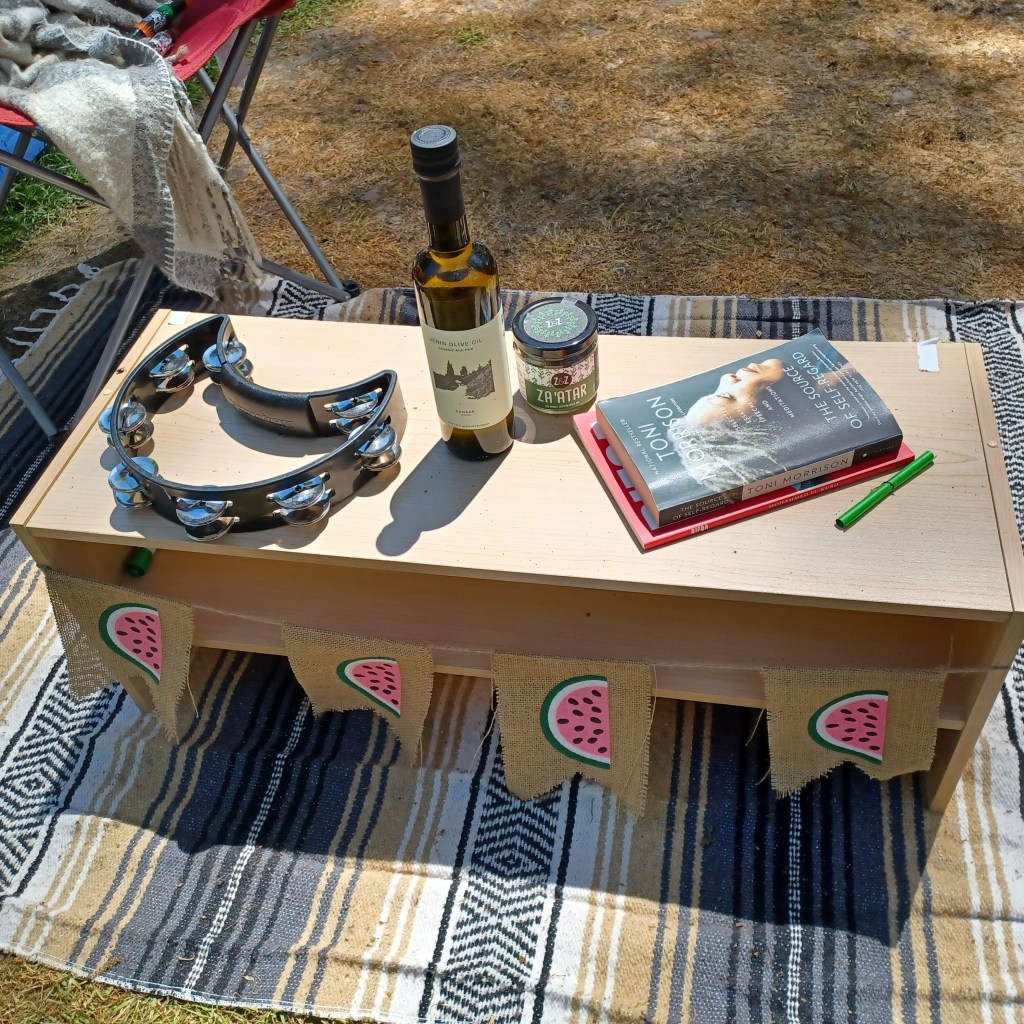
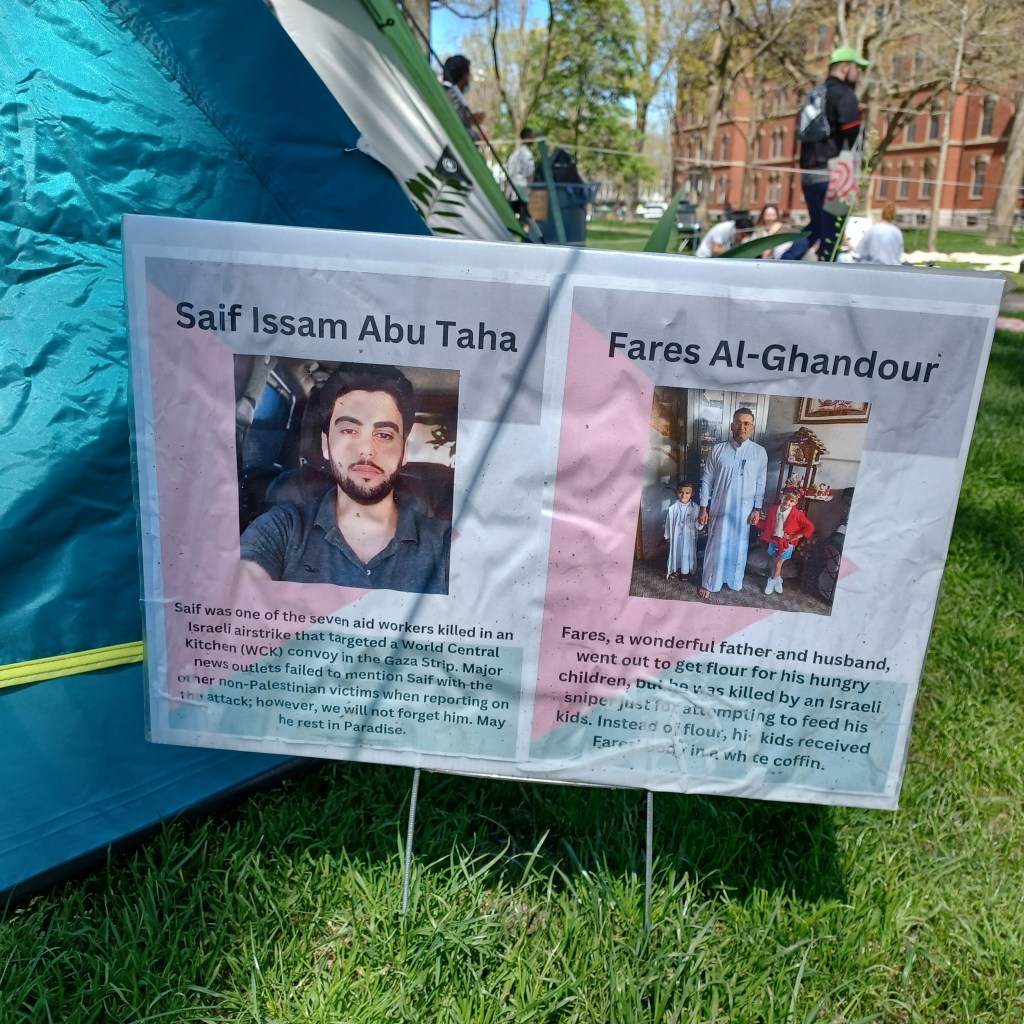
I hate America because racism, xenophobia (fear of strangers), and misogyny (fear of women) are so deeply embedded in our culture. Too many of us have accepted them as though there was nothing we could do about them. I hate America because we take democracy for granted and 40% of us don’t bother to vote. I hate America because we’ve been bullying the whole world, bragging about torturing people, terrifying the Middle East with our armed drones. And refusing to acknowledge climate change even after New Orleans and the wildfires in California. Not to mention keeping the pandemic going, all by ourselves if we have to, because…freedom?

I love America because of our ideals of equality before the law, free speech, and human rights. I hate America’s failure to live up to them. I love that so many of us are trying to finally make democracy real.