You can’t have a government “of, by, and for the people” if the people don’t participate. When Americans are distracted from politics, avoid learning about politics, or think all politicians are dirty so there are no real choices among them, our government does not serve the people. It only serves those who participate.
In 2010, the Supreme Court decided in the Citizens United ruling that money equals speech. They argued that limiting campaign contributions is the same thing as limiting our right to free speech. This unbelievably harmful ruling ensures that big money rules our elections. The rich can spend so much on campaigns that they drown out whatever ordinary people are trying to say.
Trump and his billionaires are the end result of a process that has been going on for decades. Ordinary Americans should be driving this car, but most have been too distracted or too cynical to do the job. Instead, the very rich have pushed us aside. They have taken the wheel of American politics so that they can just keep on getting richer. The politicians they put in power are the ones who will do what they want. This means lower taxes for the rich, higher taxes for the rest of us, fewer regulations, and less oversight, so they can get away with more monkey business.
Now Trump’s administration is in the process of destroying the working parts of our government. They are not trying to throw out the bathwater and keep the baby. They’re throwing the baby out too. Education? Medical research? Food safety? Consumer protection? Environmental rules that fight climate change? The billionaires have decided we don’t need any of that.
It’s much easier to destroy things than to build them. It took a long time and a lot of work to get our government to help people in crisis, take care of the elderly, educate children with special needs, and keep industry from spoiling our air and water. Now all the structures that were so carefully put in place to help ordinary Americans are being torn down as fast as the billionaires can manage.
For a long time, Americans have allowed ourselves to believe that we don’t have to participate in politics. What difference does one vote make, after all? The problem is that if millions of people think this way, it makes a huge difference.
Trump and his billionaire besties are driving this car right over a cliff. His tariffs make everything we need more expensive, not cheaper. He is turning our allies into enemies, and making friends with dictators. He is leaving our country at the mercy of the next epidemic, in spite of all we learned from COVID. Instead of negotiating fair deals for the resources we need, he threatens to take them by force.
It won’t be easy to take the wheel back from the billionaire class that has grabbed it. They are ruthless, they own most of the media, and they don’t care whom they hurt. They will lie, cheat, and use violence to keep themselves in power.
But that car belongs to us, the people of the United States. We have a Constitution for a reason. For all the faults of that document, it does insist that the country belongs to the people who live here, not just the rich and powerful. If we pay attention, if we decide to participate, we can take this country back.
It is tempting to sleep through this era of loss and destruction. But the only way to rescue our country is to wake up to our power to change things. Too many of us have left the driving to others. We need to take the wheel and steer ourselves back toward peace, justice, and a sustainable future.
I’m an American Jew, and this year the High Holy Days of my religion have a special, and terrible, meaning for me. Another year of violence in the Middle East has brought tragedy to millions, and contributed to a surge in anti-semitism around the world. Last Monday, I found some comfort in the company of others who feel, as I do, that our community should mark this Day of Atonement with more than personal acknowledgement of what we have done wrong.
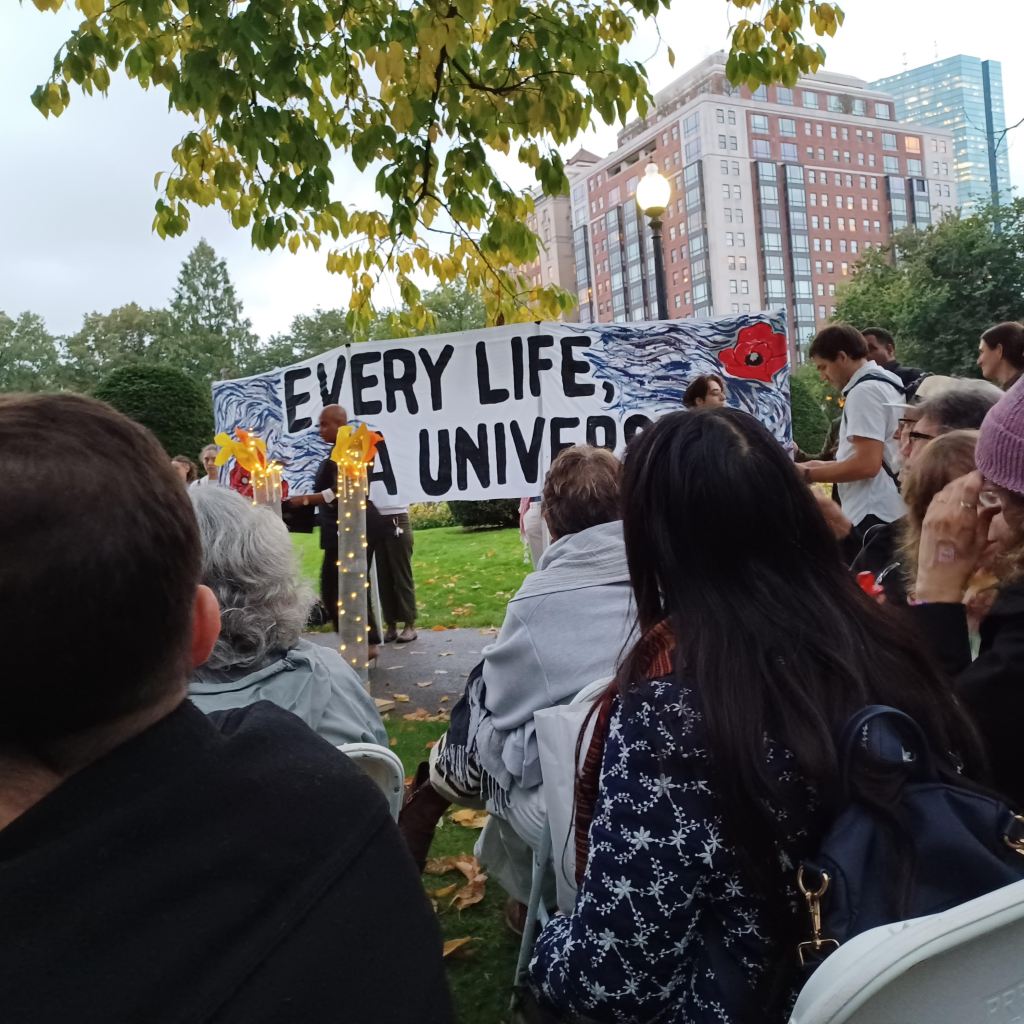
A year after a vicious Hamas attack on Israeli civilians turned long-simmering violence into open warfare, a couple of thousand non-Zionist Jews and our allies gathered in the Boston Garden. We met to grieve — not only for the more than 1200 Israelis killed on that day, and the hundreds kidnapped, but for the tens of thousands of Palestinians killed in the bloody year since then, and for the Lebanese who are now also under Israeli attack. The event was organized by IfNotNow, a group devoted to ending American support for Israeli apartheid and aggression toward Palestinians.
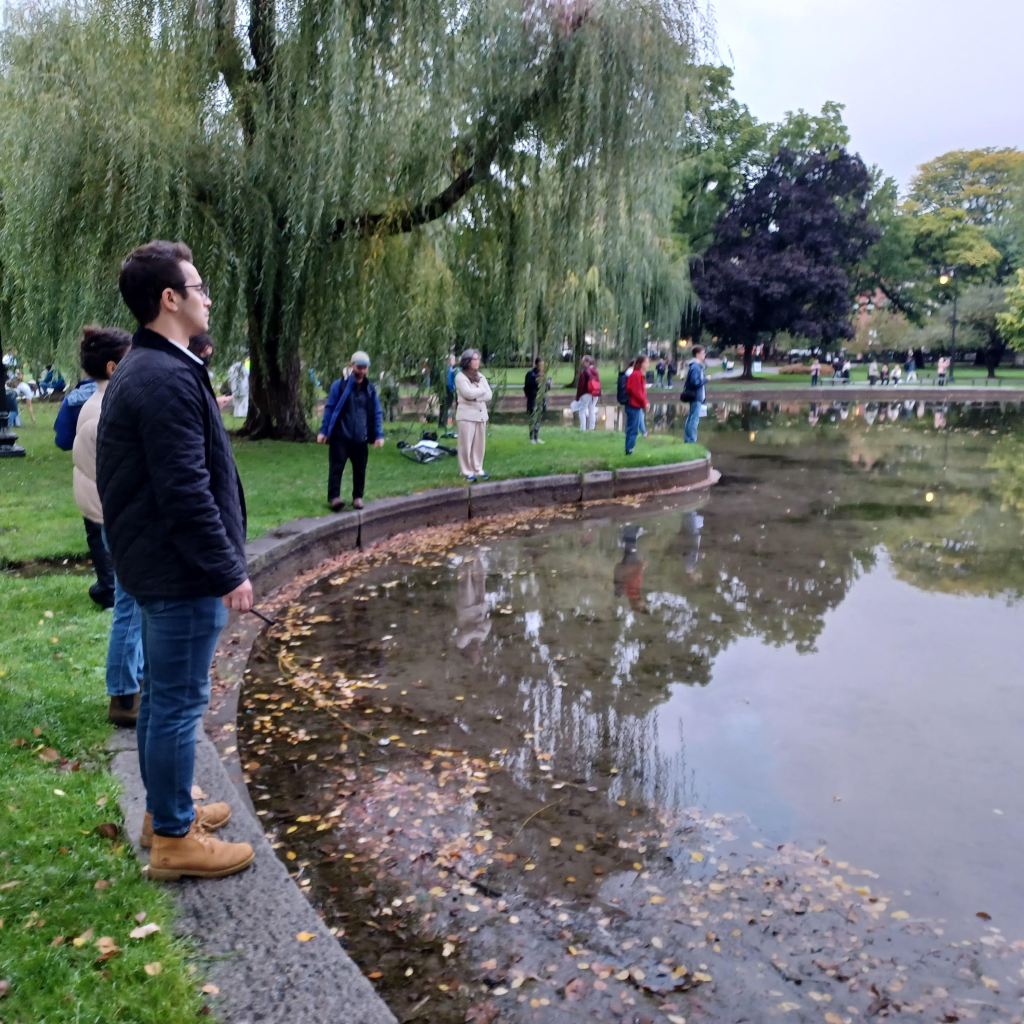
Late on the damp Monday afternoon of that sad anniversary, before most of the crowd showed up, a young rabbinical student led us through an ancient Jewish ritual called Tashlikh. This ceremony is performed during the “Days of Awe” between Rosh HaShanah – the Jewish New Year – and Yom Kippur, the Day of Atonement. One symbolically casts off one’s sins by throwing something in flowing water to be washed away. Usually people throw bread crumbs, but out of concern for the fish in the pond, we threw pebbles or dead leaves instead. The pond water wasn’t washing anything away, which also seemed symbolic to me.
The theme of the main event was “Every life is a universe”. Speakers included Rep. Ayanna Pressley, Rabbi Toba Spitzer, Imam Ahmad Barry, and Rakeea Chesick Gordis. That young woman gave eloquent testimony to losing close friends and family members during the Gaza war, including both Israelis and Palestinians. She spoke of drowning in grief, feeling overwhelmed by waves of it. Again and again, the speakers insisted: Jews cannot be safe if Palestinians are not free.
After an hour of speeches, prayers, and songs, rain began to drip through the trees. Mosquitos emerged from the mist over the pond to ensure our discomfort. Considering the suffering we were there to commemorate, nobody complained. At one point, volunteers handed out small strips of cloth we were to rip, as a sign of mourning, and attach to our clothes.
October 12 is the Day of Atonement in the current year 5785 of the Hebrew calendar. I believe that American Jews have a lot to atone for. I am not refering to personal sins; Jews are no more or less hateful, thoughtless, or selfish than anybody else. I mean the Jewish community as a whole. For the most part, we have supported Israel for the 76 years of its existence, no matter what it did. We have pressured the US to continue sending more than $3 billion a year in military assistance to Israel, and ignored what Israel did with all those weapons.
Ever since the Holocaust killed six million Jews in Europe and the Nakba displaced three-quarters of a million Palestinians in Israel, both sides have committed too many atrocities to list. The difference is that American weapons have turned the Jewish state from David into Goliath. Israel has become a paragon of military might. Nearly all of its people are or have been soldiers. They believe they are fighting for survival, which excuses all their violence as self-defense.
According to the United Nations, from 2008 through 2020, 5590 Palestinians were killed in the ongoing hostilities, compared to 251 Israelis. There are many conflicting estimates of the casualties since the founding of Israel in 1948, but on one thing they all agree. Far more Palestinians have died than Israelis. This conflict is deeply lopsided, and not only in lives lost. The longer it goes on, the more territory originally set aside for a Palestinian state disappears into Israeli hands. Even the rubble that was Gaza is likely to get rebuilt into beach towns for Jewish tourists.
Now it seems that many American Jews have decided to drop their indifference to religion and rejoin the Jewish community. During most wars, previously apolitical people tend to rally around the flag. This is “my country, right or wrong” time. Jews everywhere have been taught to believe that Israel, and not the Torah, is the central element of our religion. In many ways, Israel has become our religion.
After 9/11, the US squandered the world’s sympathy by starting two completely unnecessary and unprovoked wars. Instead of hunting down the gang of Saudi terrorists that bombed the World Trade Center, we invaded and occupied Afghanistan and then Iraq. We killed hundreds of thousands, and made millions homeless. Now Israel has squandered the sympathy it garnered after the Hamas attack by bombing the millions of Palestinians it holds captive behind walls and military checkpoints in Gaza and the West Bank. Most of those who survive are now homeless, and many are starving.
Zionist Jews, and most Israelis, believe that this violence is justified because it’s the only way to destroy the criminal gang that is Hamas. Yet this policy is doomed to fail. Violence begets violence. Every time an Israeli bomb kills someone, Hamas can recruit more members from among the people who loved them. Zionists blame Hamas for all the destruction on both sides, just as the most extreme pro-Palestinians blame it entirely on Israel’s decades of oppression and occupation.
The truth is that there is plenty of blame to go around. So long as we find war acceptable, we all must share the blame for the loss of so many irreplaceable universes. I am grateful to IfNotNow for giving us a chance to start the new year by acknowledging our part in the ongoing crime of mass murder. May the year to come bring a ceasefire, and healing to all who suffer. We must make peace. If not now, then when?
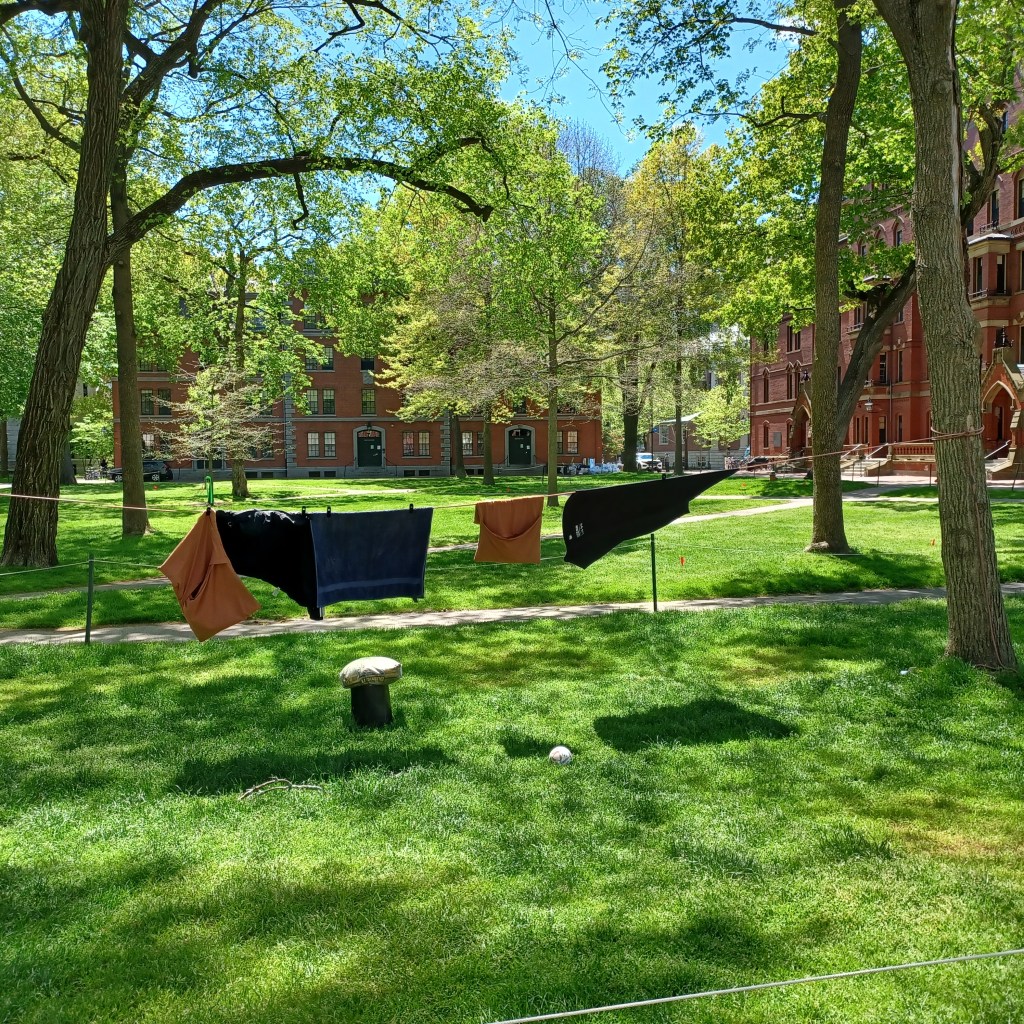
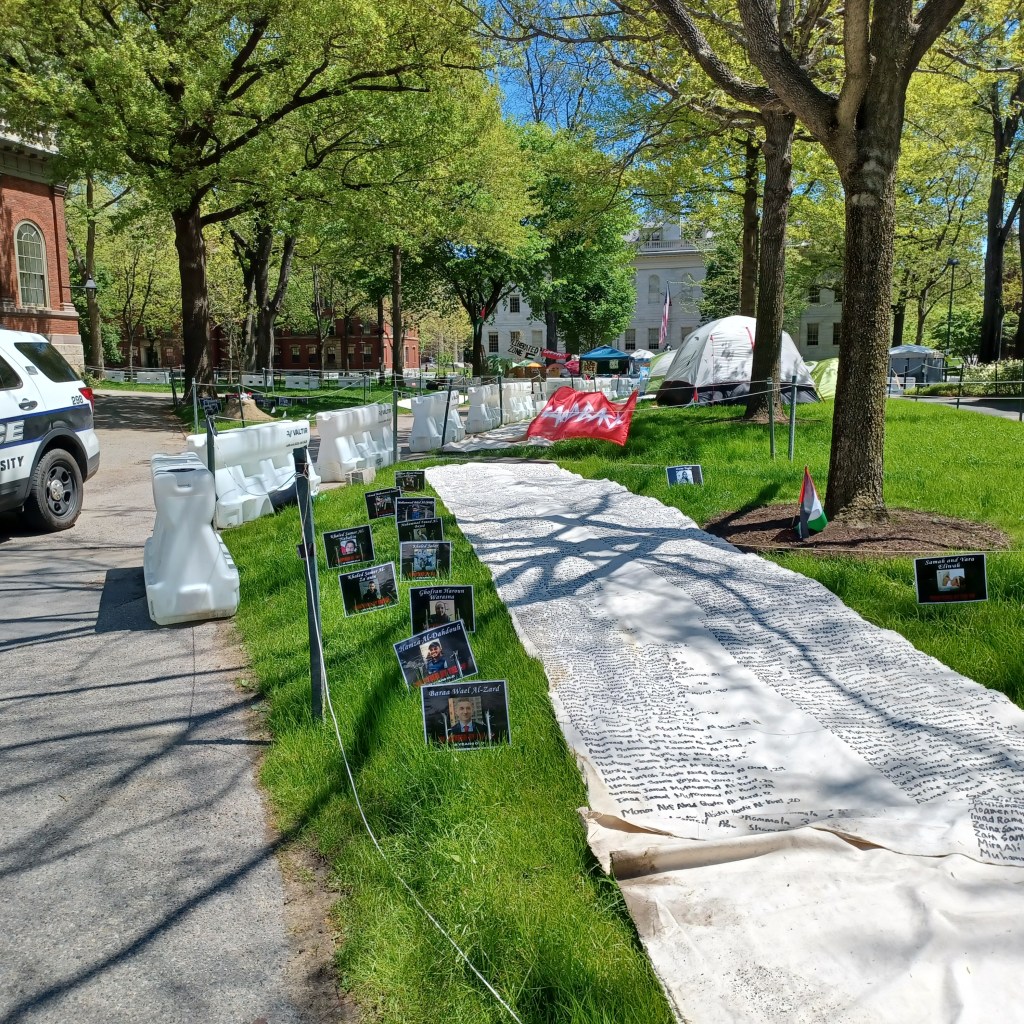
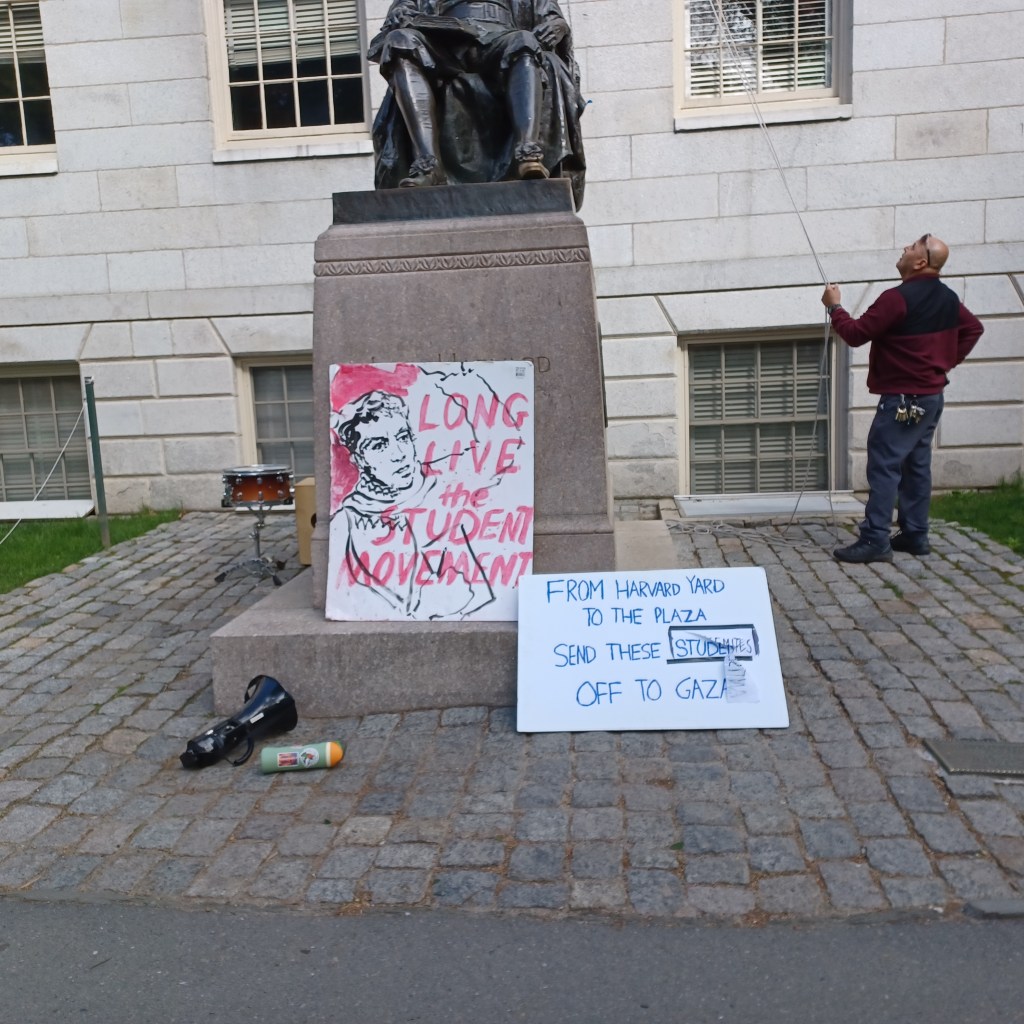
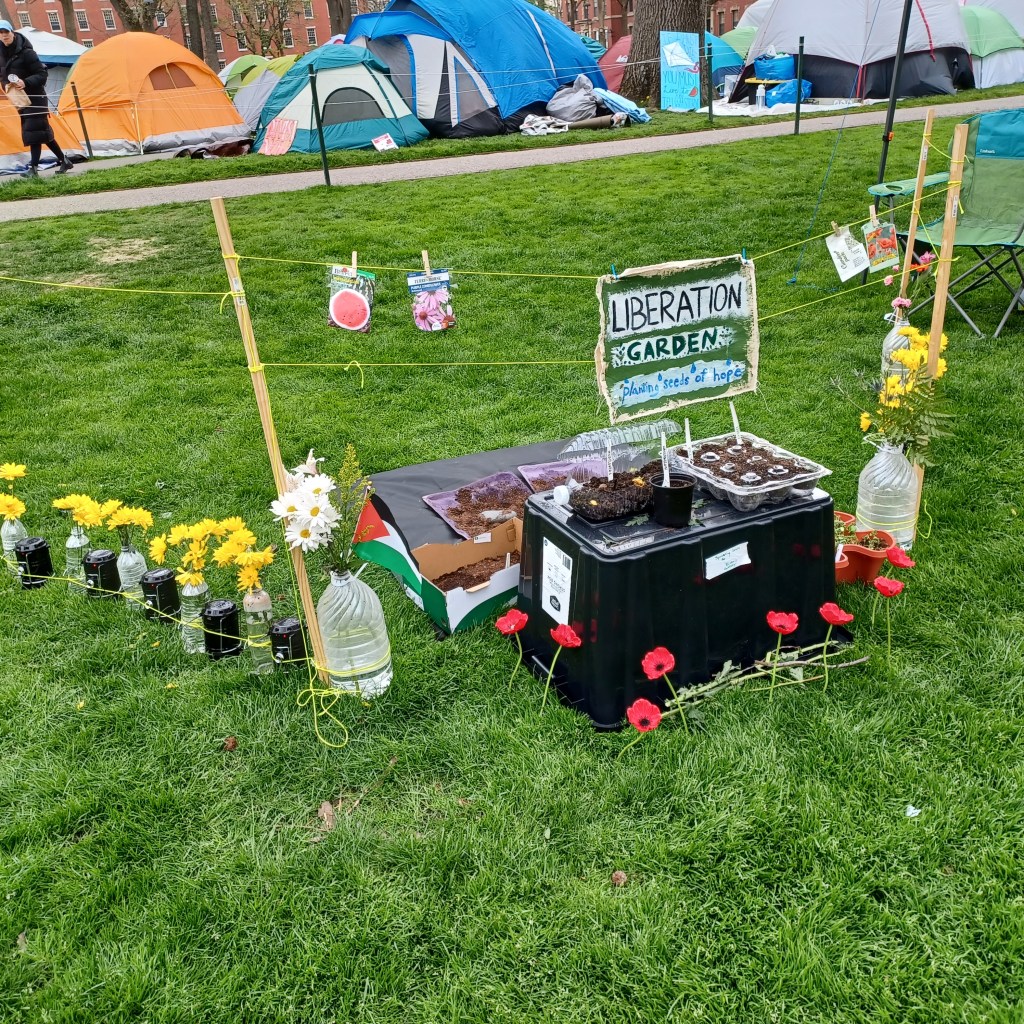
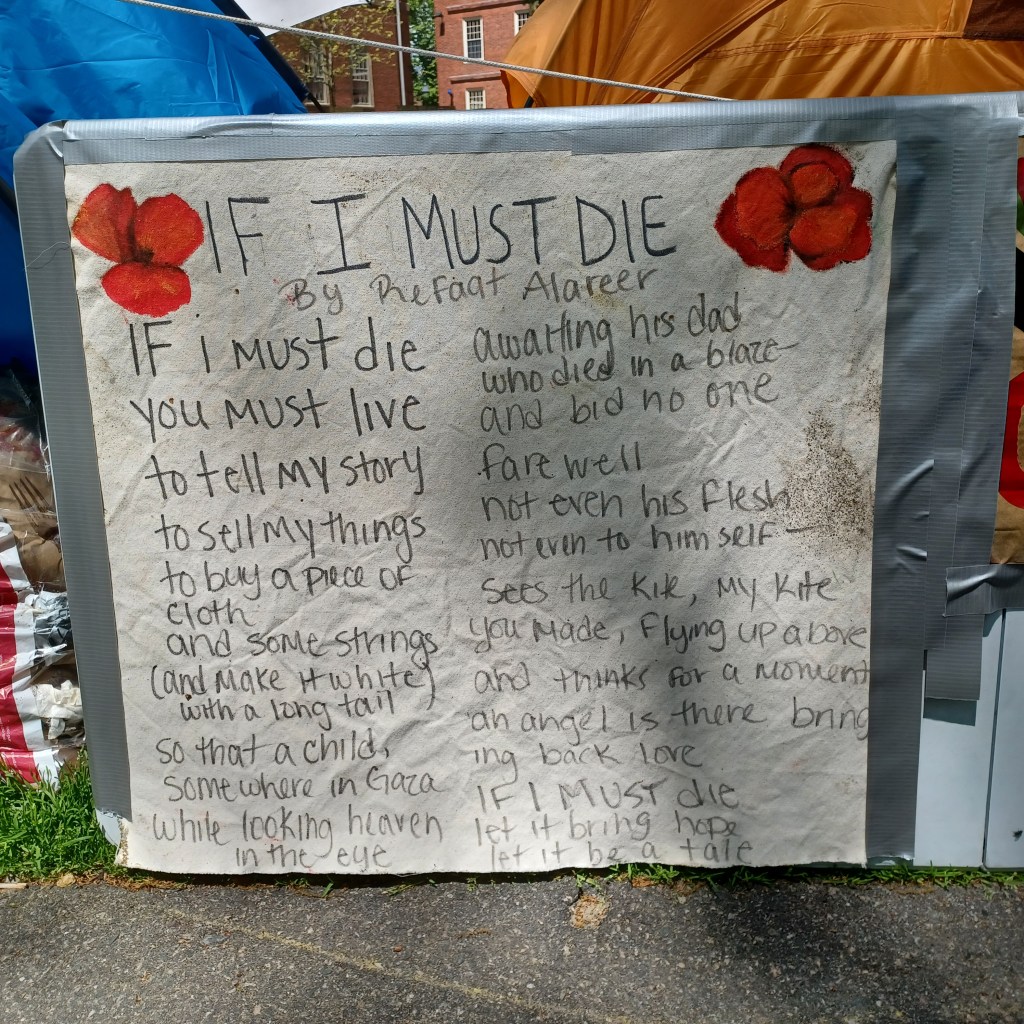
Yesterday, Mother’s Day Sunday, was the last move-out date for freshmen. Now the campus is eerily quiet. The only noise comes from riding lawn mowers, and a supporter of the protest – not obliged to follow its policies – who is standing outside the gates with a megaphone, shouting Free, free Palestine! He calls out the University for its complicity in war, fossil fuels, and Big Pharma. Spread out on the lawns near Johnston Gate are at least five very long scrolls of canvas with the names of the dead in Gaza.
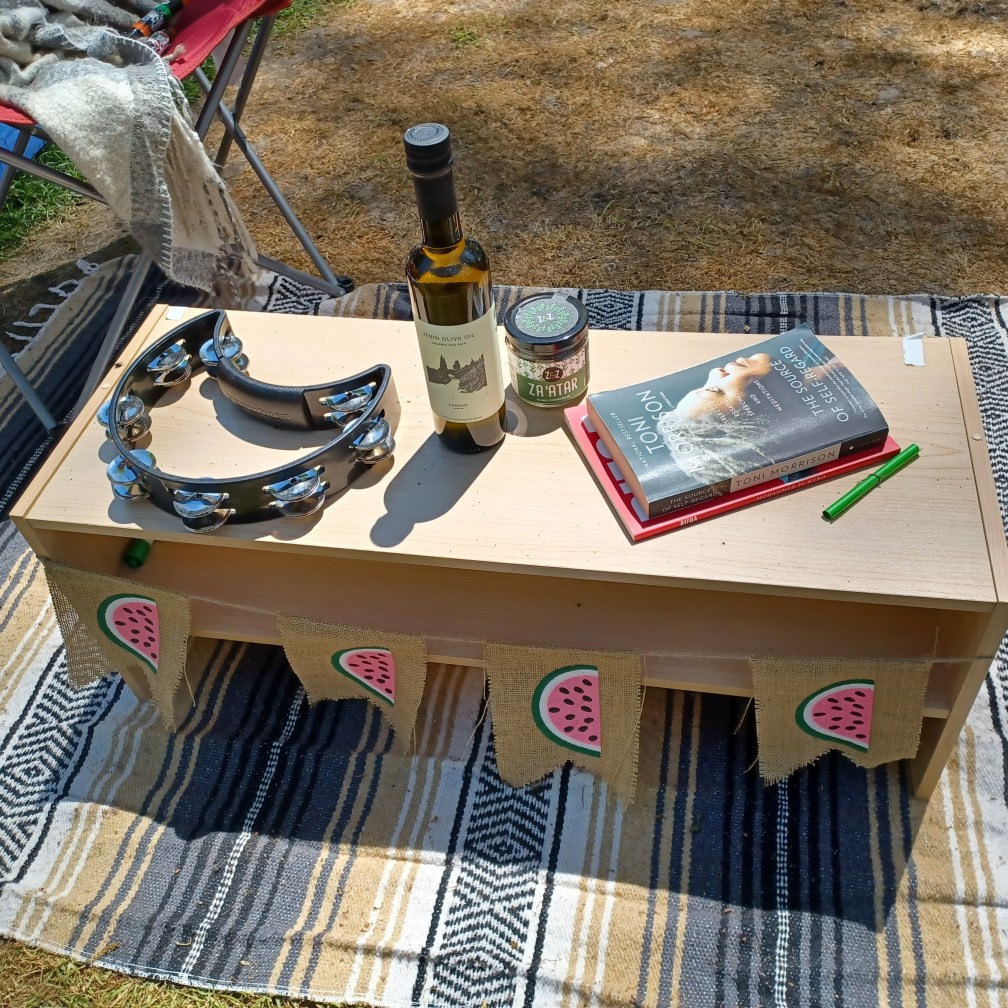
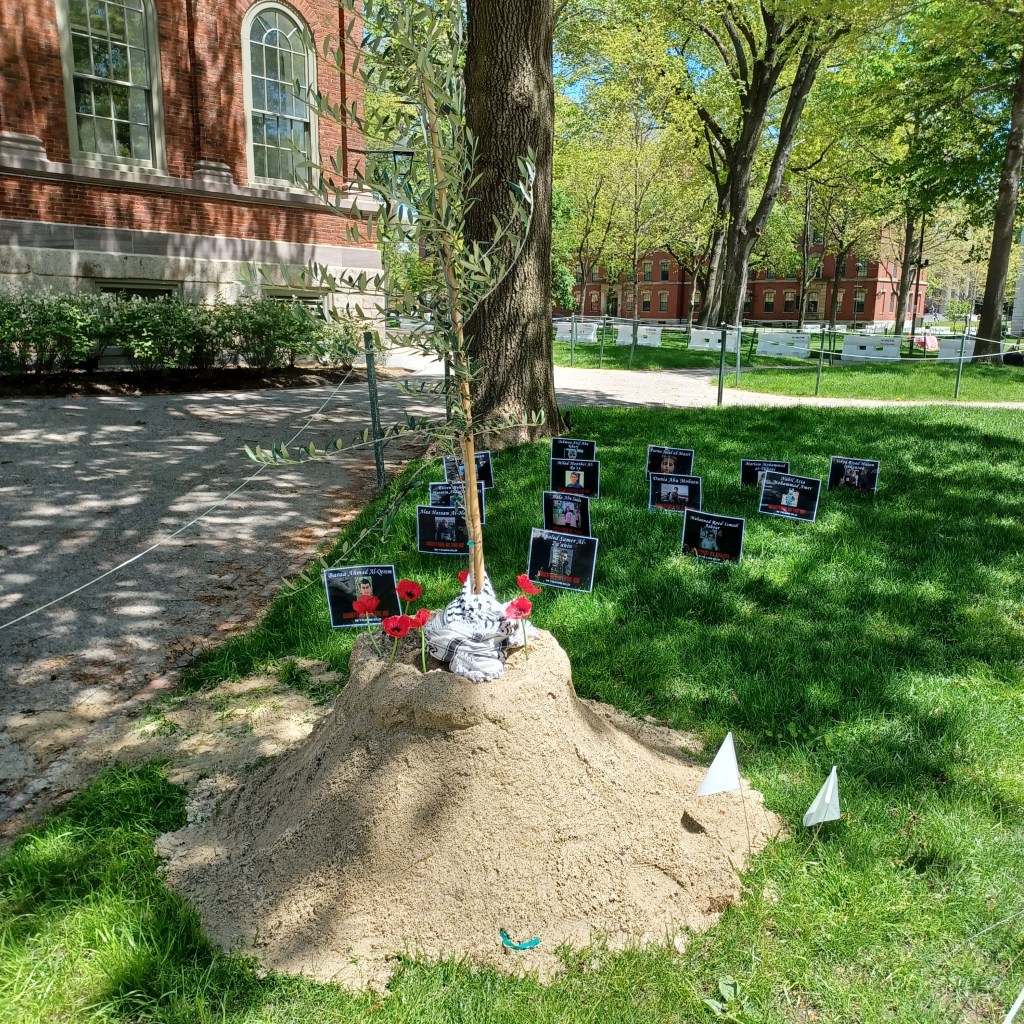
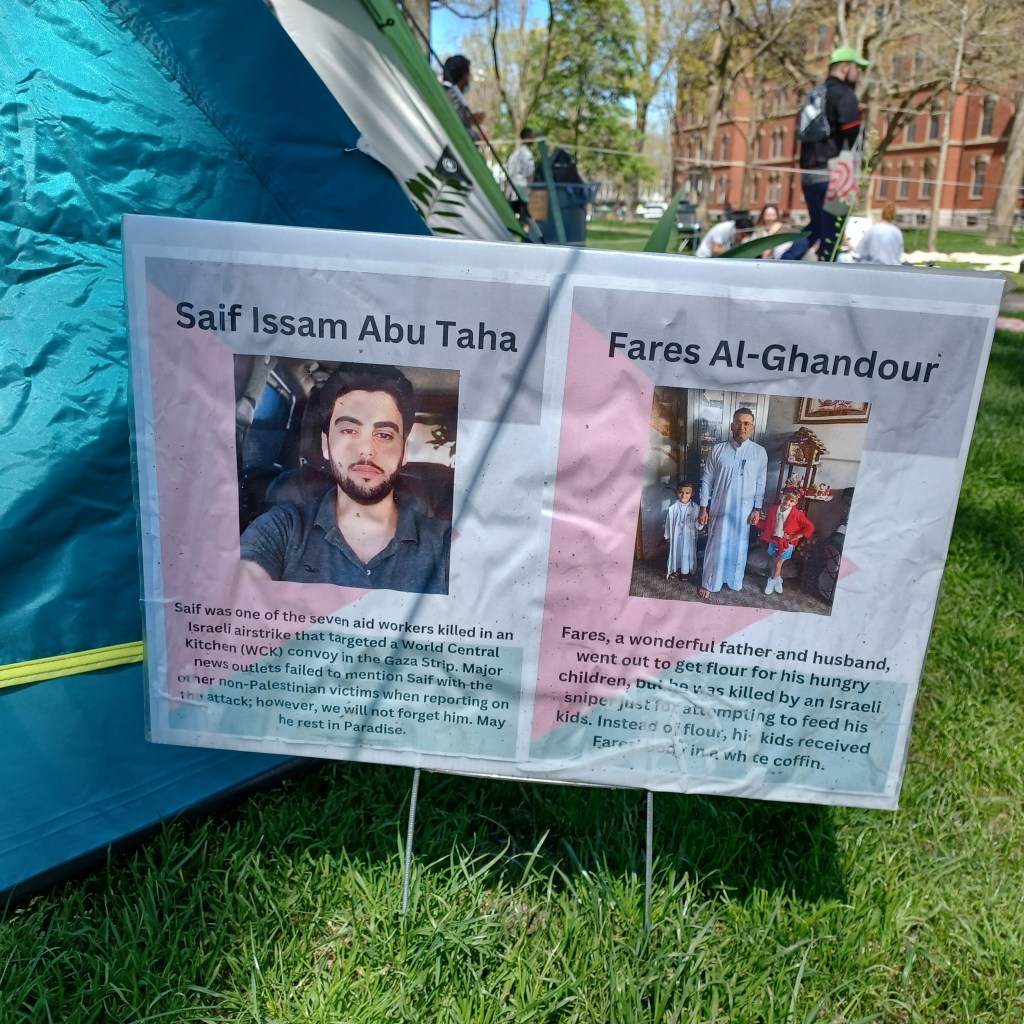
The protesters have planted an olive tree outside Harvard Hall, surrounded by placards bearing photos of people killed in Gaza, their names and ages, and the phrase “Martyred by the IDF” (Israeli Defense Forces). The placards bearing photos, names, and ages of people martyred in the October 7 Hamas attack that were in this area last week are no longer in view.
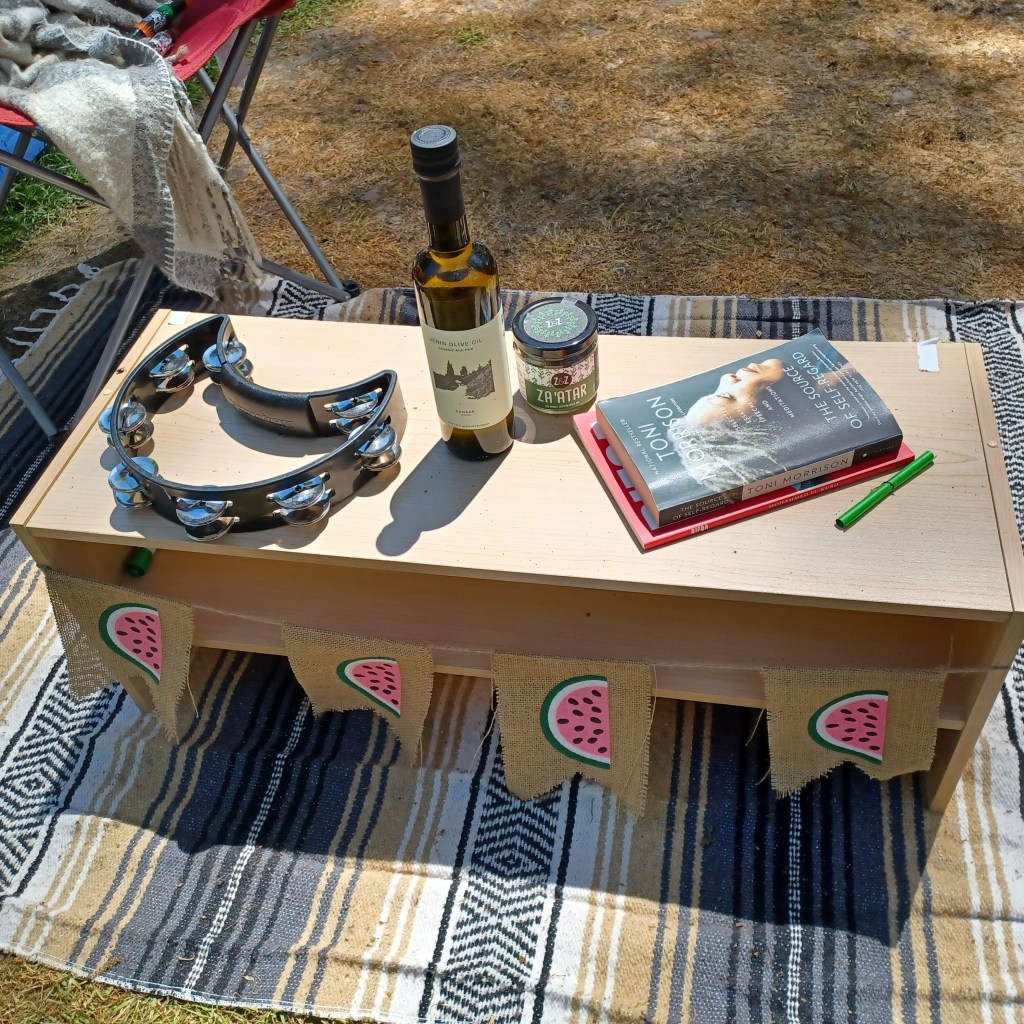
All the campers but one are talking inside a gazebo-style tent with one wall covered by the sign “Harvard Jews for Palestine.” A supporter tells me they are taking a “wellness day”. They’re discussing what to do next. The University is sure to dismantle the camp before Commencement, Harvard-speak for Graduation, which is coming up in ten days.
I missed a lot of excitement on Saturday. There were marches and rallies as scheduled, with about 200 people attending. There were also unplanned events. Some marchers sat down in Peabody Street, blocking traffic for ten minutes. They spent two minutes in silent meditation.
During all that commotion, somebody broke the big padlock on the main gate into the Yard. Evidently they decided to open up the Yard to outsiders with a bolt cutter. This too was not something the group had agreed upon. Nobody managed to get in, however, before security people installed a wire lock to close the gate again.
Now, while the students talk in the gazebo, about a dozen faculty and staff supporters form a circle outside the camp perimeter. A camper wanders by on his way to the tent. “Cookies? There are cookies?” A supporter has baked them in quantity. “Everyone needs cookies,” she says, with authority, “all the time.”
A student tells the group that Saturday was supposed to be more like a party, with music and food. But somehow, he says, “the plan ended up shifting for reasons I don’t know.” I think of the Paul Simon song “Peace Like a River,” about anti-Vietnam War protests: “And I remember misinformation followed us like a plague. Nobody knew from time to time if the plans had changed.”
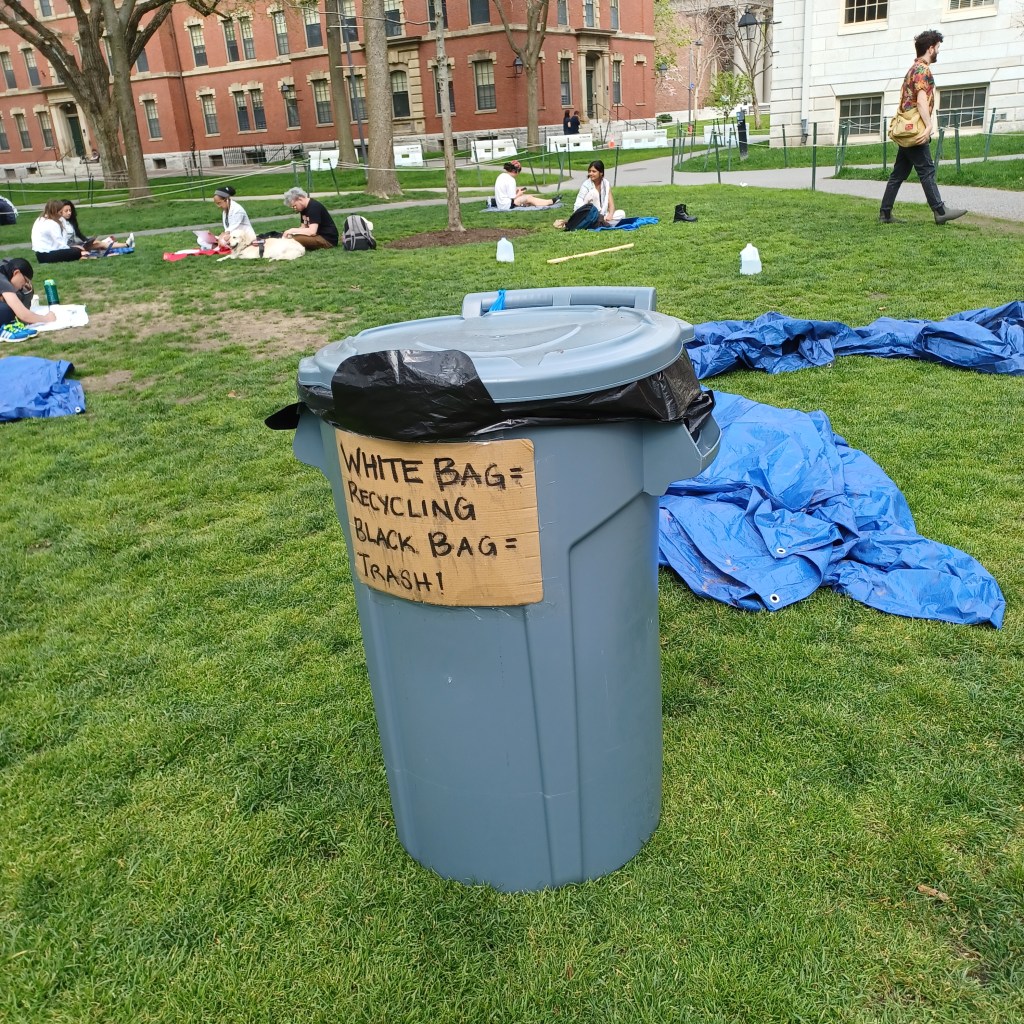
The student also says that there has been a lot of struggle within the encampment, a lot of dissension, which has been exhausting for them all to deal with. The protesters include both Jews and Palestinians. I imagine that some are pushing for compromise and some for more radical action. However they continue to co-exist peacefully and collaborate in running a clean, quiet, protocol-following camp.
I read a few Crimson articles on recent developments. Wednesday night, protest representatives met with College Dean Khurana and HU President Garber, among others. The University offered to hold further conversations with the protesters and let them avoid disciplinary action if they disbanded the camp, an offer they declined. They had offered a lower bar than divestment from Israel, such as the establishment of a center for Palestine studies, but they felt the University had not come close to meeting it.
Then Garber met with the head of the Anti-Defamation League, Jonathan Greenblatt, to discuss anti-semitism. Greenblatt conflates anti-Zionism with anti-semitism, and praises Harvard for its unwillingness to entertain the protesters’ demands. Shortly after this meeting, the first round of 20 students were placed on involuntary leave. By now, more than 60 students are facing disciplinary action. The Harvard Out of Occupied Palestine Instagram page said this showed that Harvard had capitulated to outside agitators.
I sit in dappled shade with the faculty and staff group. One of them has made bookmarks with space for messages to the protesters. She says some could use a little “parental love,” since they’ve been having difficult conversations with their families. They’re stressed, unsurprisingly, and not sleeping well. A camper asks if anybody could help them charge some of their small generators. “We need power,” he says, to laughter.
Around 3:30, seven Harvard police and security guards circle and enter the camp, filming the students. One camper tells supporters on the steps, “They’re taking pictures without our consent. Hide your faces!” I don’t need to hide mine, so I smile and flash the peace sign.
I start to leave for the day, but then I hear a commotion outside the gates. It’s a pro-Israel demonstration; tonight is the start of Israel’s Independence Day. A wild-eyed man speaks to the small crowd through a megaphone. I learn later that this man is a Columbia Business School professor, Shai Davidai. He says, “What’s at stake here is American values, which are also Israeli values. Freedom, democracy, peace. Five US citizens are being held by Hamas, the same people that they [nodding toward the encampment] are cheering on.”
This is where I lose my self-control. I letter a sign on a leaf of my notebook: “Protest does NOT cheer on Hamas. We mourn all these needless deaths.” I stick it through the bars of the iron fence. Alex, from CAMERA (Committee for Accuracy in Middle East Reporting in America), holds a small Israeli flag in front of my sign, trying to hide it. He says I’m delusional. Some pro-Palestine protesters are standing on the curb, waving Palestinian flags and chanting. When the Israeli speaker starts to list names of Hamas victims, I wish they would stop chanting for a few minutes, but they probably don’t even hear what’s going on.
The pro-Israel group sings the Israeli and American national anthems. They wave Israeli and American flags. The speaker taunts the pro-Palestine group, which is chanting “USA, USA, how many kids did you kill today?” Why don’t you honor your own country’s flag, he asks. One student turns around and snaps a smart, ironic salute.
After the rally, Davidai speaks at length to a Crimson reporter, Frank Zhou. I hear him claim that Jews and Israelis are not safe around the encampment. I try to tell Frank that I have photos of a dozen pro-Israel demonstrators entering the middle of the camp, singing songs and chanting. Nobody bothered them. Frank seems distracted since Davidai does not stop talking at him. When his article appears in the Crimson, it reports what Davidai said, without investigating or refuting any of his claims. I certainly believe Jews have been experiencing anti-semitism on campus; unfortunately it is as endemic to our society as any other form of racism. The encampment, however, has not been practicing it.
When I go back to rest on the steps of University Hall with other camp supporters, a student comes over and delivers the gentlest possible rebuke, reminding us (not looking at me especially) not to engage with counter demonstrators. I am embarrassed. The students have shown tremendous discipline and self-restraint. I failed to show equal maturity, and egregiously violated camp protocol. I think most of them agree with what my sign said, but I had no right to speak for them.
Now I hear on the news that the students have agreed to dismantle their camp immediately, and the University has agreed to rescind their punishments. I feel proud of both the protesters and the University. Protests won’t end so long as the misery of Gaza continues. But Harvard and its students have managed to close this phase with a degree of dignity and mutual respect that few other universities have achieved. To this, I can only say, Shukran, and Mazel tov.
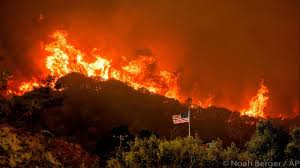
It’s the fall equinox today. Day and night are balanced. California and Oregon are burning. The earth is out of balance, and so is the United States.
The Awesome and Notorious RBG finally died, 45 days before the election. Trump will ram through some anti-abortion right-wing nutjob for the Supreme Court, and McConnell will rush them through the Senate confirmation.
Some people are still holding out hope that Susan Collins will vote no. They always hope she’ll do the right thing, and she never does.
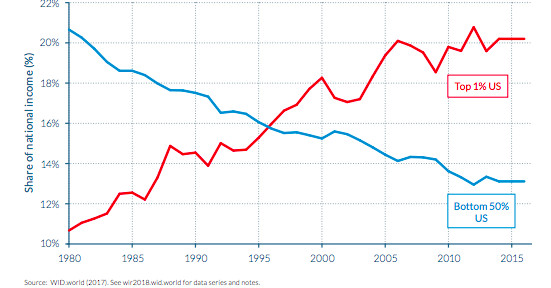
There’s a reason people are almost as angry with establishment Democrats as with the completely corrupted and spineless GOP. Neither party has done much for working people in the last 40 years. Obamacare helped; but Obama was a negotiator, not a warrior. The Republicans stopped him cold two years in.
Meanwhile the rich have kept getting richer, and the rest of us have gotten poorer. The USA’s record concentration of wealth has been stolen from ordinary workers. We need a wealth tax to get it back.
Don’t expect Biden to give us what we need, if we’re lucky enough to have him win the election. The only way we’ll get health care, affordable housing, student debt forgiveness, a Green New Deal, and significant change to our policing and prison systems is if we insist on it. The American people must lead.
Make a sign. Write an email. Tweet your legislator. The real struggle starts after the election.


 Alice T4