There will be no way to avoid a succession of horrors in the coming four years. It’s no use waiting for the Democratic Party to tell us what to do. It has become a creature of corporate interests, out of touch with the needs of the non-rich. We have to tell the Party what to do.
The non-profit sector is a mess of single-issue organizations competing for attention and money. We are not single-issue people. Whether you are on a board or just a member, pressure your group to join other groups in as many coalitions as it can manage. All our issues are connected under the banner of peace, justice, and a survivable environment. Progress on any of our goals helps us to achieve all of them. Solidarity is key. We must stand up for one another.
More than changing institutions, we need to change minds. Leave your comfort zone. Don’t stick to preaching to the converted. If you can get access, go on Fox or the bro podcasts. Wait in line for a call-in radio talk show. Try to reach new audiences. Don’t talk down; persuade. Explain what you believe, and be ready to back it up.
We need big change. That means our actions must be non-violent. Violence is not change; it’s just part of the same cruel culture that is wrecking our world. If you are part of a protest, do whatever you can to keep things civil, no matter the provocation.
Expand your social set. Meet people who are not like you. Listen to them with respect. Everyone has something to teach. You don’t have to leave the country to find whole new worlds to explore. Besides, we need you here.
Most of all, keep yourself and your friends from wallowing in despair. If we think there’s no hope, we’ll stop trying, and then there really won’t be any hope.
I’m 76 years old. I’ve been homeless, crazy, sick, lost people I love, seen good things turn to shit. And I still believe in magic.
I believe in the magic of loving kindness. I have seen it, felt it. Tried to practice it. And I’ve been watching a long time, and it works. I’ve seen it work.
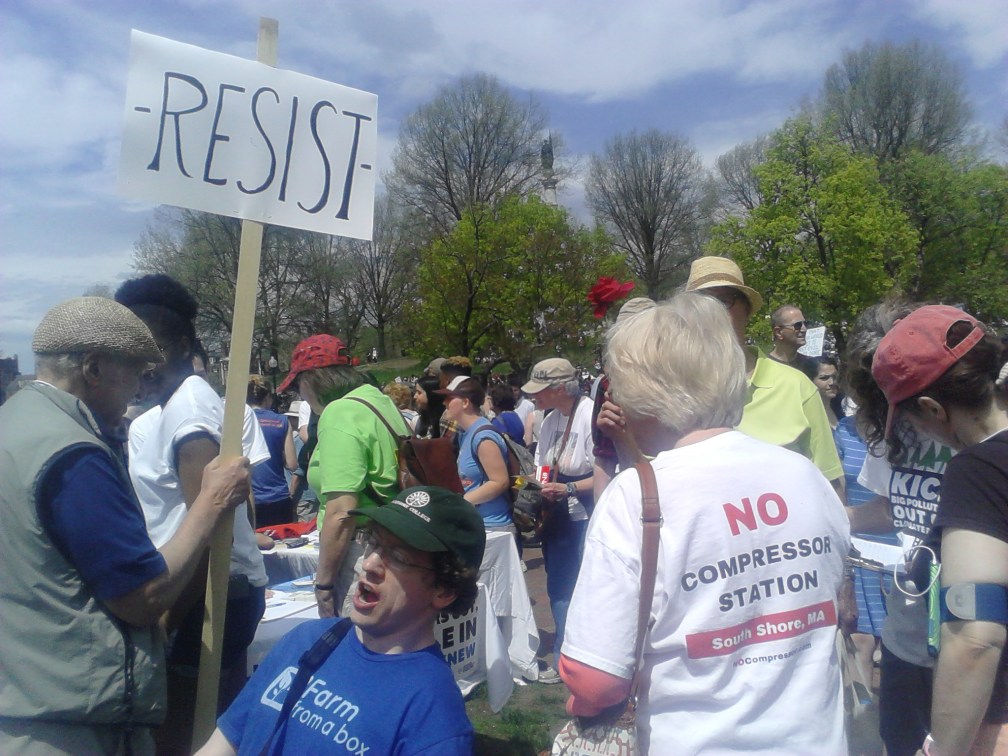
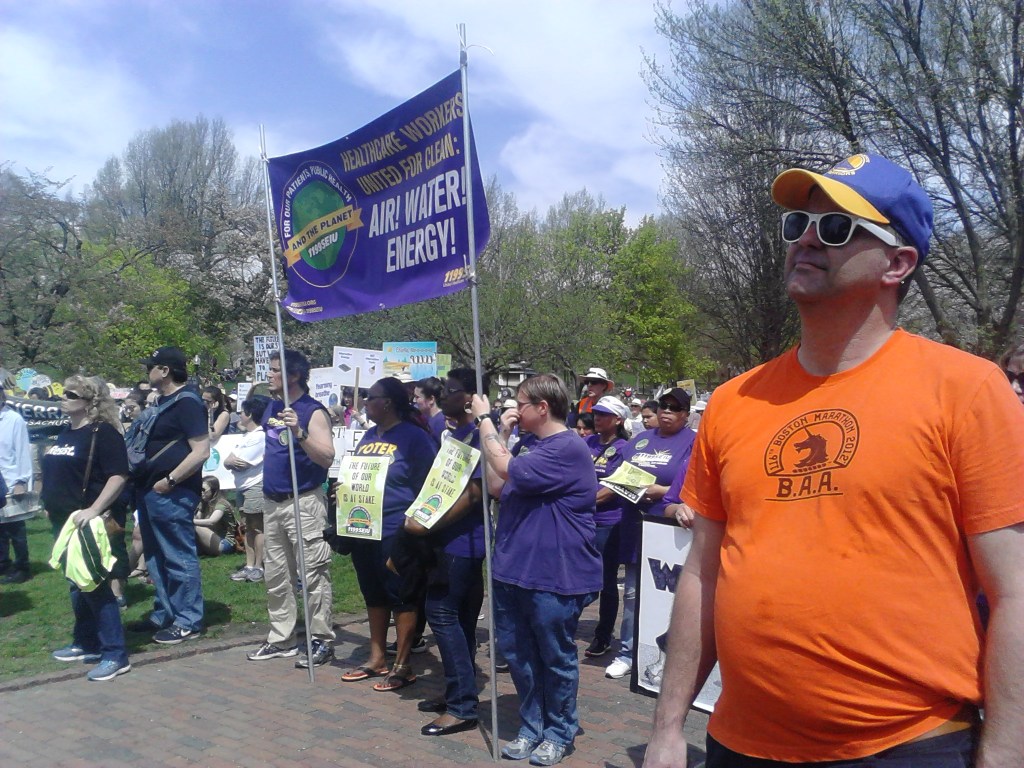
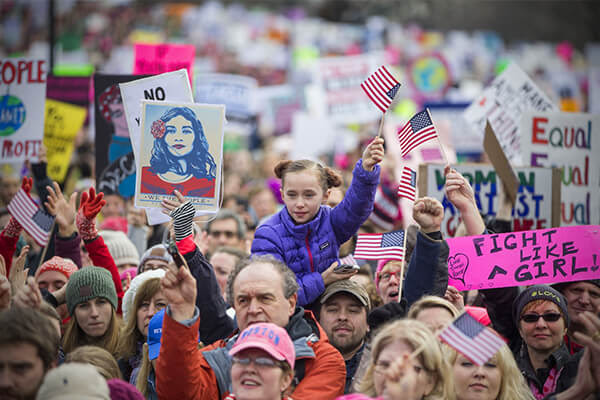
I felt it in the streets in the ‘60s and at protests and vigils and marches ever since. For every useless war, every awful court decision, people come out in the street to say no together: No, please, not again.
I’ve felt that magical fellowship in congregations of many faiths, at neighborhood barbeques, at music and art events, parks, and beaches. I even felt it once in the Manhattan terminal of the Staten Island ferry, when a woman’s parrot got loose and many teams of strangers instantly formed to get it back.
The meek are everywhere. We take comfort in one another’s presence. We get along peacefully. We’re all colors, genders, religions. We exist in every country.
Some big ape starts hooting and beating his chest, and all the other big apes start hooting and beating their chests. Usually it’s just noise, and boys marking their territory, but sometimes it gets serious and leads to war.
This has nothing to do with protecting mothers and children. It’s anger, insecurity, arrogance, and pride, all the worst parts of our nature, roused up, encouraged. Feeling things are going their way, the big apes can strut their supremacy. They have the power now; they think it’s done. But this is not over.
We are the people of peace, and we must win. Magic lives in our hearts. The secret is to practice it together, in solidarity, across every issue, and to never give up.
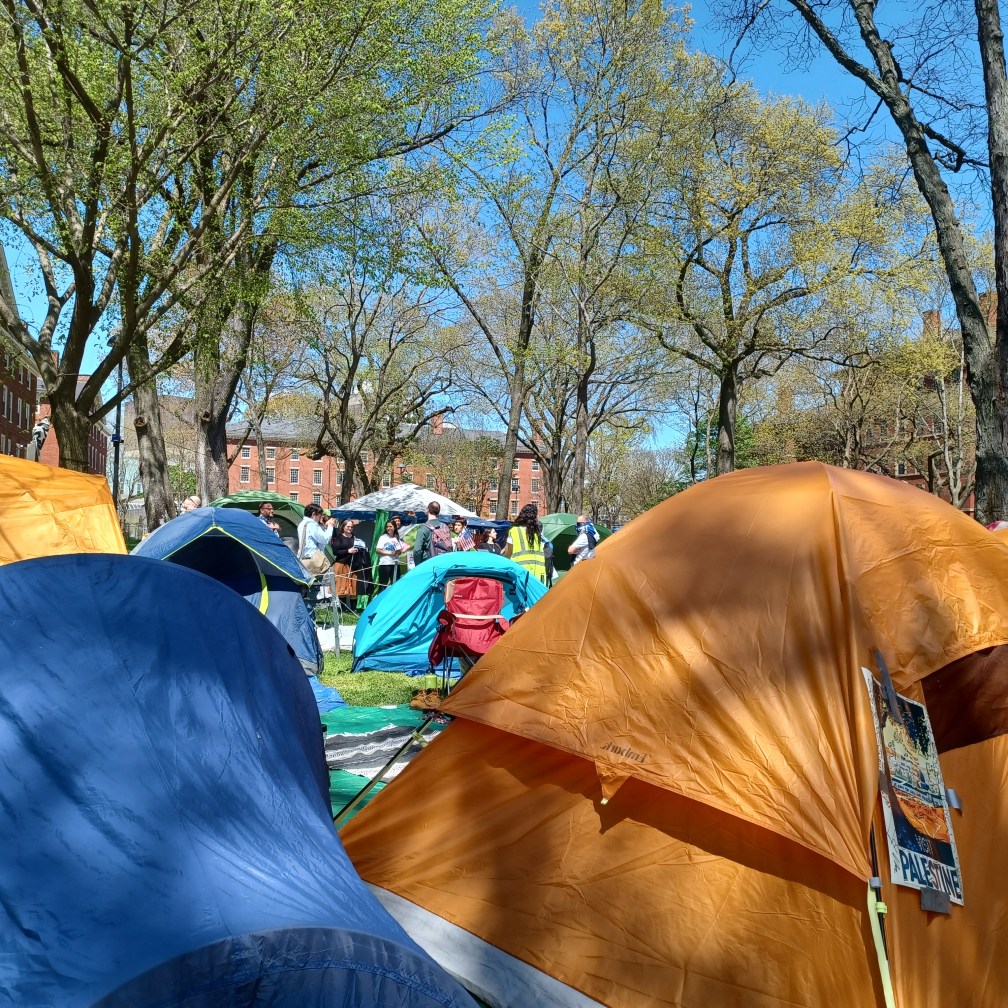
When I left Medford, it was a warm sunny day. In Harvard Square, it was chilly, damp, windy, and overcast. The mood of the encampment was equally gray. The students had just received a warning from the Ad Board that if they continued to camp outside University Hall they would face serious consequences. They were busy texting their family and friends, and possibly lawyers and media as well. I was there most of the afternoon from around noon until past 4 pm, and nobody was shouting, chanting, or using a bullhorn. There was one very interesting session on Palestinian textiles, especially the kaffiyeh and embroidery (tatreez), attended by half a dozen women.
If people are concerned about a kaffiyeh being draped over the John Harvard statue, I would remind them that it is an ancient Harvard custom for frat boys to piss on it.
I tried to respect the community norms. First I spoke with a nice young woman who was patrolling the perimeter of the camp, to find out with whom I should speak, as a friend of the camp and not a member of the media. She promised to find me a member of the outreach committee. Meanwhile I took photos, careful not to include anyone’s face.
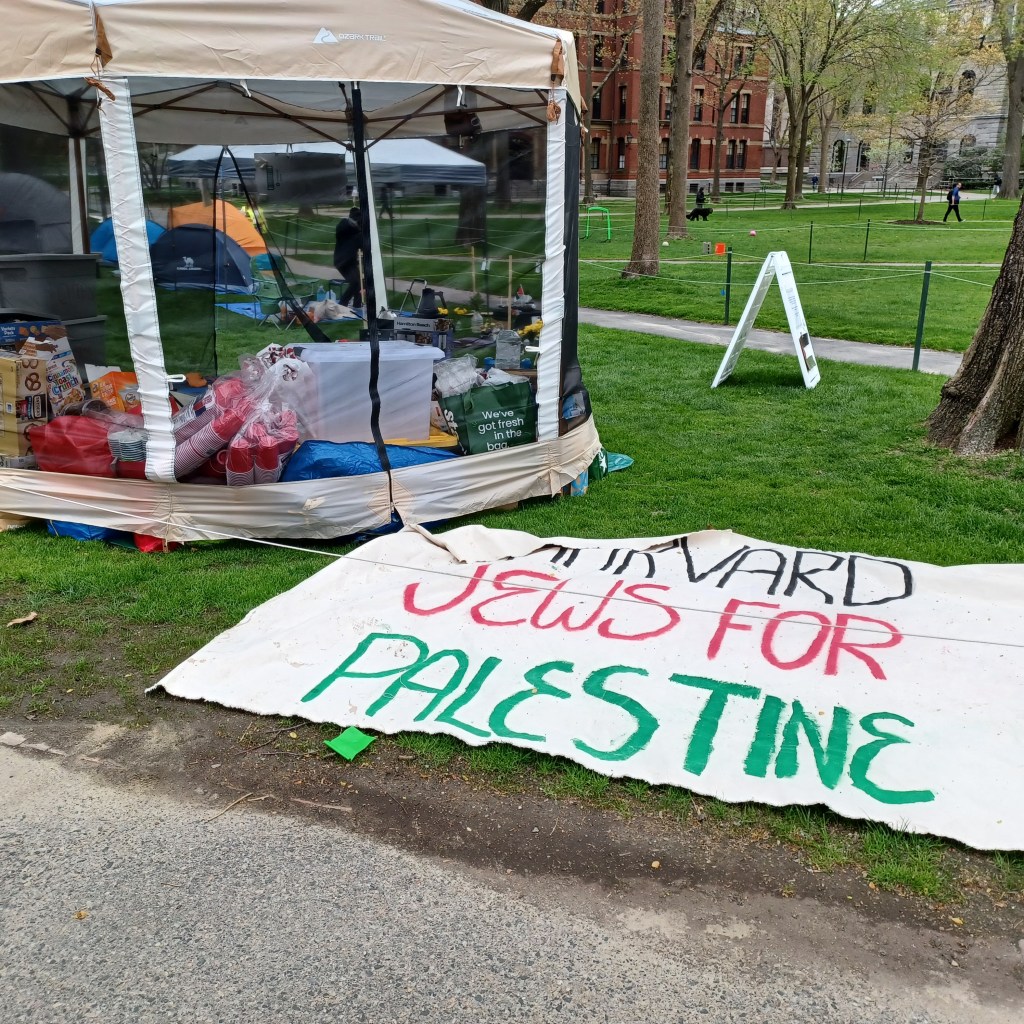
The signs outside the tents were hardly combative. Demands were posted, for HU to disclose and divest from its investments in Israel, and to drop all charges against students for their activism. I doubt any of the protesters expect these demands to be met. Other signs said: While you read, Gaza bleeds; Nationalism is Chametz (Hebrew for food prohibited on Passover); No Justice, No Peace, Palestine will never walk alone; Harvard invests in Palestinian death; and a big banner saying Harvard Jews for Palestine.
As for the slogan “From the river to the sea,” it first appeared in the original charter of Israel’s Likud party, where it did not refer to a hoped-for multi-ethnic democracy.
I chatted up several people while I waited. I asked if any administrators had opened a dialogue with them; they said not yet, but they were trying to negotiate something.
The students are risking their academic careers, and probably the wrath of their parents. As always with student protests, they are among the University’s most thoughtful, serious, and conscientious affiliates. They have a lot to lose and nothing to gain, on a personal level. What is the administration afraid of? Losing Zionist donations; and losing even more face than it has since it bumped its first Black president over…not much. Looks like somebody could go out with a handheld mic and just let people talk.
Finally I got to speak with one of the organizers, a Palestinian freshman named Mahmoud. He and many others have been protesting since Israel began its crazy over-reaction to the brutal Hamas attack in October. He said “The administration doesn’t understand that repression fuels us to fight harder.” The community is committed to non-violence, he told me.
As I started to leave, a man approached the camp wearing a kippah and a scarf with Stars of David on it. The perimeter-walker I first met was tailing him, much to his annoyance. She wouldn’t talk to him, which he thought was rude; I agreed, but I pointed out she was probably following camp protocol, and the idea was certainly to protect both him and the protesters. I made four or five rounds of the camp with this guy and the very determined young woman. She had probably never been called rude in her life. She couldn’t talk to the guy; he refused to tell me anything about himself or his opinions since he thought she was recording him; so I talked to him. As usual in such discussions, we got nowhere, but we parted on friendly terms. I walked him out the library gate.
5.2.2024
An old colleague of mine was gracious enough to meet with me for half an hour yesterday. She’s a very sweet, thoughtful person, and we were glad to see each other again. I asked her if the administration had established any dialog with the protesters. She couldn’t tell me details but said there were talks going on quietly in the background. She told me some students were feeling a lot of pressure from both peers and outside forces, and were afraid to speak out. We agreed on the nature of the encampment – nonviolent, disciplined, and committed – and on the need for the students to come up with some achievable goals.
The protesters’ three current demands, set by the national movement, can and will not be met. The University certainly will not disclose, much less divest itself of, its investments in Israel. It still hasn’t divested from fossil fuels, and many of us have been working on that for decades. It took forever to divest from South Africa during Apartheid. The third demand, for amnesty for student activists, can’t be met before they even go through the disciplinary process.
So I went back to the camp to tell them the little I had gleaned from talking with my colleague.
The weather was warm and sunny, and the mood seemed lighter accordingly. My perimeter-walking friend told me everybody was happy I had talked (and talked) with the counter-protester on my first visit, since their camp has agreed not to engage with provocateurs.
I tried to convince a few protesters to have the group consider setting goals the University might actually meet. Maybe teach-ins, or listening sessions, or moderated debates could be small steps toward spreading their understanding of the war in Gaza and the history of Israel/Palestine in general. While we were talking, I noticed Dean Khurana on the outskirts of the camp. The students said he’d visited before but wouldn’t talk with them.
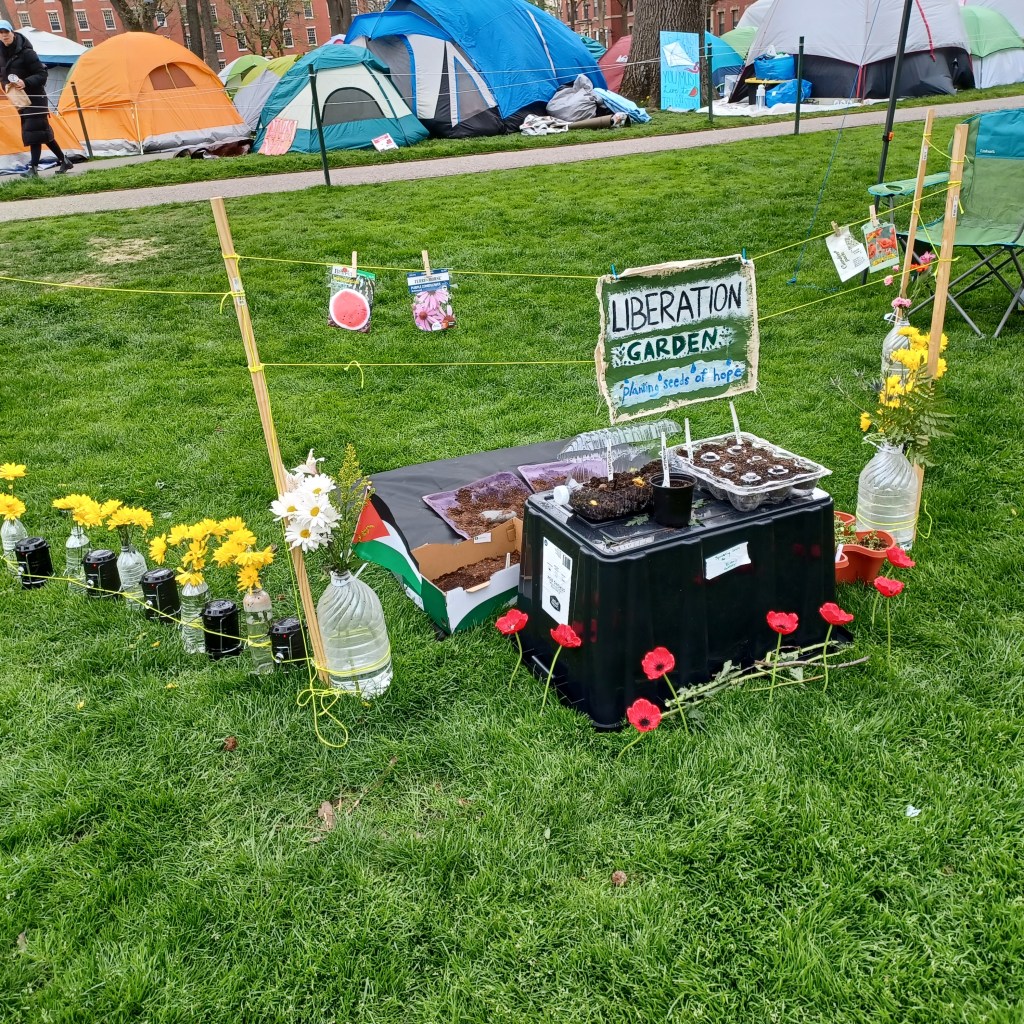
There are about 50 tents in the Yard, fewer than during the Living Wage campaign in 2001 but probably more than during Occupy Harvard in 2011. Like those encampments, this one is self-policing and keeps itself clean. Yesterday some clotheslines had been strung up between trees. Sleeping bags and coats were hung up to dry.
At this time, early afternoon, about a dozen counter-protesters showed up. I have to describe them as quite loud and aggressive. They marched right into the middle of the encampment, singing Hebrew songs, accompanied by a man with a guitar. Their signs quoted the very worst threats from Hamas (“October 7th was just the first time…”) and showed photos of some of the hostages. They stayed in the middle of the camp for around 15 or 20 minutes. The pro-Palestinian campers did not engage with them at all. While the singing and shouting was going on, the campers quietly rearranged the perimeter ropes so the Zionist group had its own little peninsula open to the paths.
The counter-protest moved out of the camp itself to the lawn outside Mass Hall, where it could be more easily seen and heard by the media outside the gates. One man shouted: “Jews on this campus will not be intimidated, and we will not be silent.” I noticed my walking buddy from Monday in the group, and waved to him; he smiled and waved back to me.
I overheard a counter-protester say “Stop them from using the name Harvard, it’s a violation of trademark rules. Call Meta.”
A man from CAMERA, the Committee for Accuracy in Middle East Reporting and Analysis, a decades-old pro-Israel group, told passersby that they had planted 1200 Israeli flags on the HLS campus. I didn’t go to see and can’t find any reports confirming this. He expected they would soon be taken out. He also told a Globe reporter hovering outside the gates that this encampment was an unprecedented disruption at Harvard. I joined their conversation to correct that statement. As for noise, the encampment schedule for some days lists about an hour at dinner time to “make noise for liberation.” I haven’t stayed late enough to determine just how much noise that comes to. Most of the time the camp seems extremely quiet.
The camp was treated to a show of more than 100 bare backsides late last night during the annual Primal Scream event. The Crimson asserts that the streaking was nonpartisan and nonpolitical. Nobody seems to object to the primal screaming.
Don’t stand with Israel. Don’t stand with Palestine. Stand for peace.
Since the inexcusable massacre of Israeli civilians by Hamas, many thousands are suffering and dying on both sides. More suffering is sure to follow. Israel has trapped more than 2 million Palestinians in the Gaza strip, where Hamas uses them as human shields. Any attack on Hamas leadership is going to kill civilians. Israel seems determined to deprive that population of food, water, and electricity. Neither Israel nor Egypt has given them a way out of the trap so far.
Both sides have terrible governments, which care only about their own power and not about their people, or justice, or democracy. Horrors have been committed by both sides for decades while the rest of the world has only added fuel to the fire. Both sides have rejected nonviolent solutions. Both sides have killed leaders who worked toward peace.
Americans must push our own far-from-adequate government to send food, water, and medicine to Gaza; establish escape routes; and use our substantial leverage with Israel to effect a ceasefire and begin peace negotiations with Palestinians who abhor the terrorist strategy of Hamas. No lasting peace can come without justice for the dispossessed.
There is much more at stake here than the fate of the Middle East. I believe human survival depends on nonviolent resistance to war. War not only ruins lives, communities, and environments, it sucks up the attention and resources we need to curb climate change.
If the US had not set a terrible precedent by occupying Iraq in an unprovoked war, or if NATO had not been so aggressive in its recent expansion, perhaps we could have prevented the Russian invasion of Ukraine. If the world had encouraged the nonviolent Boycott, Divest, and Sanction movement protesting the Israeli theft of Palestinian land instead of dismissing it as anti-Semitism, perhaps we could have undermined the fury that supports Hamas.
Vigils, petitions, letters to Congress, and marches for peace and justice might not seem to have much effect. But they hearten participants, create alliances, educate, and with luck might change a vote or two. At the very least they serve to target our real enemy, which is the war machine that has made our country the world’s largest arms merchant, and continues to enrich a few while destroying the planet for the rest of us.



 Alice T4