Atheist’s Bible: The Meek

I was raised Jewish. The New Testament was off limits. When I got old enough to question why, I read the books, and became – not a Christian – but a fan of Jesus of Nazareth. He was a radical poet, a superb teacher, a lyrical rabbi. His words, his stories, his metaphors, moved and delighted me in a way that rarely happened when I studied Jewish lore in the Talmud.

What was so dangerous in the teachings of this great rabbi that his work was forbidden to Jews? He taught that the most important thing was to be kind to one another, not to follow the rules. This threatened the fabric of Judaism, knitted from thousands of strands of legal arguments, meant to cover the actions of Jews at all times. If one could put aside these historic threads, one would be, in effect, naked in the world. One would be the agent of one’s own actions rather than limited by the prescriptions and prohibitions of generations of wise men.
If the meek are going to inherit the earth, we should get ourselves organized.

In a system, or an anti-system, like the one Jesus proposed, every individual would be a free actor. Such a person might or might not choose to remain in the community built for protection and survival over the centuries. The rabbis, those living encyclopedias of rules and regulations, would be no more and no less than any other people except as they demonstrated compassion towards others, non-Jews as well as Jews. All would be equal in the sight of God.

What Jesus represented was a threat to the powers that be. In his day, those were the Sanhedrin, the council of rabbis, as well as the occupying army of the Romans. In the centuries to come, they were the Church, and the priests who claimed its power for themselves, as well as nation-states. He taught that souls were equal, even the souls of small children, and of women. What glory they could claim belonged to themselves alone, for their acts of kindness, and not for their service to organized religion. To counter such egalitarianism, the Church turned the words of Jesus into mysteries that could only be safely plumbed by priests, intermediaries trained by the Church. Ordinary people could not be trusted with the Word.

Jesus trusted ordinary people. He could have remained among the rabbis, a precocious scholar, rising to be powerful and important among the established leaders of his faith. Instead he hung out with prostitutes, drinkers, and gamblers, not to mention fishermen. He believed in the meek, the gentle, the powerless. He threatened the idea of corporal power itself. If you knew that all you needed to satisfy the only true Power in the universe was compassion, you would be less likely to submit to those who rule through fear. You would be free.

Nobody who has risen through a hierarchy of power likes people to be free. What would happen if the masses of people, the lowly ones, the meek, began to see themselves as equal to those who rule them? Every person who has fought for and gained power in an organization would feel a disturbance, shall we say, in the force. The few who use force would have to recognize the overwhelming numbers of the gentle. Such a change in public consciousness would shake not only religions but nations.

The rabbis knew Jesus was a threat. All hierarchical organizations know that he remains a threat. He didn’t believe in top-down power. He tried to awaken power in the grassroots, from the bottom up. He believed in people; he exalted the meek. What he preached was neither obedience nor resistance, but solidarity, the most revolutionary concept in a world designed to keep the meek under the knee of the powerful.
My 50th Harvard Reunion

Harvard Square was empty this Commencement day, as it was last year. Except for the pandemic, it would have been mobbed with black-robed graduates and their beaming, picture-taking families. It would have been the 50th reunion of the Class of 1971.

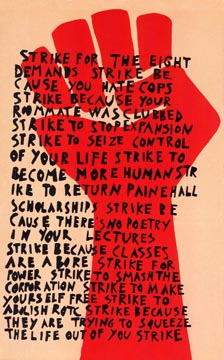
Some of my classmates were involved in the takeover of the main administration building during the so-called Revolution in the spring of 1969. I was out of town that year, in a frontier kibbutz in Occupied Syria. The then-president of Harvard University called mine “the worst class ever.”

I’m not the worst member of the worst class, but I try. Every five years, at the major reunions, I make a fool of myself in some way. Our reunion committee used to schedule talent shows where any member of the class could sing or recite or play an instrument for five minutes.

At the 20th reunion, I read a poem about a new world forming suddenly, like crystals in a supersaturated solution. At the 30th reunion, in 2001, I read one about the meek, so nervous about it that I had to take my shoes off to be sure of my ground.

At the 35th, I harangued the audience about the Iraq War. At the 40th, I ran a slideshow called “Instead of Apocalypse.” By the 45th reunion, the committee decided those open-mike nights were too hard to manage. Instead, they offered an evening of entertainment by the famous artists and performers in our class. A good friend of mine ran off a few hundred stapled-together booklets of his artwork and my poems. We stood at the doors of the entertainment, handing them out. People took them thinking they were programs for the evening.

This year there were no events to take part in, or to crash. So I postered the Yard.

            Every life is big to the person living it.

The bulletin boards had just been cleared. There were many open places where I could tape up little slips of paper. I broke one poem into stanzas:

……………………………..

Love is not dead, not defeated, not damaged, not out of reach. Love has not been bought, sold, or stolen. Love is not a wholly-owned subsidiary of any corporation. The kingdom of loving is within you. Love is not something you fall into. Love is something you make and keep on making. Love is an act of will. Love is a way of life. Love is the opposite of greed. Love is not blind; lust is blind. Love sees truly. Love is the only path to our survival. Love is revolution.

Revolution cannot be violent. Revolution is change. Violence is just more of the same damn thing. There is no use fighting to save the world with violence. The rulers of this world have more weapons and fewer scruples than anyone else. Violence is their game. We cannot win that game. We must stop playing it. We must play a new game. Our strength lies in one another. Love is real change. Love is revolution.

The world is changing. Learn to travel light. When the water rises, all your stuff will not help you. The things you own will mean nothing any more. Your community will mean everything. Be ready for the change. Pay attention. Help where you can. We will survive by taking care of one another. Selfishness is suicide. Love is revolution.

When the old world ends, the new world begins. In the old world, money was power. In the new world, spirit is power. You choose to make the world better or worse with every act. This is your power. Race, nationality, class, gender, physical appearance – these matter in the old world, not in the new. The most important things in the new world are the quality of your awareness and the strength of your relationships. The old world ran on greed. The new world runs on human connection. Love is revolution.

……………………………..

I said hello to a few old friends: the guard at the gatehouse, the head of Yard security, an eloquent and clear-minded homeless man. Otherwise I was confident no one would want to look at me. I’m a short, plain old woman with a peace sign on my hat.

I’m invisible. I have trouble talking. But I can still speak my mind, and I hope you will speak yours.

How many lives do you think you have? Is this not your planet?