There will be no way to avoid a succession of horrors in the coming four years. It’s no use waiting for the Democratic Party to tell us what to do. It has become a creature of corporate interests, out of touch with the needs of the non-rich. We have to tell the Party what to do.
The non-profit sector is a mess of single-issue organizations competing for attention and money. We are not single-issue people. Whether you are on a board or just a member, pressure your group to join other groups in as many coalitions as it can manage. All our issues are connected under the banner of peace, justice, and a survivable environment. Progress on any of our goals helps us to achieve all of them. Solidarity is key. We must stand up for one another.
More than changing institutions, we need to change minds. Leave your comfort zone. Don’t stick to preaching to the converted. If you can get access, go on Fox or the bro podcasts. Wait in line for a call-in radio talk show. Try to reach new audiences. Don’t talk down; persuade. Explain what you believe, and be ready to back it up.
We need big change. That means our actions must be non-violent. Violence is not change; it’s just part of the same cruel culture that is wrecking our world. If you are part of a protest, do whatever you can to keep things civil, no matter the provocation.
Expand your social set. Meet people who are not like you. Listen to them with respect. Everyone has something to teach. You don’t have to leave the country to find whole new worlds to explore. Besides, we need you here.
Most of all, keep yourself and your friends from wallowing in despair. If we think there’s no hope, we’ll stop trying, and then there really won’t be any hope.
I’m an American Jew, and this year the High Holy Days of my religion have a special, and terrible, meaning for me. Another year of violence in the Middle East has brought tragedy to millions, and contributed to a surge in anti-semitism around the world. Last Monday, I found some comfort in the company of others who feel, as I do, that our community should mark this Day of Atonement with more than personal acknowledgement of what we have done wrong.
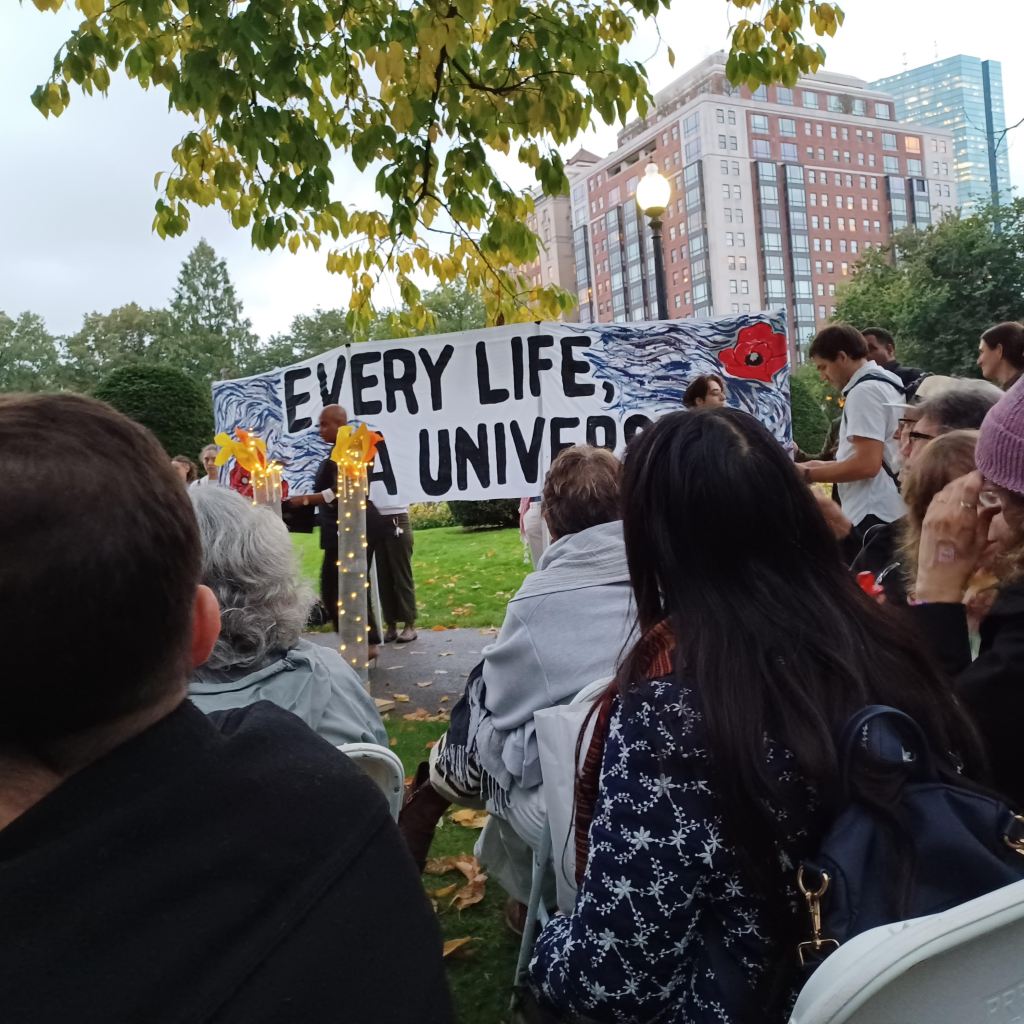
A year after a vicious Hamas attack on Israeli civilians turned long-simmering violence into open warfare, a couple of thousand non-Zionist Jews and our allies gathered in the Boston Garden. We met to grieve — not only for the more than 1200 Israelis killed on that day, and the hundreds kidnapped, but for the tens of thousands of Palestinians killed in the bloody year since then, and for the Lebanese who are now also under Israeli attack. The event was organized by IfNotNow, a group devoted to ending American support for Israeli apartheid and aggression toward Palestinians.
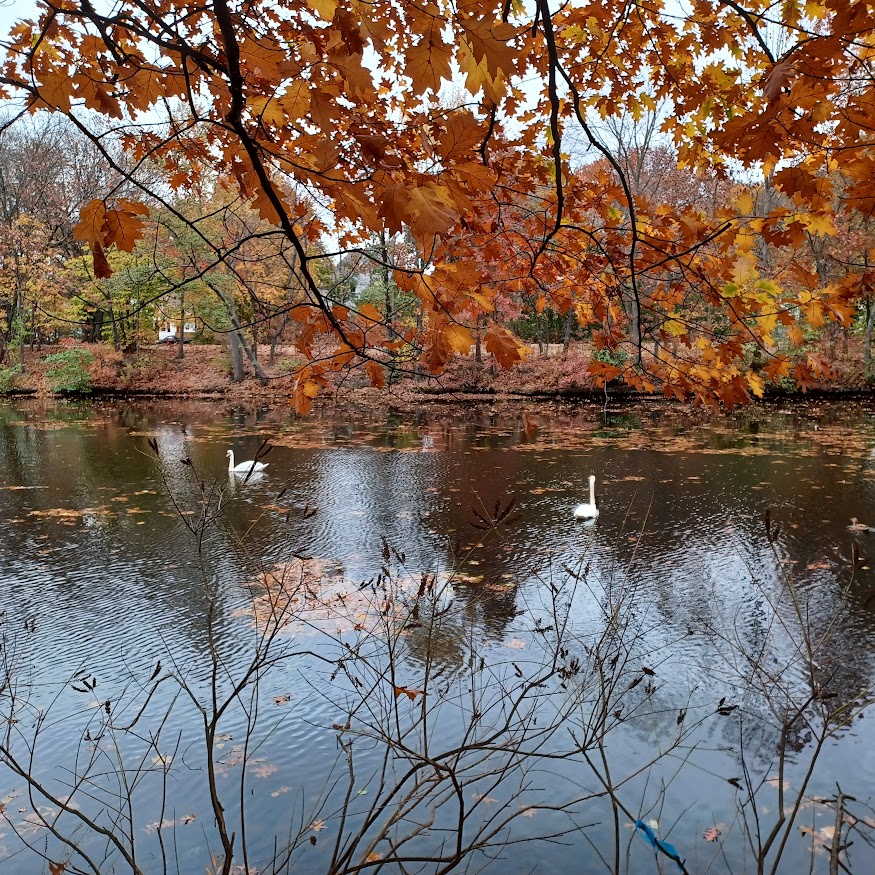
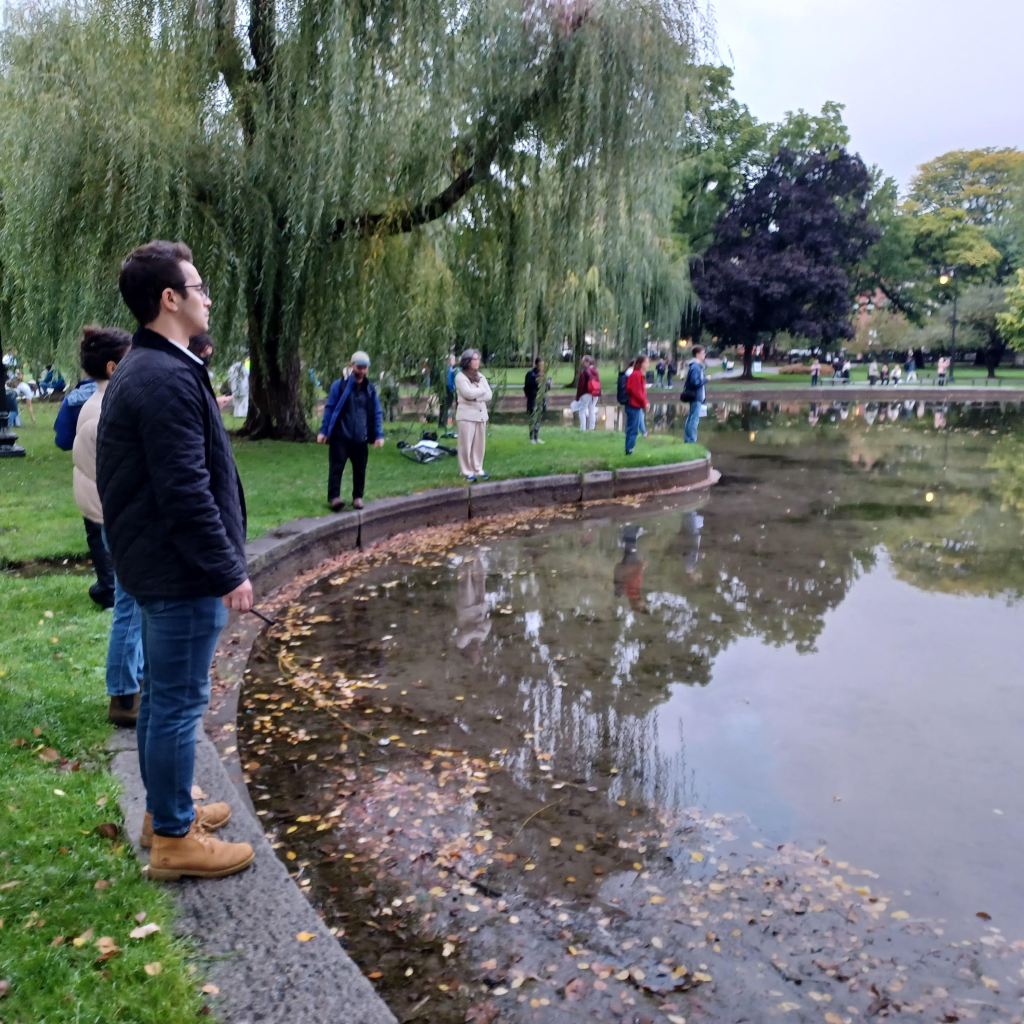
Late on the damp Monday afternoon of that sad anniversary, before most of the crowd showed up, a young rabbinical student led us through an ancient Jewish ritual called Tashlikh. This ceremony is performed during the “Days of Awe” between Rosh HaShanah – the Jewish New Year – and Yom Kippur, the Day of Atonement. One symbolically casts off one’s sins by throwing something in flowing water to be washed away. Usually people throw bread crumbs, but out of concern for the fish in the pond, we threw pebbles or dead leaves instead. The pond water wasn’t washing anything away, which also seemed symbolic to me.
The theme of the main event was “Every life is a universe”. Speakers included Rep. Ayanna Pressley, Rabbi Toba Spitzer, Imam Ahmad Barry, and Rakeea Chesick Gordis. That young woman gave eloquent testimony to losing close friends and family members during the Gaza war, including both Israelis and Palestinians. She spoke of drowning in grief, feeling overwhelmed by waves of it. Again and again, the speakers insisted: Jews cannot be safe if Palestinians are not free.
After an hour of speeches, prayers, and songs, rain began to drip through the trees. Mosquitos emerged from the mist over the pond to ensure our discomfort. Considering the suffering we were there to commemorate, nobody complained. At one point, volunteers handed out small strips of cloth we were to rip, as a sign of mourning, and attach to our clothes.
October 12 is the Day of Atonement in the current year 5785 of the Hebrew calendar. I believe that American Jews have a lot to atone for. I am not refering to personal sins; Jews are no more or less hateful, thoughtless, or selfish than anybody else. I mean the Jewish community as a whole. For the most part, we have supported Israel for the 76 years of its existence, no matter what it did. We have pressured the US to continue sending more than $3 billion a year in military assistance to Israel, and ignored what Israel did with all those weapons.
Ever since the Holocaust killed six million Jews in Europe and the Nakba displaced three-quarters of a million Palestinians in Israel, both sides have committed too many atrocities to list. The difference is that American weapons have turned the Jewish state from David into Goliath. Israel has become a paragon of military might. Nearly all of its people are or have been soldiers. They believe they are fighting for survival, which excuses all their violence as self-defense.
According to the United Nations, from 2008 through 2020, 5590 Palestinians were killed in the ongoing hostilities, compared to 251 Israelis. There are many conflicting estimates of the casualties since the founding of Israel in 1948, but on one thing they all agree. Far more Palestinians have died than Israelis. This conflict is deeply lopsided, and not only in lives lost. The longer it goes on, the more territory originally set aside for a Palestinian state disappears into Israeli hands. Even the rubble that was Gaza is likely to get rebuilt into beach towns for Jewish tourists.
Now it seems that many American Jews have decided to drop their indifference to religion and rejoin the Jewish community. During most wars, previously apolitical people tend to rally around the flag. This is “my country, right or wrong” time. Jews everywhere have been taught to believe that Israel, and not the Torah, is the central element of our religion. In many ways, Israel has become our religion.
After 9/11, the US squandered the world’s sympathy by starting two completely unnecessary and unprovoked wars. Instead of hunting down the gang of Saudi terrorists that bombed the World Trade Center, we invaded and occupied Afghanistan and then Iraq. We killed hundreds of thousands, and made millions homeless. Now Israel has squandered the sympathy it garnered after the Hamas attack by bombing the millions of Palestinians it holds captive behind walls and military checkpoints in Gaza and the West Bank. Most of those who survive are now homeless, and many are starving.
Zionist Jews, and most Israelis, believe that this violence is justified because it’s the only way to destroy the criminal gang that is Hamas. Yet this policy is doomed to fail. Violence begets violence. Every time an Israeli bomb kills someone, Hamas can recruit more members from among the people who loved them. Zionists blame Hamas for all the destruction on both sides, just as the most extreme pro-Palestinians blame it entirely on Israel’s decades of oppression and occupation.
The truth is that there is plenty of blame to go around. So long as we find war acceptable, we all must share the blame for the loss of so many irreplaceable universes. I am grateful to IfNotNow for giving us a chance to start the new year by acknowledging our part in the ongoing crime of mass murder. May the year to come bring a ceasefire, and healing to all who suffer. We must make peace. If not now, then when?
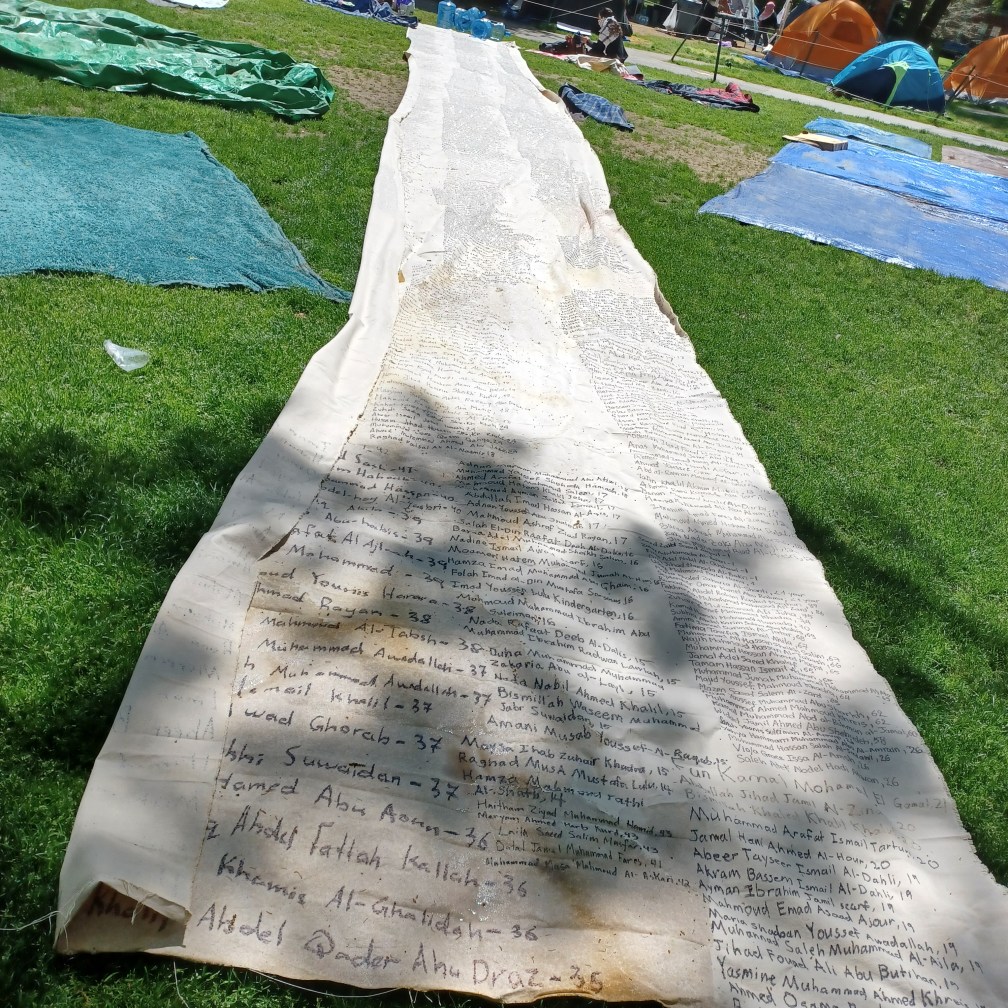
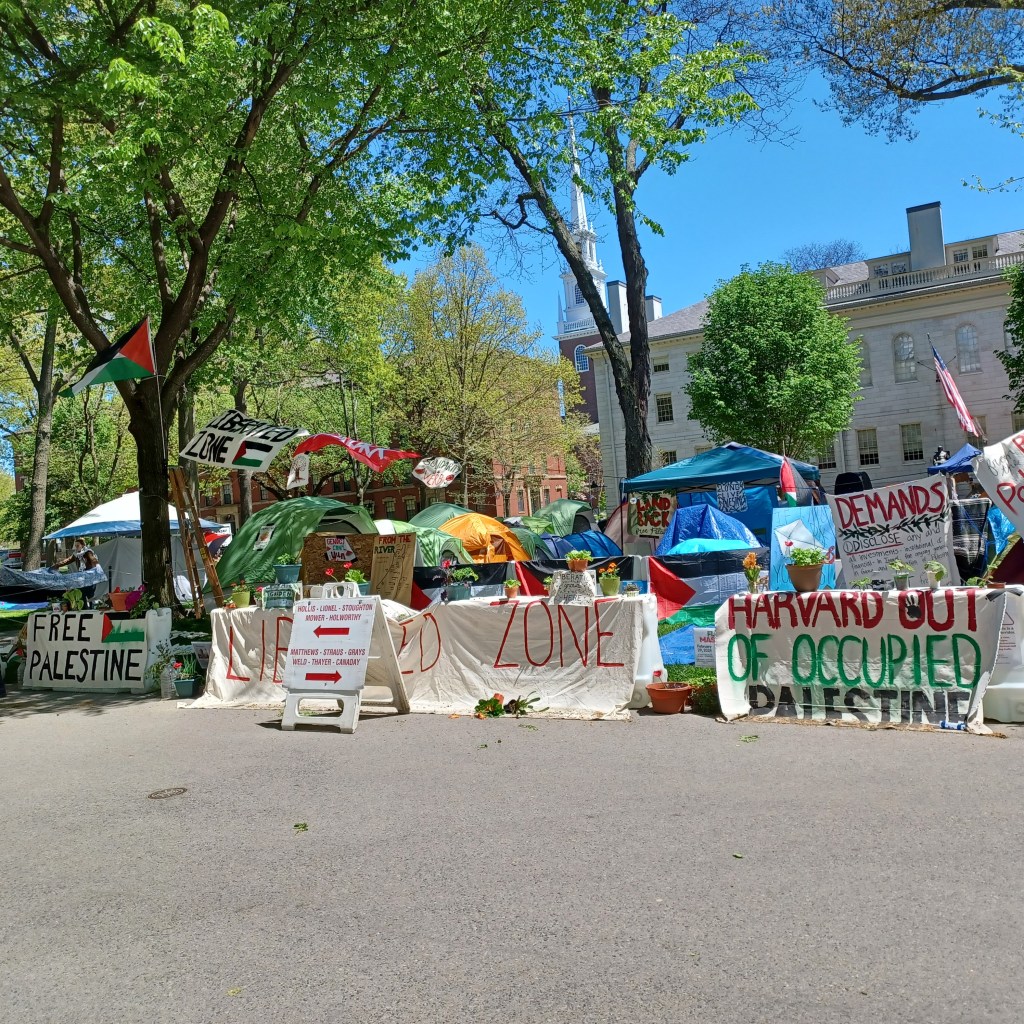
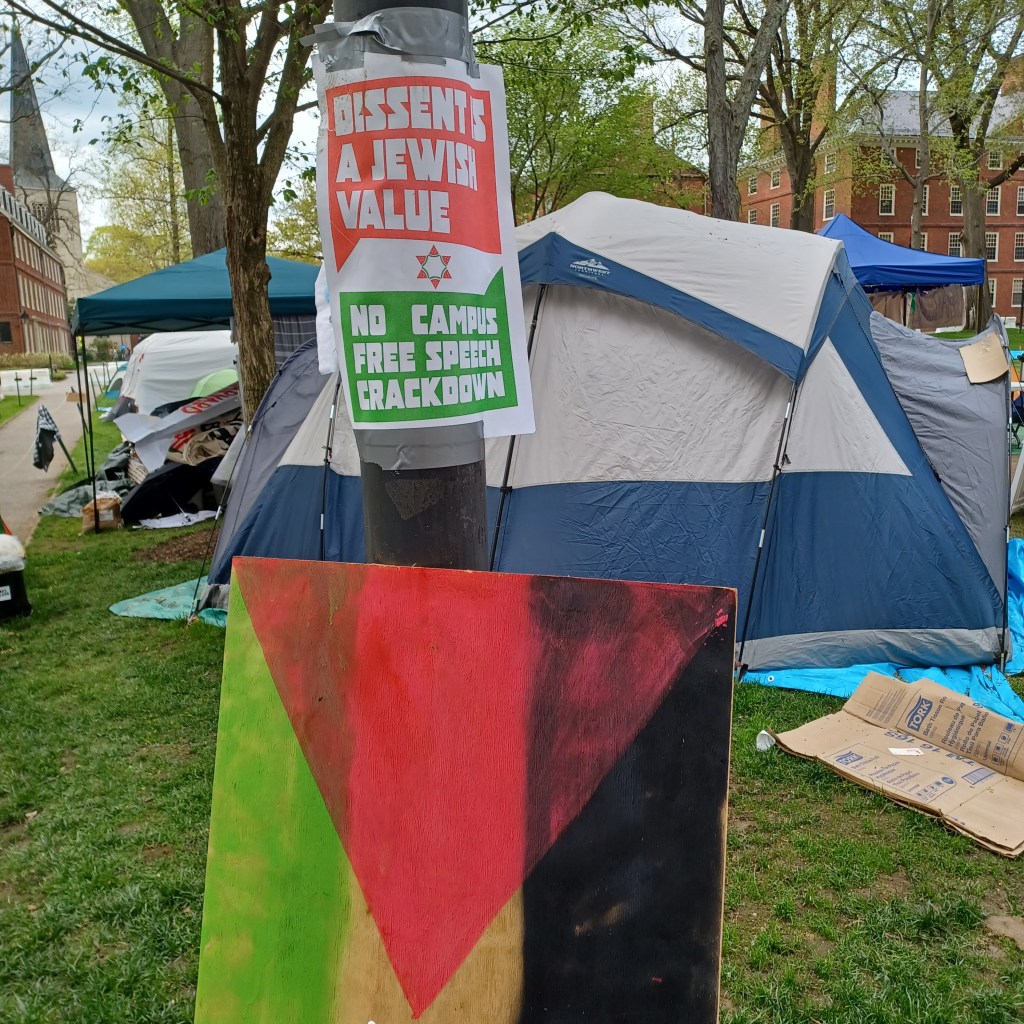
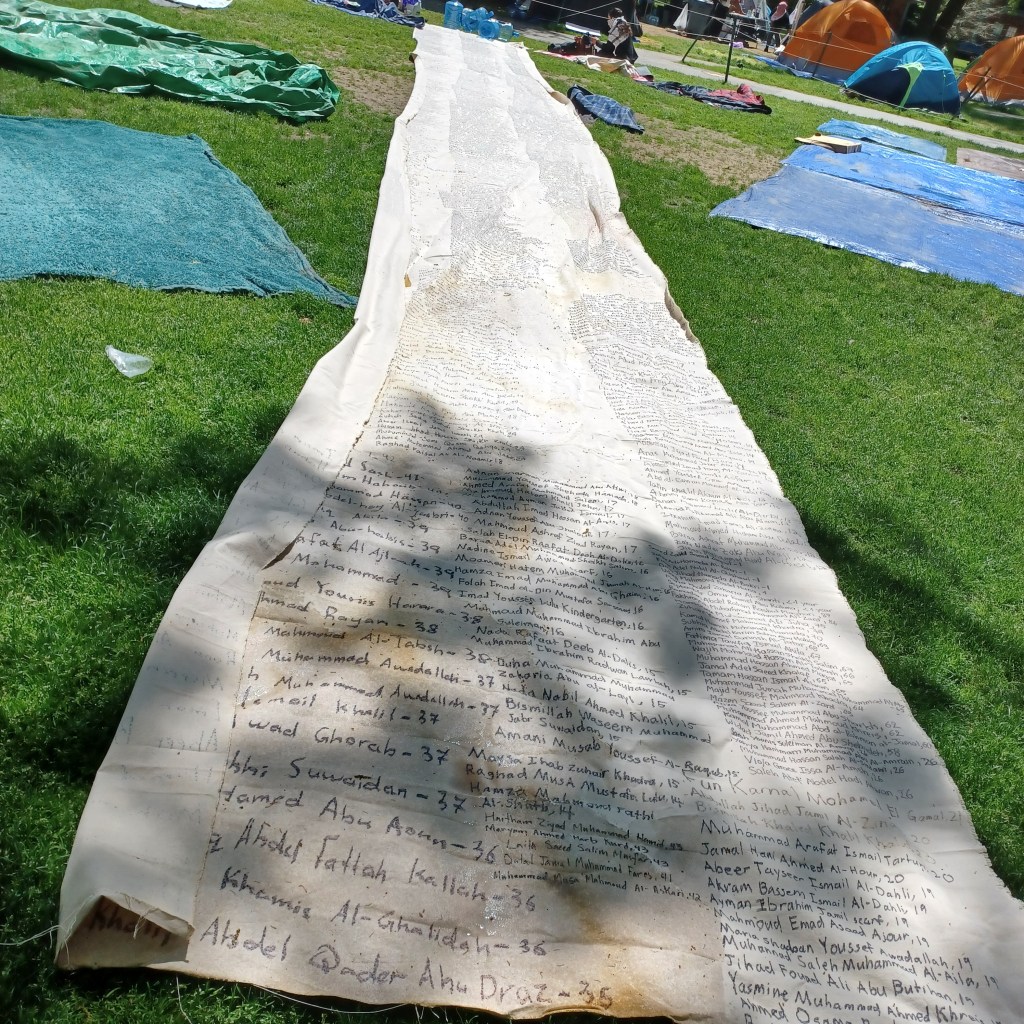
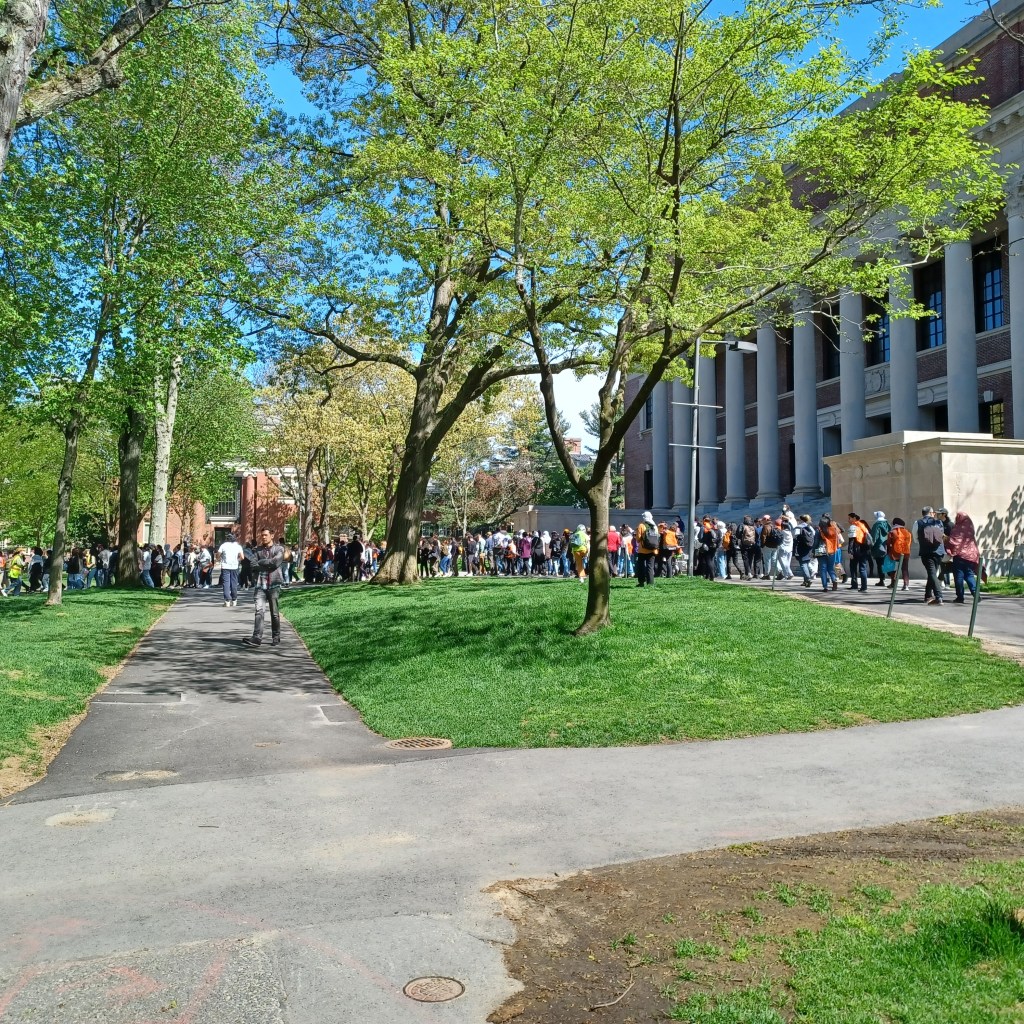
Friday, May 10, is a cool, sunny day. Rising sophomores who lived in the Yard this year are carrying mattresses, couches, and huge cardboard boxes from their dorms. Parents have only 20 minutes to park in the Yard to receive them. The protest tents are not in the way, though so many gates are closed that there is some level of inconvenience for cars coming and going.
A few pro-Israel counter protesters play pop music on a radio very loudly, right next to the encampment, which is deep in discussion as usual. I don’t know why the music stops after a few minutes.
A protester asks friends on the steps of University Hall to help clean up the wet, dirty tarps on the “event space” next to the tents. Another remarks, laughing, “I haven’t had a shower in a week.”
People I knew from my campus labor union tell me that students who have been suspended or put on involuntary leave seem to have been chosen almost at random. They aren’t leaders or organizers, or even necessarily people who slept in the tents overnight. It’s more a matter of someone in the administration happening to see and recognize them, in spite of the masks or scarves many have been wearing.
Another press conference is scheduled for 2 pm. Most protesters go all the way around through the Science Center gates to get outside Johnston Gate where the press is gathering. I don’t want to walk that far, and I can’t hear the speakers anyway. Yard security and campus police are present, though not in great numbers; the tall bald guy who looks the most serious squats on his heels on a nearby path. The University’s president Garber comes out of Massachusetts Hall now and then, accompanied by a guard. I haven’t seen anyone else approach him.
Outside the gate, the crowd is chanting “Free free Palestine! Long live Palestine!” The Harvard protesters appear to have decided not to use the inflammatory chant of “From the river to the sea, Palestine will be free” or to call for an intifada, which means uprising or resistance.
I hear one woman, annoyed at not being allowed in, ask a guard about Askwith Hall, which is blocks away from the Yard at the Harvard Graduate School of Education. She is not happy with his answer, and says to her companion, “Okay, let’s go to the media.”
My union friends and a rainbow-haired woman from the Business School think Harvard is treating this protest more harshly than previous encampments. They call it “the Palestine exception.” A student worker wonders if they lose ID access to buildings because of the disciplinary process, will that be grievable through the union.
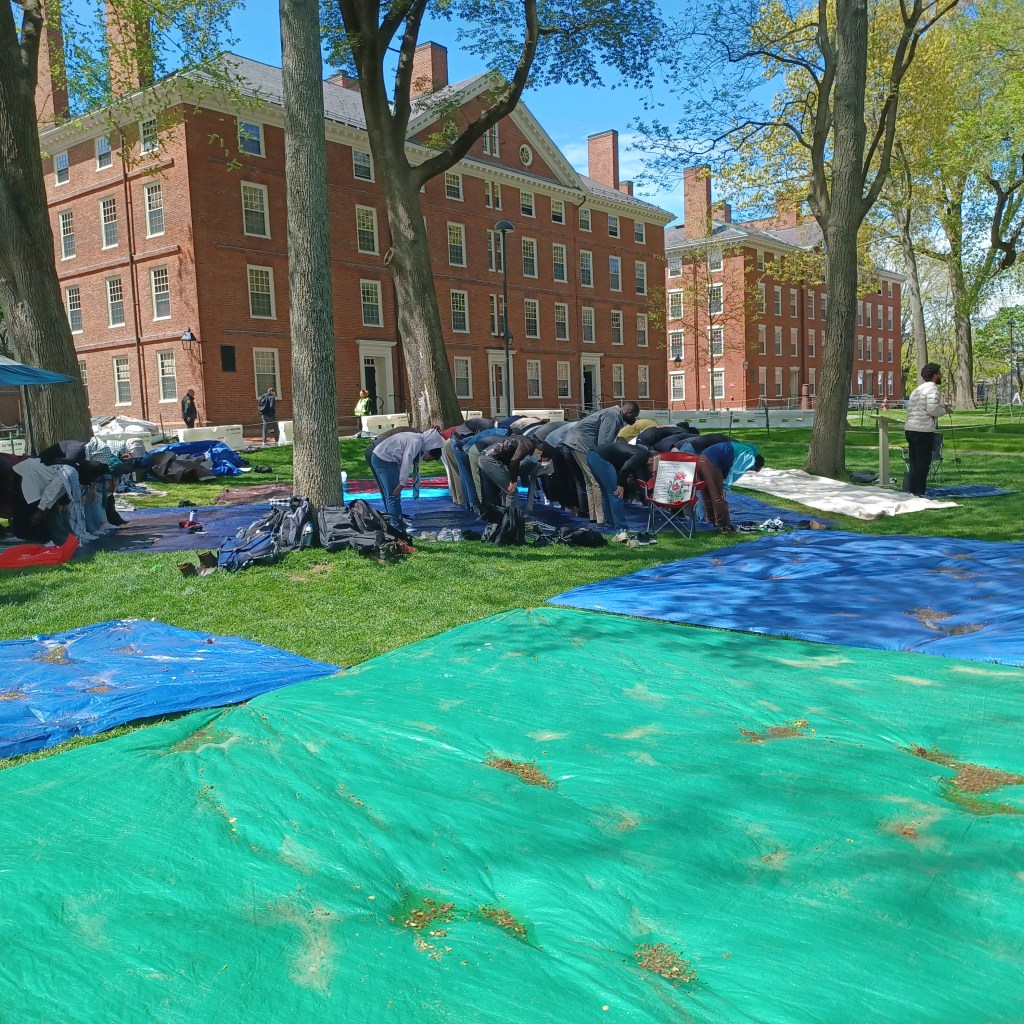
About 25 people attend a Muslim service in the “event space.” The young man leading the service often lapses into Arabic, but from what I can understand, he’s mostly talking about how we will return to the Creator after death. He talks about how many lives have been lost, and how many hospitals, homes, and schools turned to dust. He talks about “the dead earth” left behind, and “the will to destroy.” He says of the Israelis, “They built upon the imaginary [sic] that there was no one living in the land, that it was empty earth.”
The speaker says, “Somebody has taken the desires of their own heart as God,” taking for themselves the powers that should only belong to Allah. He notes that an Israeli real estate company is already trying to sell land for housing and luxury hotels in Gaza.
The most aggressive counter protester stands next to me. “Do you believe in this?” No, I say, I’m just listening. “You see they separate the women from the men.” So do orthodox Jews, I respond. “But this is 2024!” he says. Yes, I reply, and I don’t like it either, in any religion.
A helicopter hovers low overhead, evidently trying to disrupt the service. When the sermon ends and people bow and pray, I notice it sounds a lot like the davening during a Jewish service.
Supportive faculty and staff form a circle and hand out identifying pins, with the watermelon logo of these protests, and orange vests saying Faculty and Staff so they’re not taken for camp marshals. They expect the University to take the tents down soon, in the middle of the night.
A student who says he’s going to be “Ad Boarded” in a few minutes tells us about a supposedly secret meeting with President Garber. All the president did was tell the protesters how the endowment works. The student says 10 to 15 students were put on involuntary leave during the first raid this morning. Some never had their IDs checked at the protest, but most had been highly visible.
A student marshal in an orange vest speaks to a circle of others. “Don’t engage with police. Our job is to de-escalate.” She says some things I don’t understand. What is a stretchie, and how does it crack?
Later in the afternoon there’s a march and rally, attended by many more people than hang out in the camp. They go all around the Yard after surrounding Mass Hall for a while. I don’t go with them. I hate chants, and I’m tired.
A counter protester accuses one of the protesters of removing his sign from the foot of the John Harvard statue. “Not cool!” he says. A protester points out that the sign is still there; the wind blew it over. “You’re just not looking.” The wind has strengthened so that while workers try to lower the big American flag over the statue, it twists around the pole so they have to raise it, shake it, and try lowering it again several times before they get it down.
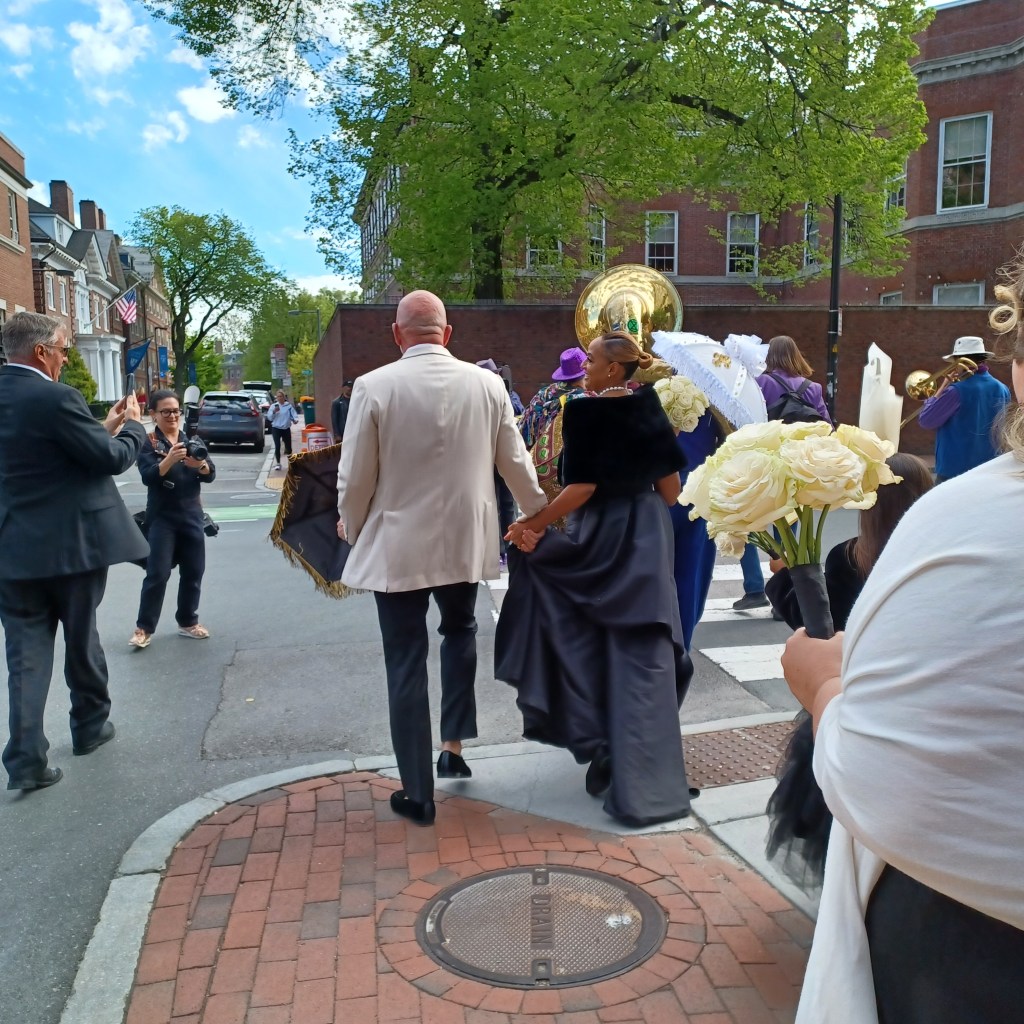
As I leave the Yard, I hear a brass band. Has somebody taken protest music to the next level? Then I spot a tuba over the head of a joyful line of people snaking down the Holyoke Street sidewalk, waving white kerchiefs. It’s not a protest. It’s a wedding. In the middle of all this difficulty and angst, life goes on.
To quote Robert Burns: “O, wad some Power the giftie gie us/ To see oursels as others see us!”
Growing up in my argumentative Jewish family, I remember most political and cultural issues were subjected, at some point, to the question: but is it good for the Jews? This question was also the punchline of many jokes. I was born three years after the Holocaust, when my relatives remaining in Poland were massacred. I read Rise and Fall of the Third Reich when I was 12. So I knew about a lot of events, places, and people that had not been good for the Jews. Not all members of my family believed in God. But every one of us believed that no matter where we lived, how thoroughly we acculturated, or how outwardly successful we became, our environment might at any moment become not good for the Jews. We assumed antisemitism was everywhere, perhaps well-hidden, but endemic.
Israel was our hope. Every other country might reject or turn against us, but Israel would always let us in and protect us. Zionism was our strategy for long-term survival. The country was surrounded by enemies, its allies were self-serving and unreliable, but Israel was backed by God (and American military aid) and would prevail, like David against Goliath.
What many American Jews are only now realizing is that over the past 75 years, Israel has become Goliath and the Palestinians have become David. All the military might is on Israel’s side. Arab countries have paid lip service to the cause of Palestinians without offering them much actual help. They are just pawns in the great game. World sympathy, which might have been a major factor in Israel’s favor after the brutal Hamas attack on October 7, has turned to anger because of Netanyahu’s brutal response. He has bombed most of Gaza to rubble and killed around 25,000 people, mostly women and children. Many more are sure to die of bombs, famine, thirst, and disease.
Now “my” people, only 80 years after being subject to genocide, are accused of committing genocide ourselves. Many Israelis and Jews in the Diaspora (the whole world outside Israel) respond indignantly that Hamas wants to wipe out all Jews in Israel, so Netanyahu is trying to wipe out Hamas instead. And besides, they say, Hamas is using Palestinian civilians as human shields, so it’s impossible to kill Hamas militants without killing innocent people. It’s not our fault. We have no choice. It’s either them or us. If Israel is no longer safe for the Jews, nowhere is safe. So this carnage is good for the Jews around the world.
But the massive rise in antisemitism worldwide proves that the opposite is true. Seventy-five years of Israel’s terrible treatment of Palestinians – forcing Palestinians off their land, herding them into open-air prisons like Gaza in a virtual apartheid regime, depriving them of full citizenship in Israel, making a separate homeland all but impossible, meeting thrown rocks with bullets, finally telling two million Gazan residents to crowd into southern Gaza and then bombing southern Gaza – have had their predictable result. Nonviolent resistance has failed, with the Boycott, Divestment, and Sanctions movement dismissed as antisemitic. Israel has left Palestinians with few options besides violent resistance, ie., Hamas. The many Palestinians who hate Hamas are afraid to say so in public. The thugs would torture and kill them and their families. Meanwhile, every innocent killed by Israeli bombs or siege conditions creates more recruits for Hamas. Hamas is not, as Israeli leaders keep calling it, a snake. It is a Hydra. Cut off one head, and more will grow in its place.
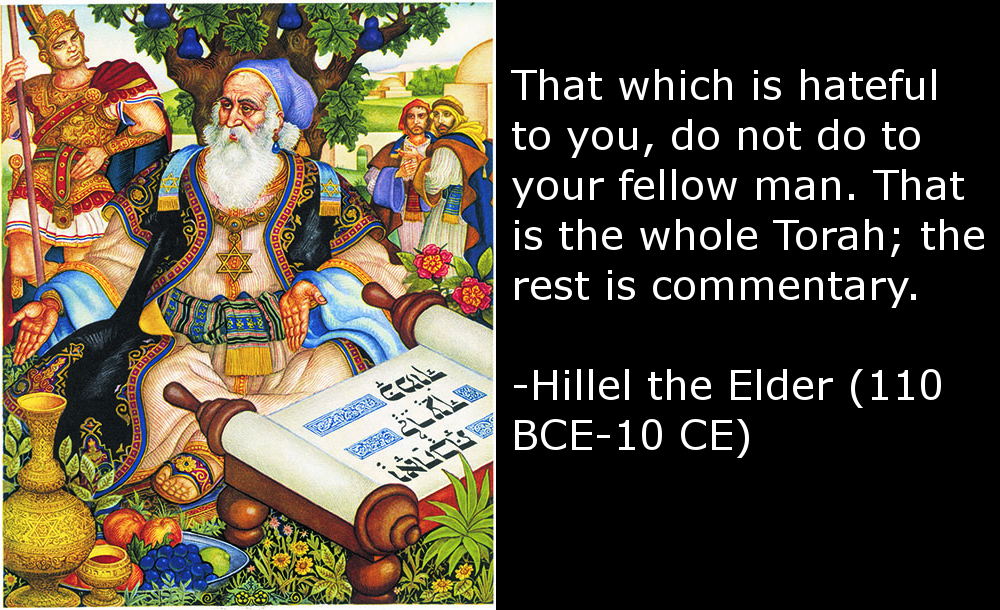
The hideous ambitions of Netanyahu give credence to South Africa’s claim of genocide. Meanwhile, the People of the Book have forgotten the words of one of our greatest teachers, Rabbi Hillel. When challenged by some joker to teach him the Torah while he stood on one foot, Hillel responded: “Do not do to others what you don’t want done to you. The rest is commentary.”
American Jews have pushed our government to support Israel no matter what it does. We should remember that we are Jewish before we are Zionist. What Israel is doing to Gazans goes against everything Judaism has always stood for. It is beyond horrible for Palestinians. It’s time more of us realized that it is also very bad for the Jews.
Talk radio is a tough medium. Hosts can be hostile; callers are often abusive. Liberal pundits avoid these venues, where they come under attack with no one to defend them. Facts turn out to be puny weapons against ignorance and prejudice. But the guests on this particular show were as tough as the medium. And they came armed with more than facts. They had stories to tell.
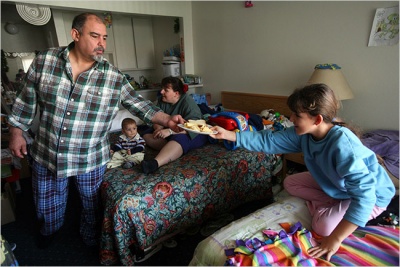
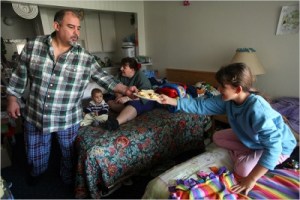
More than 30 years ago, I sat in the green room at WRKO in Boston, watching four women battle with host Gene Burns and his right-wing audience. These women were homeless along with their children. They were living in welfare motels and time was running out on their stays. If they couldn’t find anywhere to move when their time was up, the state would put their kids in foster care and they’d be on the street. They had nowhere to move; if they hadn’t already run through all their options, they wouldn’t have been in the motels. They were desperate. They were angry. They had nothing left to lose.
Burns expected these women to be victims, or leeches. He had no idea who he’d be dealing with. These women were warriors.
TriCap, a local anti-poverty agency, had hired me to organize people on welfare, scraping my poverty-level salary from the dregs of federal and state programs. I got to know dozens of homeless parents over a year of meetings. These four women were among the most articulate and clear-minded people I had met. They had been training for this show one day a week for a month.
photo from Bread of Life in Malden, MA
At our first training, the women told their stories. One survived a serious illness but lost her job. Another one’s husband disappeared with their car and their life savings. Another fled a man who had raped her daughter. The fourth had been trying to escape dependency by going to college, until the state raised the fees so she could no longer afford rent. The women critiqued one another’s stories: be sure to tell that part, maybe leave those details out.
At the second training, we brainstormed how to respond to the worst calls they might get on the show. They came up with witty rejoinders to every ugly assumption, corrections for each common misunderstanding. They practiced responding calmly to name-calling. We laughed a lot that day.
The Massachusetts Coalition for the Homeless sent a policy wonk to our third meeting. She handed out one-page fact sheets and the women quizzed her on state policies. That was a serious discussion. We had pizza, and they brought leftover slices back to the motels where volunteers had been taking care of their kids.
Our fourth meeting wasn’t really a training. The only thing we did was tell our birthing stories. Only mothers can stand all the gory details, and even relish them, if mother and baby survived. By the end of that day we were sisters.
Burns had booked the women for the first hour of his four-hour show. After that hour, he called me in the green room to see if they could stay another hour. He did that twice more. When they started talking, he was skeptical and condescending. But as they answered his questions honestly, and met his listeners’ nasty comments with humor and understanding, his attitude shifted. Eventually he started saying things like “I can’t believe this is happening in America” and “This is such a cruel system, we have to change it.” Even his callers began to show some respect.
The show ended at 2pm. Burns thanked the women, praised their intelligence and courage, and then told them the station wanted to treat them to lunch at a nearby Italian restaurant. That was the first hot food some of them had eaten in months. They weren’t allowed to cook in the motels. Everyone got boxes for the leftovers, to give their kids.
We had to take three trains back to our ride in Revere. An old man was playing guitar in the Park Street subway station where we waited for the first train. He began to sing “Dream a Little Dream of Me,” a standard by Doris Day that everyone seemed to know. We sang along.
Sweet dreams till sunbeams find you Sweet dreams that leave all worries behind you But in your dreams whatever they be Dream a little dream of me
When our train came in, I gave him my box of leftover lasagna. After we got on board, he blew us kisses while we waved and smiled.
Burns told us that his show reached 100,000 people. Two weeks after the women’s show ran live, he played the whole thing again, on Mother’s Day. Who knows how many minds the women changed. Maybe the strength they showed that day was enough to bear them through whatever came next. But I don’t know what happened to them. Their time at the motels ran out, and in those years before cell phones and email, we had no way to stay in touch.
Today, the US is about to experience a new wave of homelessness, worse than the one Reagan caused when he destroyed affordable housing programs in the 1980s. There have been eviction moratoriums during the pandemic, but they don’t cover everybody and they can’t last forever. Sooner or later, the rent will come due. Many renters won’t be able to pay. Some will find new, cheaper housing. Some won’t.
There are still talk radio shows people listen to while they drive to work, and podcasts galore. Pundits will share what they think about homelessness. I hope somebody remembers to ask the homeless.
The USA is at a turning point. This country has been a disaster for the past four years. We just managed to fire the man who almost destroyed the rule of law, undermined education, greatly increased the flow of money from the poor to the rich, harmed the environment, alienated our allies, and encouraged racist, misogynist, xenophobic, and violent behavior. The virus is still raging here because of his indifference and incompetence.
Now scientists around the world are developing vaccines faster than anyone thought possible. And evidently the Trump administration had no real plans to get them to us.
These are thrilling and dangerous times. We have to change our way of living, fast, to survive. Wearing masks and isolating ourselves for a few months, this time like we mean it, won’t be impossible if households get adequate subsidies. The way many other countries have handled COVID has proved we can do it if we try. We know our hope lies in coordinated communal action. Once the worst of the pandemic has receded, we’ll need this knowledge to cope with global warming.
Tens of millions of Americans are hungry and homeless, or close to it. Hundreds of thousands of families grieving unnecessary deaths. Businesses gone, children behind in their education. Health care workers exhausted and burned out. It’s staggering how much mental and physical damage we must try to heal. We’re all the walking wounded.
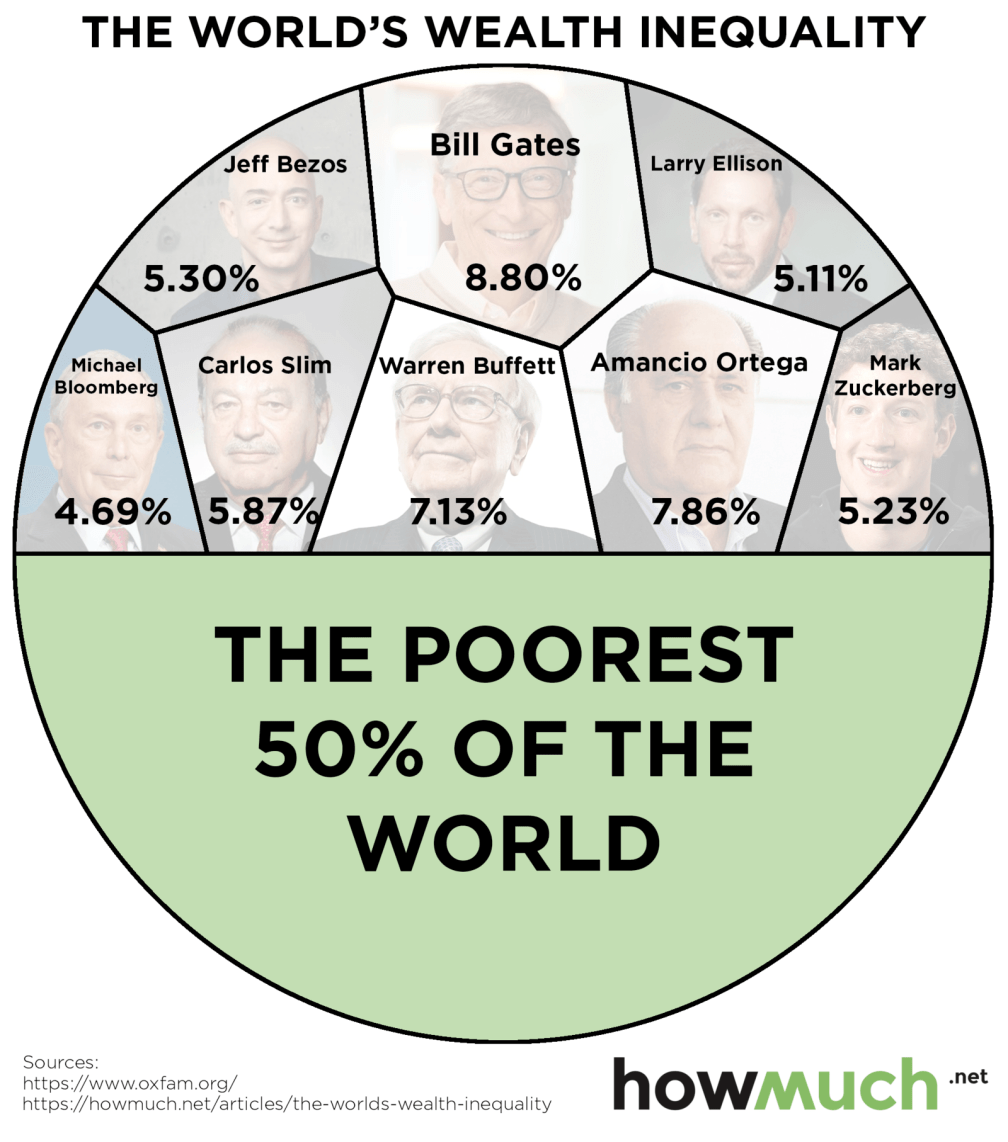
The rich have been getting richer for a long time, but the trend has accelerated over the past 40 years. Where did all the billionaires’ money come from? Working people have been paid too little, and been charged too much. Now our communities have been sucked dry by this wicked scheme.
We have to take the money back to do what we, the people, need it to do. We need it to feed the hungry, house the homeless, heal the sick, and teach the children. We need to clean up our nasty habits, train ourselves to stop mindlessly consuming as though earth’s resources were endless, and help rescue our species from climate change.
The rebellion now taking place in many American cities has been building for a long time. Trump made it inevitable. Remember when he encouraged police not to “be too nice” when putting “thugs into the back of a paddy wagon” in 2017? He told them not to keep suspects from getting hurt by helping them duck as they enter the cop car: “You could take the hand away.” This is only one of many times Trump has incited police violence. He goads his followers to injure protesters and members of the press. His racism is beyond question.
Then the pandemic increased the pressure on everybody, but especially on black communities. Not only are people of color disproportionately in front-line positions, from hospitals to grocery stores, but services in their neighborhoods have been cut, and cut, and cut, so they don’t have the resources they need to stay safe. Housing is overcrowded. Community health centers have disappeared. Food deserts in cities mean they spend more money for worse diets. Their air is polluted, their water is toxic, public transportation won’t get them to where jobs are…The list of injustices is too long for this blog.
Over the past few weeks, on top of a tremendous death rate from COVID-19, on top of people’s desperation from their money running out with no help in sight, on top of endless stories about white police murdering unarmed black people, some especially shocking videos have emerged. One is of two white men chasing down and killing Ahmaud Arbery for jogging while black. One is of a white woman, Amy Cooper, calling the cops to report a black man was threatening her life, when he was just asking her politely to put her dog on a leash as the park required. And then, the last straw, the one of George Floyd getting strangled to death while in handcuffs by a white cop kneeling on his neck. In none of these incidents has justice been done.
Peaceful protests get ignored. Even if hundreds of thousands hit the streets, the media generally pay no attention unless things turn violent. The movement for justice has many voices but no single leader, so media usually interview some random bystander instead of just reading the damn signs. It’s a terrible truth that a city has to burn before our society really takes notice.
And what kind of action will result? Nothing good under Trump, we can be sure. He would love a race war. He could impose martial law and cancel the election he suspects he will lose. Cities burning distract people from his constant mistakes, provocations, and lies.
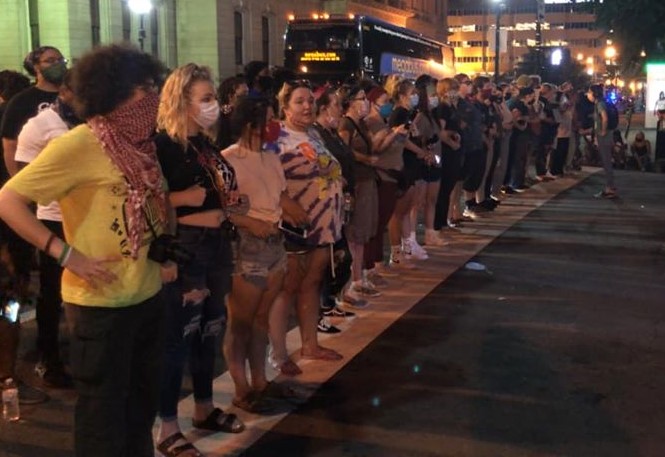
The violence against black people has been ongoing and remorseless. Black people can’t stop racism on their own, even with all their intelligence, persistence, and courage. White people have to show up for the rebellion. This is not only a fight for racial justice. It’s a fight for the rights of all of us to be equal under the law, no matter our ethnicity or gender or class, no matter where we live or how much money we have. It’s a fight for the soul of America. No one group can do it alone. We must stand together if we’re going to win.
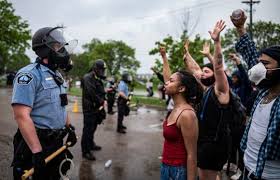
This is how to use privilege: White women protecting black demonstrators from police in Louisville, Kentucky






 Alice T4