Flying Monkey Song

Once were some critters came from the sea
Thought they’d see what they could see
Climbed up in the nearest tree
Said, Hey mama, won’t you look at me

Unidentified flying monkeys.
Fly, fly, fly, monkey, fly

Tree to tree to tree they swung
Grew themselves an opposable thumb
Climbed back down to get them some
Watch out, sabretooth, here they come

Race around like a forest fire
Chasing every new desire
Always tryin’ to get a little bit higher –

Kinda funky
flying monkeys
fly, fly, fly, monkey, fly

Field Report from Alice T4

These human beings have donned thick hulls.
Within memory they came out raw and slow, and stayed long in the sun.
Now they are visible from time to time
scurrying between their burrows and their borrowed shells
on their way to or from their holes in the main hive.

They still war. There are spotty mass die-outs.
They leave large areas barren and desolate.
From their nests emerge mighty songs.
The rest of us are compelled to listen;
there is no place far away from them.

But their children, and certain mutant colonies,
show that they possess an innate sense of harmony
along with the five senses that they recognize;
that they can function in and help maintain
green heavily specied areas.
They are beginning to mind their manners at watering places.

Their population curve has rounded a corner;
the dizzying rate of climb is bending
toward a plateau on which others might live.

They seem to do everything they need to do
by the skin of their teeth,
the nails on the tips of their fingers, and tails
they don’t even have.
I am amused and horrified,
wheeling hysterically among them,
along for the ride.

Dolphin Song

I want to be a dolphin, that is what I want to be
I won’t have to work all day in that land beneath the sea
I won’t be called by creditors where everything is free
And you can have my furniture, my clothes, and my TV

I will not vote for president, I will not care who wins
Won’t have to hit a keyboard with my flippers or my fins
Won’t care what’s in my bank account, I’ll never pay a fee
When I’ve given up my arms to swim the freedom of the sea

Won’t listen to commercials, won’t be buying any junk
No storm will ever sink me, ’cause I’ll already be sunk
I’m going to join the dolphins now if I can find a way
‘Cause all I want to do in life is sing and fuck and play

I’ll learn to live on sushi, give up chocolate and caffeine
and pass up every chance to interface with a machine
Don’t try to send me e-mail, ’cause I won’t be found online
Don’t set up an appointment ’cause I sure won’t know the time

We’ve been told the hills won’t hide us, so why bother with the hills
Let’s run into the ocean and then try to grow some gills
It’s dolphins, and not humans, who live naked, wild, and free
It’s dolphins who put down their arms, so they’re the folks for me

The Dark Years

Thomas Smith, accompanied by pianist/composer Leonard Lehrman

My mind was going a mile a minute
but I didn’t say a word
Everything that I was thinking about
started seeming so absurd
Every day I was filled with outrage
till it almost made me cry
Didn’t seem I could do much about it
but to watch it all go by

None of my friends are sleeping well
The pills don’t work any more
It feels like we’ve drifted out to sea
and we can’t get back to shore
Where are the superheroes
who will come to save the day
Nothing we do is working
and it does no good to pray

The dark years are upon us
Hold on

I went to some demonstrations
and I saved them on my phone
We felt so strong together
then we all went home alone
I want that beautiful feeling
when the people speak as one
telling the dreadful powers
that we see what they have done

The dark years are upon us (etc)

We can shout online, we can make some noise
but the ones in power won’t hear
They will threaten our lives and freedom
They will punish us with fear
But we never will let them stop us
from trying to make things right
We are magical, we are many,
and we know we are the light
We are magical, we are many,
and we’ve just begun to fight
We are magical, we are many
We are all of us the light

Though the dark years are upon us

Hold on

Bad Behavior

We worry a lot about bad behavior. Kids ignoring social distancing during a pandemic. White cops killing unarmed black people; people frying their brains on drugs or alcohol; families torn apart by domestic violence; destruction of the environment by greed-driven corporations: we have no end of bad behavior to concern us. But is there a common thread?

Until the pandemic began, people gathered in the streets to protest historic levels of economic inequality, or catastrophic climate change. People demonstrated against killings motivated by racism or fanaticism, the surveillance state, cuts to poor people’s programs, or bombing campaigns in countries we can barely find on a map. Were these protests connected?

Something is brewing beneath the surface of our society. We have spent too many years on a path toward self-destruction, sometimes making progress but more often sliding backwards. Racism still hurts and kills people of color every day. Poverty makes hellish the lives of billions. Male aggression wounds and kills women. Our news media tell us lies or partial truths, and all our media conspire to distract us with trivia. And we continue to pollute our air and water, level forests, and strangle fellow-species with our trash, in spite of all our green intentions. Is it any wonder so many people are angry?

Is this the way we are doomed to behave? Do we have any other options? Or are we just greedy, curious, violent primates who will soon poison ourselves with our own waste? Many voices tell us that war is inevitable. They tell us that big corporations and rich people get their own way, that’s just how it is. But is that how it has to be?

We need to look around for examples of people doing things right. If we look, we will find them. In fact most people, most of the time, are doing things as right as our culture will let them. They work. In a lock-down, they stay home. They pay their bills. They wait patiently in line. They try to meet their responsibilities. They are kind. You can think they are suckers. Or maybe they are the meek who are supposed to inherit the earth.

If it were not for other people’s good behavior, meaning decent, helpful behavior, none of us would survive infancy. Good behavior is the ground against which bad behavior stands out. We take it for granted, just as we used to take our health for granted unless we got sick. For most of us, if we know the right thing to do, we will try to do it.

The problem with most people, the problem with the meek, is that we think we have no power. If we don’t have money or celebrity, we think we’re nobody. Yet most of the people in the world want only to be able to live life in peace. What if all of us nobodies decided to act together to make that possible?

But before we can even think about what we have to do to survive, we have to believe that humanity deserves to survive. We have reason to think otherwise — far too many reasons to think we are only a plague on the planet. Give the earth a few million years without us and she will generate millions of new life forms, every bit as marvelous and exuberant and weird as the life forms we are annihilating today. We will be gone, and no one will miss us. Why fight it?

Because the majority of us, the meek, deserve better than to go extinct. Our monstrous world system is run by a cynical few who refuse to allow any changes that would threaten their power, even if we need to make those changes in order for the species to survive. The idea that humanity is not worth saving is the most dangerous weapon in their arsenal. This is a sword that strikes down many good people, strikes them so they choose to sit and watch the carnage, strikes them so they choose not to intervene. They are among the walking wounded of this civilization. Their hearts have been crippled.

There are many reasons to feel the earth would be better off without us. They are all reasons to make peace with Apocalypse, the end of all human hopes. But spend some time around very young humans, and all those reasons come to nothing. We are born beautiful. We are as innocent and as lovely as any species on the planet. It is the culture based on greed and violence that is ugly and deserves to die.

Almost Exactly the Same

People are all almost exactly the same. I say almost because, even though we are 99.9% alike, that one-tenth of one percent difference is very important to us. That’s how we tell one another apart. Since we’re social animals, we depend on knowing exactly who another person is, even though she is almost exactly the same as we are. So we make a big deal out of that one-tenth of one percent difference.

Race, gender, class: these things help us tell one from another, along with details like body shape and facial features. But the differences are tiny. If you’ve ever seen a montage of many diverse faces, you have seen what Human looks like. In the same way, if you read the literature of any language or time, you know what Human behaves like.  We are fascinated by our tiny differences; we obsess about them. But they remain tiny.

If you doubt how much we are the same, remember what it is like to go to a movie in a theater. You laugh and gasp in the same places as everyone else there. You like the same characters and have no trouble identifying the bad guys. Also consider the fact that a good actor can play almost any role and make us believe it. How is that possible, unless we each contain in ourselves the whole range of human behavior?

There are other ways to tell how small our differences are. We think race, gender, and class are very important, and in some ways of course they are. Yet when you know someone’s race, gender, and class, you still know almost nothing about them that really matters. You don’t know if they’re kind, for example. You don’t know if they’re funny.

We will always be fascinated by the details of how each of us is unique and different from all the rest. We will always be interested in the soap opera of our secret, special, individual lives. But there come times when we have to look up from these details. We have to look at our civilization as a whole. We have to look not at personal behavior but at the behavior of our society.

When civilization has behaved so badly that we have begun to threaten our own survival, it’s time to think about what we can do differently.

Because each of us can be anybody. Each of us is capable, under the right circumstances, of every kind of human behavior. We contain in our own secret selves the complete spectrum of human behaviors. Which of the many possible behaviors we enact in our own lives is decided by our imagination of ourselves and of our circumstances.

Our imagination is tremendously powerful, though we often discount it, and even refuse to believe it affects anything. In our urban world where everything except the sky is a product of people’s imagination, maybe the power of imagination is so obvious that we take it for granted and so fail to see it. Yet imagination is the key to our future. How can we imagine ourselves saving the world?

Instead of thinking about how to change individuals, we should think about how to change culture so as to encourage the creation of healthy, sane, loving, humorous, careful human beings; how to change people’s environments so as to encourage healthy habits; how to create the people humanity needs to become.

How to make it easier to be creative, and not kill imagination first thing in school. How to make it easier to raise a family, to learn new things, to grow old. Movies, tv, video games: what do we need to teach, show, tell one another? What message are we broadcasting? What will it do to the people it reaches?

False optimism is not going to work. We can’t slap a happy face on things: life is too awful for too many. We can’t keep distracting ourselves from what we can see happening more and more clearly: the poisoning of the planet, the whirlwind we have reaped through our bad behavior. The longer we ignore the consequences of our greed, the harder they will be to make right.

If the species is going to survive, it’s time to get serious about it, and figure out how to save ourselves from this mess we have created. We have to look at exactly what our culture is: what we glorify, what we despise, whom we imitate, what values we adopt. This is crisis time. We need to pull an intervention on ourselves.

Anyone who has spent time with babies knows how smart we are and how much we can learn. Our bodies stop growing but our minds never stop. We can learn new ways of doing everything. That’s culture; we do it all the time. Every day we sing a new song.

Until recently, most of us have appeared to be frozen. We’re so used to watching life instead of living it, we’ve become passive. We have forgotten that everything around us has been formed from the action of human imagination upon the materials of the earth. We, ordinary humans, have invented it all. Our power is tremendous when we agree on something to do.

Some events in recent years indicate that we might be waking up to the crisis, and responding appropriately. Our most powerful moments have been singular and quite spontaneous. Look at how we’re self-distancing, in the complete absence of national leadership. The Arab Spring, undermined by the usual gangs of thugs though it was; the Occupy movement; the Women’s March; the appearance at U.S. airports of tens of thousands of people to support Muslims when Trump announced his travel ban; these are symptoms of a vital resilience, a resistance to the forces of death.

If we can ever convene the species and discuss the situation with everyone at the table, it is entirely possible that we can agree on our mission and our direction. We will understand one another. Because in spite of our splendidly elaborated cultures, our fascinating personal uniqueness, our endless variety of experience, we are all, finally, almost exactly the same.
Neo-Optimism

Anyone who pays attention to the world has got to despair.  Our dominant culture admires violence and promotes greed. We see where these values have gotten us.

I wouldn’t trust anybody who hasn’t felt that despair. Hope comes later, if it comes at all. If the world has not struck you with horror, you haven’t looked at the way it is.

If we continue on our path of greed and violence, our species clearly will not survive. The imbalance of power between the few who benefit and the many who suffer seems overwhelming. No hero has arisen who can bring about real change. We have plenty of information, but no answers.

In our greed and short-sightedness, we have used the resources of earth as though they are infinite. Our species devours everything in its path. We destroy the wild creatures and flora of the earth. We suck the earth’s juices and then crunch its bones. The losses mount exponentially.

If all we ever did was destroy, our species would not deserve to survive. In fact we could not have survived this far.  Without kindness and caring, no human would live past infancy. Loving is so much in the background of our lives that we hardly even notice it. We must remember that love – or perhaps we should think of it as common decency – is also part of ordinary human behavior, and, even in our current diseased society, it is the largest part.

We should also remember that we have changed our paths countless times, all over the world and in every era. We are finding our way through a wilderness of the spirit, and no one has been this way before.

We have always used our ingenuity to cope with changing environments. We can live under the sea and in outer space. We share ways to cope. We invent. We imagine. We merge our individual imaginings with others and make them reality.

This is the challenge: to imagine a world in which humanity can thrive, and to make it happen. We don’t seem likely to rise to this challenge. Yet the unlikely often happens.

Fresh currents continue to bubble up through the festering swamp of our culture. In recent years there have been the Occupy movement, climate change marches, peace vigils, “Black Lives Matter” die-ins, rallies for democracy and free speech. The organizers think they are fighting separate battles. But when we begin to recognize that our battlefields may be separate but our war is the same, we will find allies we never expected. We will find that we are much stronger than we thought.

That is when we will begin to be dangerous. That is why the dominant culture insists that we compete with one another, each cause fighting all the others for members, media attention, and money. Once we begin to cooperate instead, the powers that be will become the powers that used to be.

The only possible real revolution is nonviolent revolution. No other kind of movement can bring real change. Violence isn’t change. Violence is just more of the same damned thing. Nor can revolution bring change if it harms the innocent, because injustice is also more of the same damned thing. Peace and justice: now that would be a true revolution.

So go ahead and despair. Things are pretty dark right now.  Just try not to take it so personally. It isn’t you. It’s all of us. Your despair is a sign that deep inside you, a hero is waiting to be born.

The despair you feel is only natural, and you have a right to feel it, for exactly as long as you need to. Then get over it. Look for reasons to keep going and you will find them, in art, in nature, in children, in the people you love. Don’t turn away from the world because it is ugly and cruel. Keep moving, because it is also beautiful, and everything we love is in danger.

We have a lot of work to do. You have a part in this work, a part no one else can play.  We need you, exactly you, with your terrible history and your broken heart. Despair is one step on the path forward. You will like the next one better. Stick around, so you can take it.

After you realize the odds are against our survival, and after you give up hope that we can beat the forces that keep us on the path to destruction, you might one day realize that the game is not over yet. You will no longer be an optimist who thinks all will be well. You will be a neo-optimist, who has gone through despair and come out the other side understanding that all will most likely be lost. You will know this species is the darkest of dark horses. And you will bet on that horse to win.

Where we are

Are you a “non-essential worker”? Then slow down. Give yourself a break. Unless you’re a healthcare professional, now is not a time to rush.

For the worst reason, we have a chance to stop what we’ve been doing. We needed to stop doing some things anyway. Let’s take advantage of this opportunity.

We’ve stopped doing work that did not need to be done. We’ve stopped driving to jobs we can do at home. We’ve stopped hopping all over the planet like fleas on a dog. We’ve stopped thinking money is the most important thing.

Once we make ourselves and loved ones as safe as possible, let’s try to get over the panic. We stay at home. We wait. We are, as the Buddhists say, sitting with our fear.

When we sit with our fear long enough, it will begin to fade. Then we will be able to think.

We are this Web

We are the sum of our minds.

This new creature, Humanity, is a collective, as all complex organisms are collectives of smaller beings. Most life is collaboration.

We think that because our bodies are separate, our minds are too. But they’re not. They leak. They spread. The ripples of our thoughts rock the world.

Imagine there’s a thin bright line between you and a person you’re close to. Now imagine that person moves. The line connecting you moves with them.

Imagine there’s a line like that between you and every person you meet. The line stretches but never disappears so long as both of you exist.

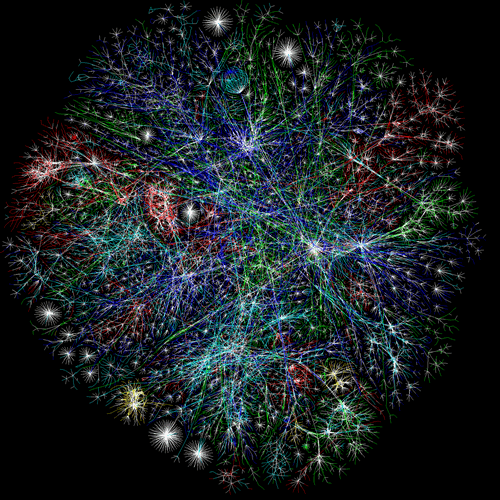
Imagine the world as a web of these lines, these human connections. That is who we are. That web. That net.