More Jews for Justice

The People Speak

Ever since Trump and Musk began to take a chainsaw to the work of generations, I’ve been hearing, “Where is the outrage?” Go to a protest near you; you will find that outrage.
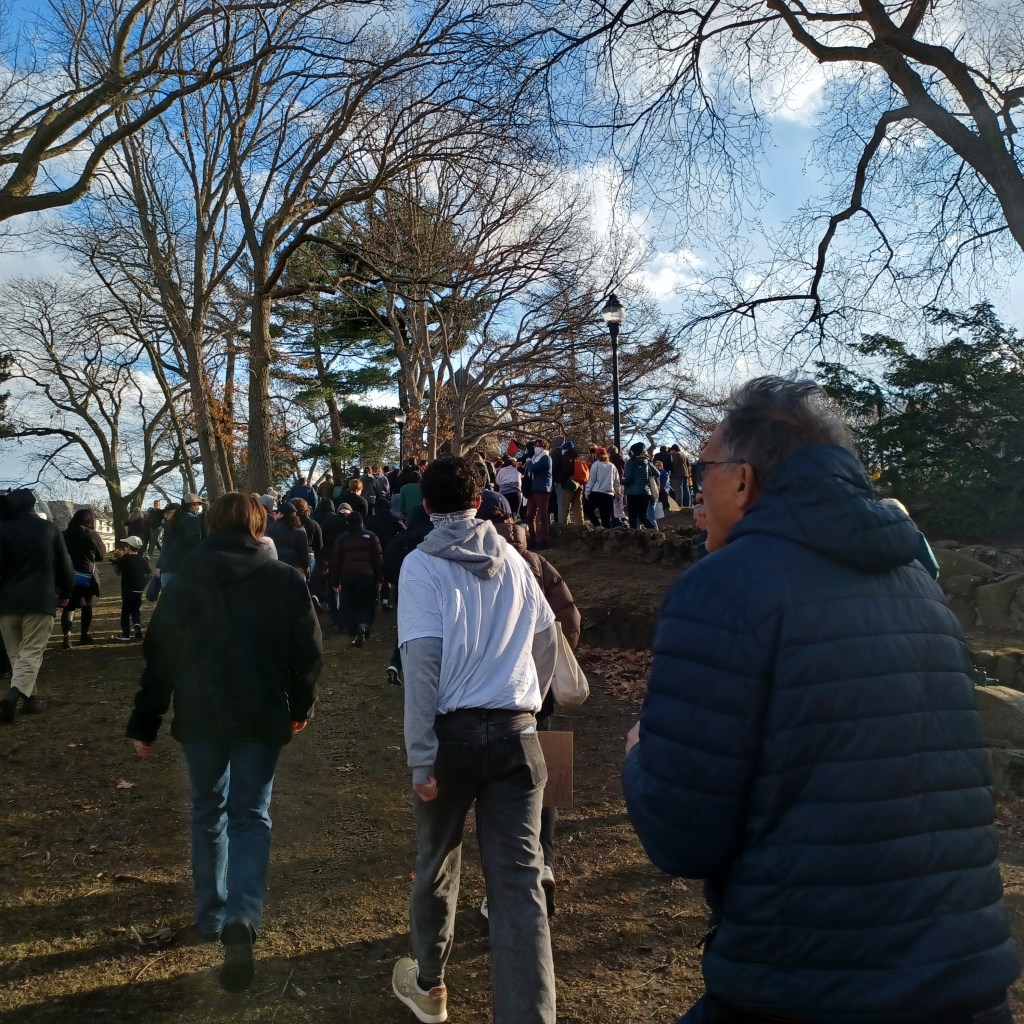
On Thursday, March 26, I went to Tufts for a rally against the abduction the day before of Rumeysa Ozturk, a Turkish doctoral student at the school. She was snatched by masked federal agents as she walked toward a friend’s house, handcuffed, and driven away in an unmarked car. Before a judge could order that the government not take her out of Massachusetts, she had already been spirited away to an ICE detention center in Louisiana.

Ozturk was grabbed without any form of due process. She was in the United States legally on a student visa. She had done nothing wrong. About a year ago, she objected to Tufts’s refusal to divest from Israel in an opinion piece in the student paper. Trump & company have decided that anyone who uses their freedom of speech in a way they don’t like is a threat to national security, maybe even a terrorist.

Outspoken international students are low-hanging fruit. Trump means to pick them and throw them somewhere to rot. He doesn’t have to abduct all of them, just enough to shut the rest of them up.

But students are not shutting up. Ozturk’s abduction, added to the equally outrageous detention of Mahmoud Khalil, a Columbia student, three weeks ago, and the rendition of  more than 250 Venezuelans to the worst prison in El Salvador with no proof that any of them were criminals or gang members, has pushed many into activism.

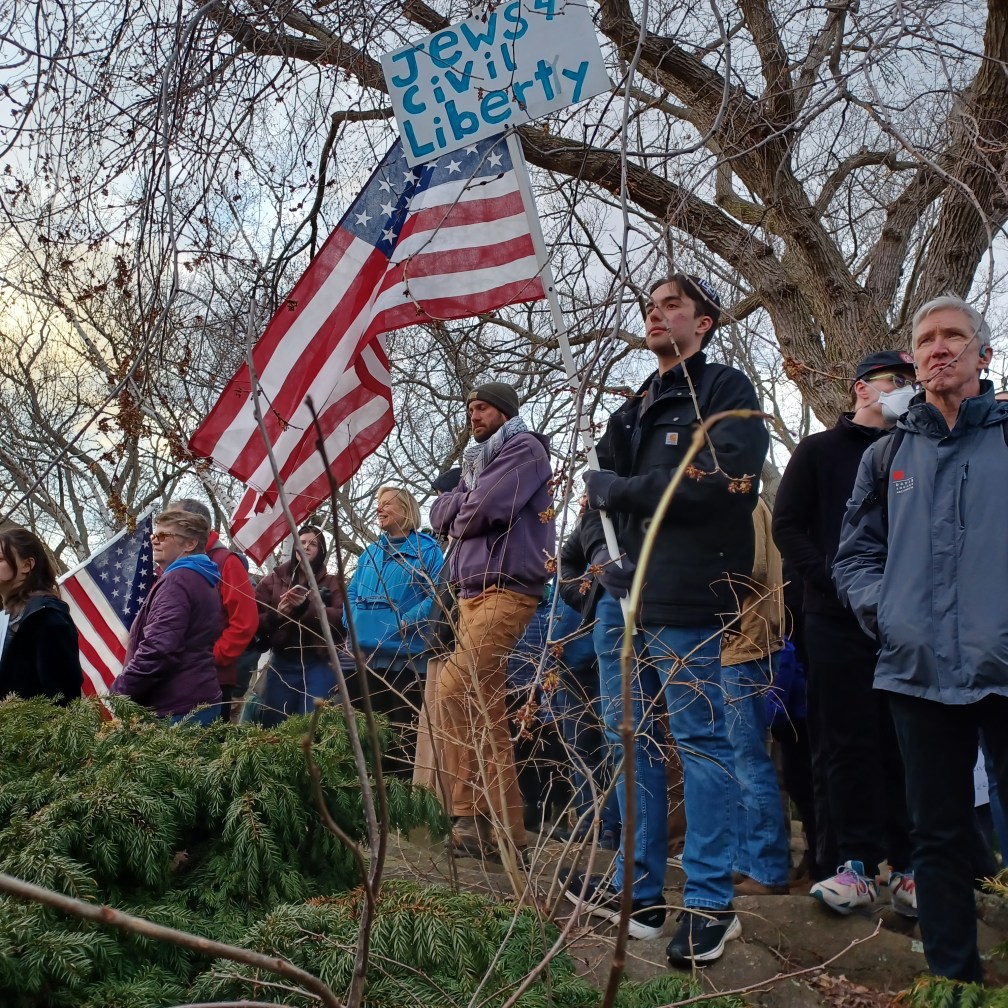
The Tufts rally comprised about 2000 people, most with handmade signs. Never mind the speakers, whom I couldn’t hear anyway. This is what their signs said:

An injury to one is an injury to all.
Free Rumeysa!
Democracy NOT deportation protects Jewish students
We will not be silenced!
Silencing dissent is the REAL cancel culture
If not fascism, then why fascism-shaped?
Democracy > Deportation
Release all prisoners of the secret police
Democracy is under attack!
Speak out against injustice or you’re gonna be silenced next
I love inclusion, equality, diversity
Stop doing evil shit
Abolish ICE
ICE out of our communities! Free Palestine!
Jews Against Deportation
This Tufts alum affirms the equal dignity and humanity of all people
Nice Jewish Students for Democracy
(a ten year old with a rainbow sign) RESIST!
Jewish Civil Liberty
Hands off our neighbors
Find courage/ find community/ fight fascism
They want us scared/ We’ll show them our strength
This is fucking insane
Free Rumeysa – Free speech
It starts with students!
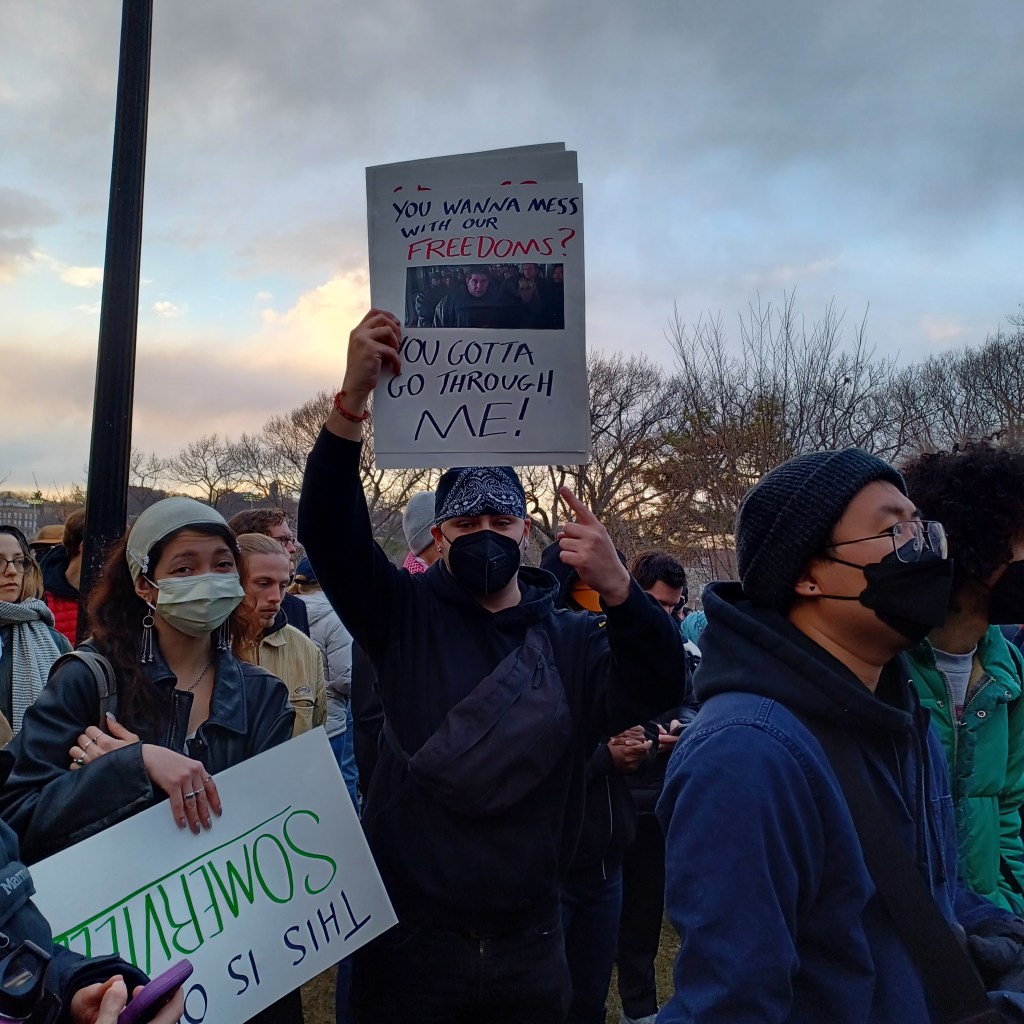
You wanna mess with our freedoms? You gotta go through me!
Stop kidnapping students.
You can’t appease a dictator!
Show your face when you steal our students.
This is OUR Somerville.
Immigrants make us great.
Don’t sleepwalk through fascism.
Stand together.
Never normalize kidnapping.
Melt ICE
Silence is complicity.
When speech is silenced, Revolution speaks.
First they come for the scholars.
Against Genocide Anywhere.
(More signs from a small, poorly organized protest in Harvard Square the next day:)
In the name of humanity, we refuse to accept a fascist America
Hands off legal students and visitors
Stop the fascist assault
I(ncompetent) C(ruel) E(xpensive)
Due process rights for ALL people (see the 5th amendment)
Our tax dollars fund genocide
In the name of humanity, let in asylum seekers and refugees
Deport ICE not students
1st amendment? Hello???
Project 2025 indicates that it won’t be long before Trump uses the military against peaceful demonstrators. There will be tear gas, pepper spray, and water hoses, mass arrests, and eventually, rubber bullets or worse.

Meanwhile, Trump is damaging everything we love: our communities, education, alliances with other democracies, the environment, and most of all our rights. Democracy is clearly under attack. As Americans realize how much harm is being done, we get angrier, maybe even angry enough to get up off the couch and do something.

The protests are becoming more frequent, and the crowds keep getting bigger. If you’re not on the streets already, I hope you will join us soon. The homemade, passionate, outraged signs at every rally help me to believe that maybe we can save democracy. Not leaders or heroes, or the corporate-owned Democrats. We, the people. 
Harvard Protest, part 5

The campers take their tents down a week before graduation, or Commencement in Harvard-speak. They believe there has been a peaceful resolution to their protest: no harm, no foul. They remove the tents without fuss so the University can proceed to set up its formal events. In return, their suspensions will be reversed so the seniors can graduate, and the rest can return to campus in the fall. President Garber has promised leniency, or so they think.

But has the University negotiated in bad faith? Although Garber’s May 14 email promises to expedite the protesters’ disciplinary cases, and he says he will ask all the Harvard schools to begin the reinstatement process for those put on involuntary leave, he never explicitly promises that they will be reinstated. And they are not. Instead, the Administrative Board — the College disciplinary body — suspends five students and puts more than 20 others on probation for participating in the 20-day encampment. This means that 13 seniors will not get their diplomas, including several Rhodes Scholars.

More than 1100 undergraduates sign a petition urging the College to overturn the sanctions. A majority of the professors present at a May 20 meeting of the Faculty of Arts and Sciences vote to overturn the sanctions, claiming that according to University statutes, the Administrative Board is “subject to the authority” of the Faculty. The next day, more than 500 faculty and staff sign an open letter asking for the sanctions to be reversed.

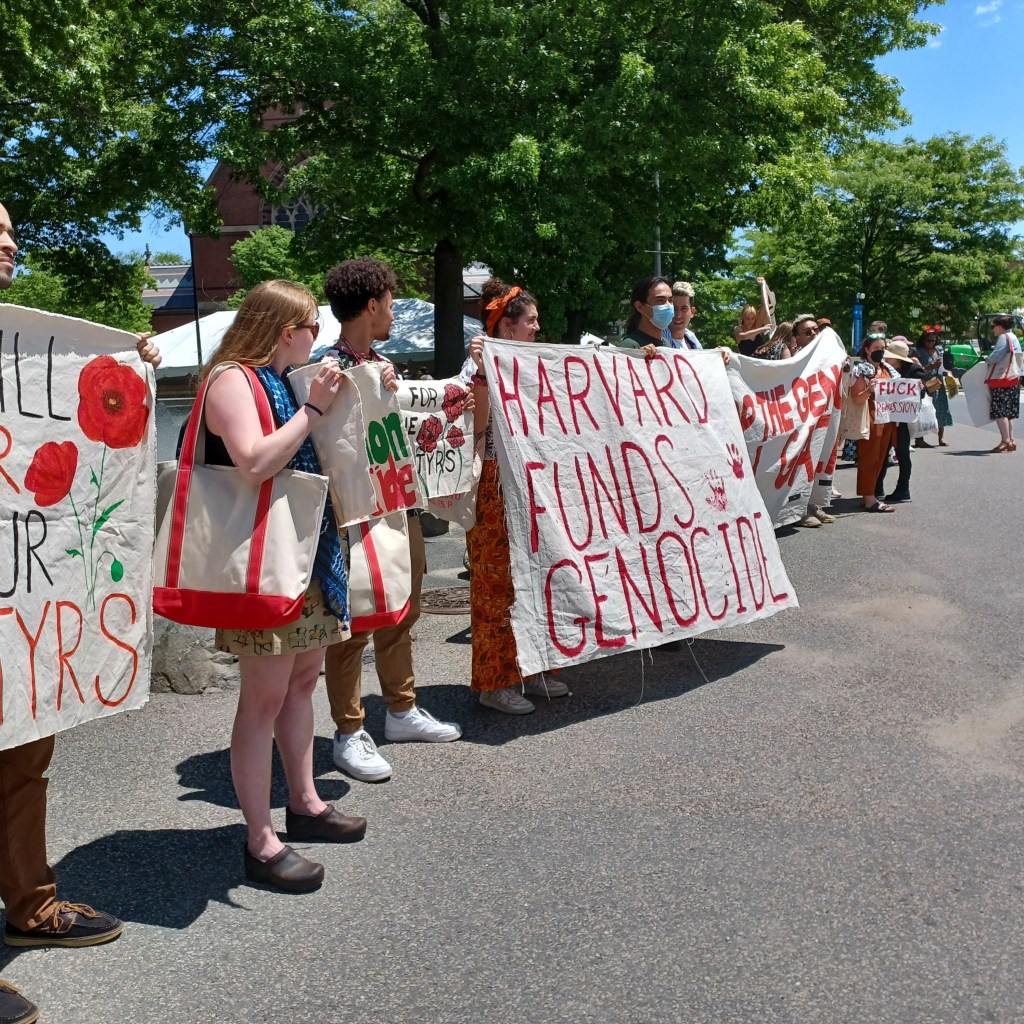
During the actual Commencement ceremony on May 23, more than 1,000 people stand up and walk out. Most walk across the Cambridge Common to the Harvard-Epworth Church for an alternative graduation ceremony.

At the formal ceremony, two student speakers go off-script to condemn the sanctions. The Senior English Address speaker, Shruthi Kumar, tells the audience she is “deeply disappointed by the intolerance for freedom of speech and the right to civil disobedience on campus.” But the Ad Board, led by College Dean Rakesh Khurana, refuses to change its decisions, and the University backs it up. Or perhaps the University sticks to its decisions and the Ad Board backs it up.

Harvard Yard has hosted protest encampments many times before. The most famous occurred in 1969, when the University called in city police to arrest students occupying University Hall to protest the Vietnam War. The brutality of those arrests prompted a University-wide student strike. In 1986, students built a “shantytown” protesting Harvard’s investments in apartheid South Africa. For three weeks in 2001, as part of the Living Wage campaign, students camped in around 100 tents in the Yard to support others occupying Massachusetts Hall, where the University President’s office is located. In 2011, tents went up for Occupy Harvard. In 2014 and 2015, students blockaded Mass Hall demanding divestment from fossil fuels. In 2016, they held a sit-in supporting a dining hall workers strike.

Since the 1969 catastrophe, aside from one arrest in 2014 and some three-week probations, no serious sanctions were imposed on such demonstrations until this protest. Protesters and their sympathizers call this unprecedented degree of punishment “the Palestine exception”.

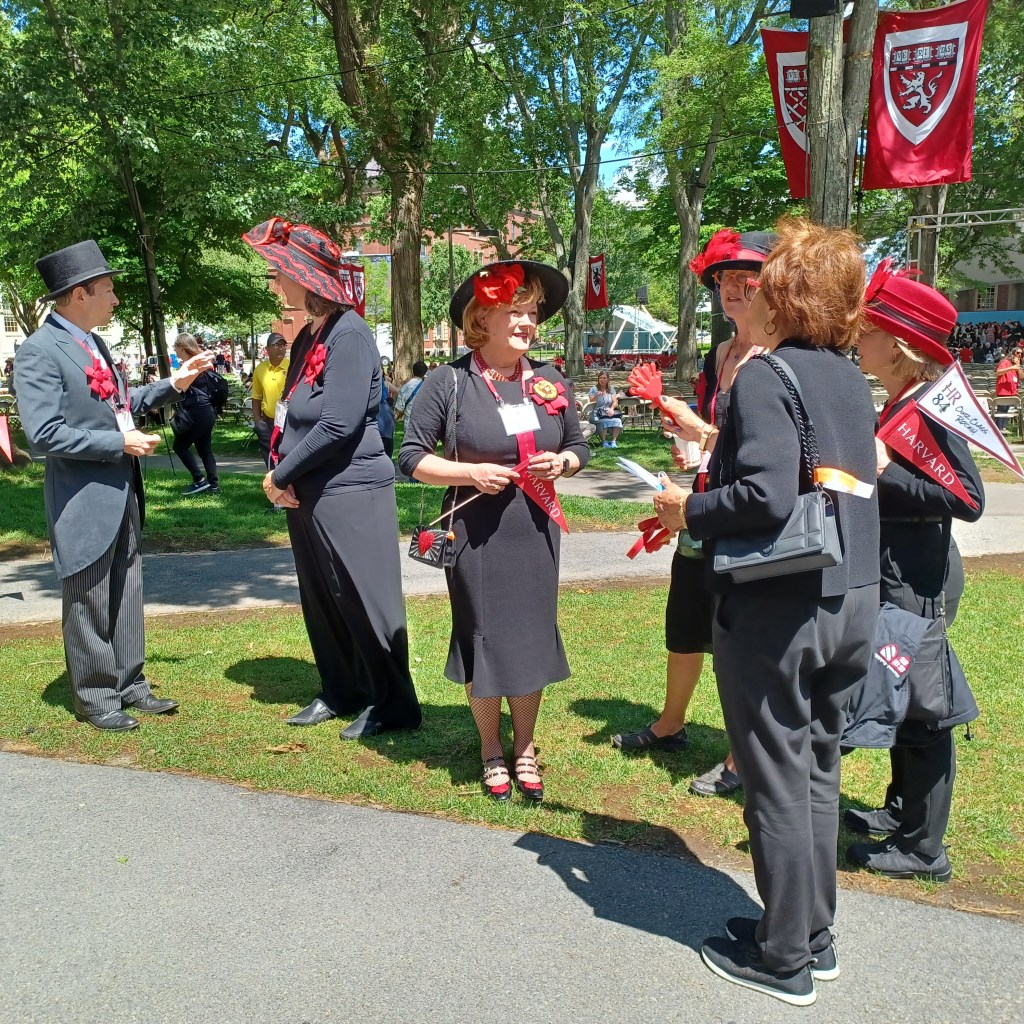
On Friday, May 31, the University holds the last of its large end-of-year events, Alumni Day. Hundreds of alumni used to form a procession on Commencement Day and march before the graduating seniors, but since COVID, alumni get our own day, a week after the students have all gone home. It’s a little odd to have such a grand procession with hardly anyone in the audience, a parade with no bystanders. Alumni are seated as we march in, filling the front rows and leaving most of the back rows nearly empty.

A friend says someone asked him why the alumni are having such trouble getting themselves into line. He answered, “Because everyone wants to be in front.”

Tiny bright green aphids rain out of the trees onto a multitude of crimson hats and gray heads. People wave red plastic clappers and flags, hold giant helium balloons, and wear red headbands with glittery pompoms on top, as though they had never worried about microplastics. My friend calls the excess of shields, banners, top hats and tails “Anglophilia”; a royal wedding would not seem out of place.

Just before President Garber stands up to speak, there is a commotion onstage. A young woman pours a vial of gold glitter onto his head, shouting “For the baby monkeys!” She is a member of PETA (People for the Ethical Treatment of Animals), unaffiliated with the University. She is arrested for assault and battery, trespassing, and disturbing a public assembly. Her cause has no connection to the movement against the Gaza War, except that it is also a cry against captivity, cruelty, and needless killing. When he begins to speak, Garber graciously tells the audience “I could use a little glitter,” and reaffirms the University’s commitment to free speech.

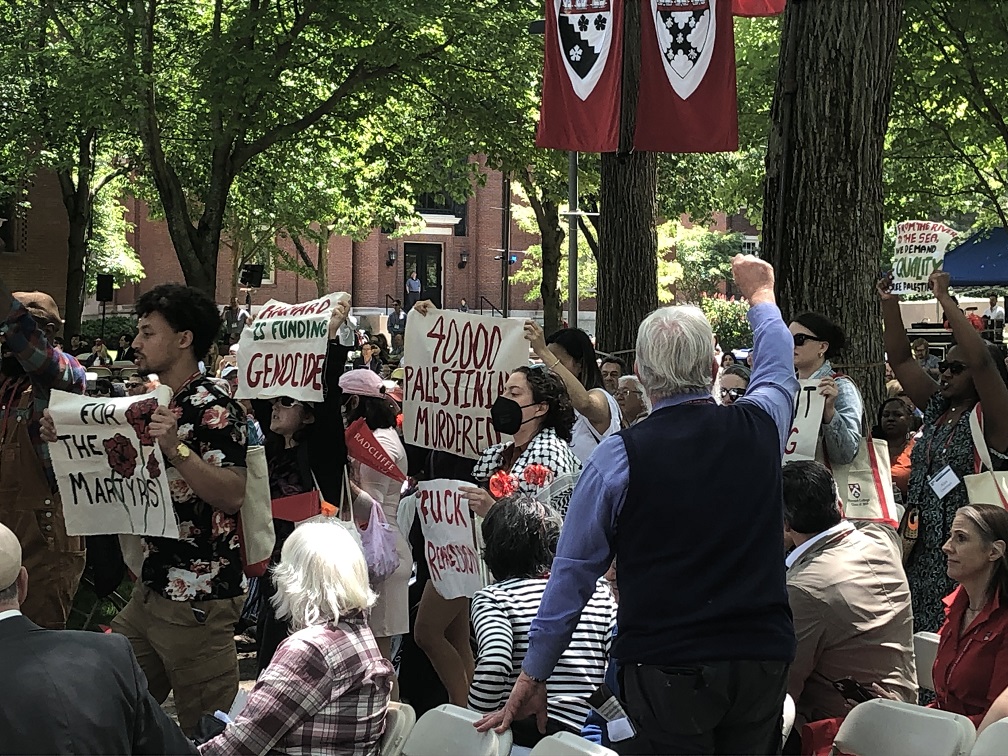
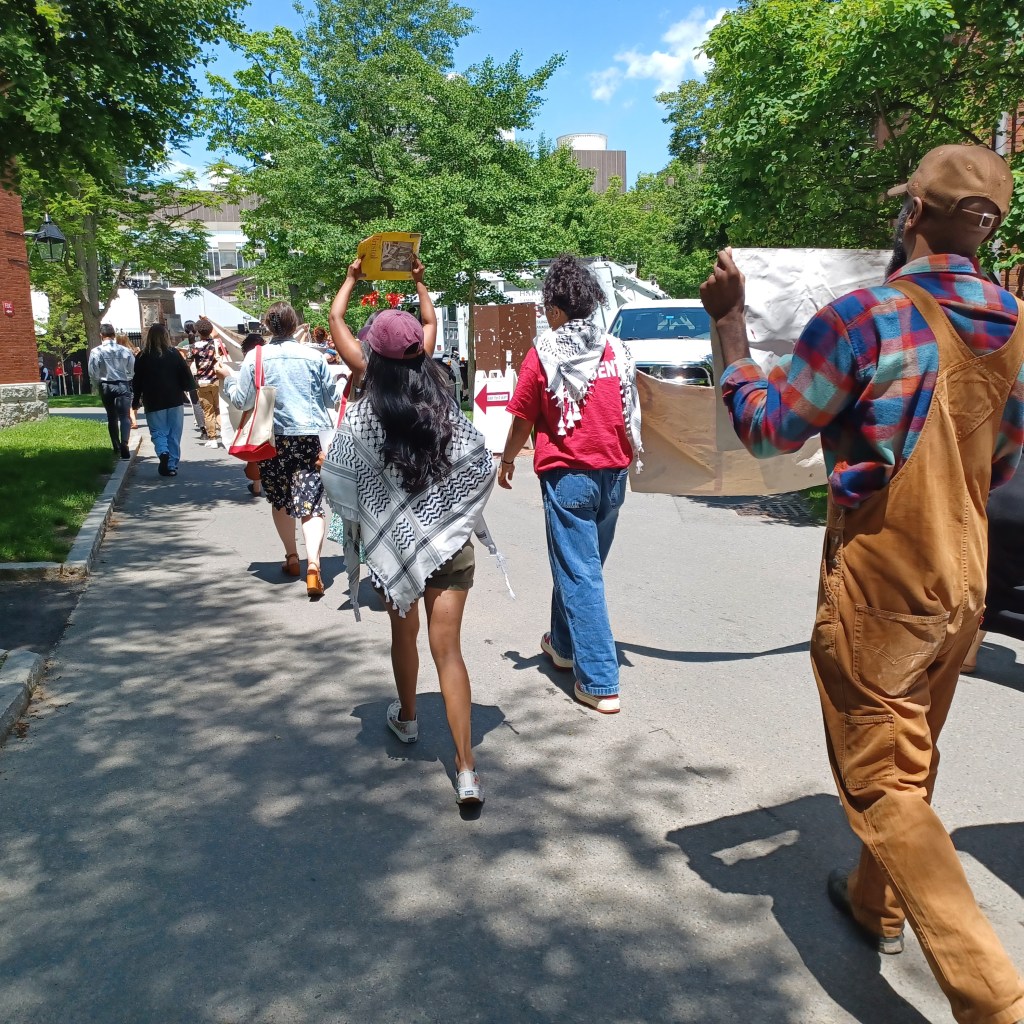
After that incident, the incursion of a couple of dozen pro-Palestine demonstrators is a bit anticlimactic. They walk up and down the aisles with banners and posters, but do not attempt to get on stage. They get loud boos and a scattering of applause. Nobody makes a move against them as they leave the Yard. I wonder if this demonstration was negotiated with the administration in advance, or if the security guards and admins simply know this group well enough by now to trust its commitment to nonviolence.

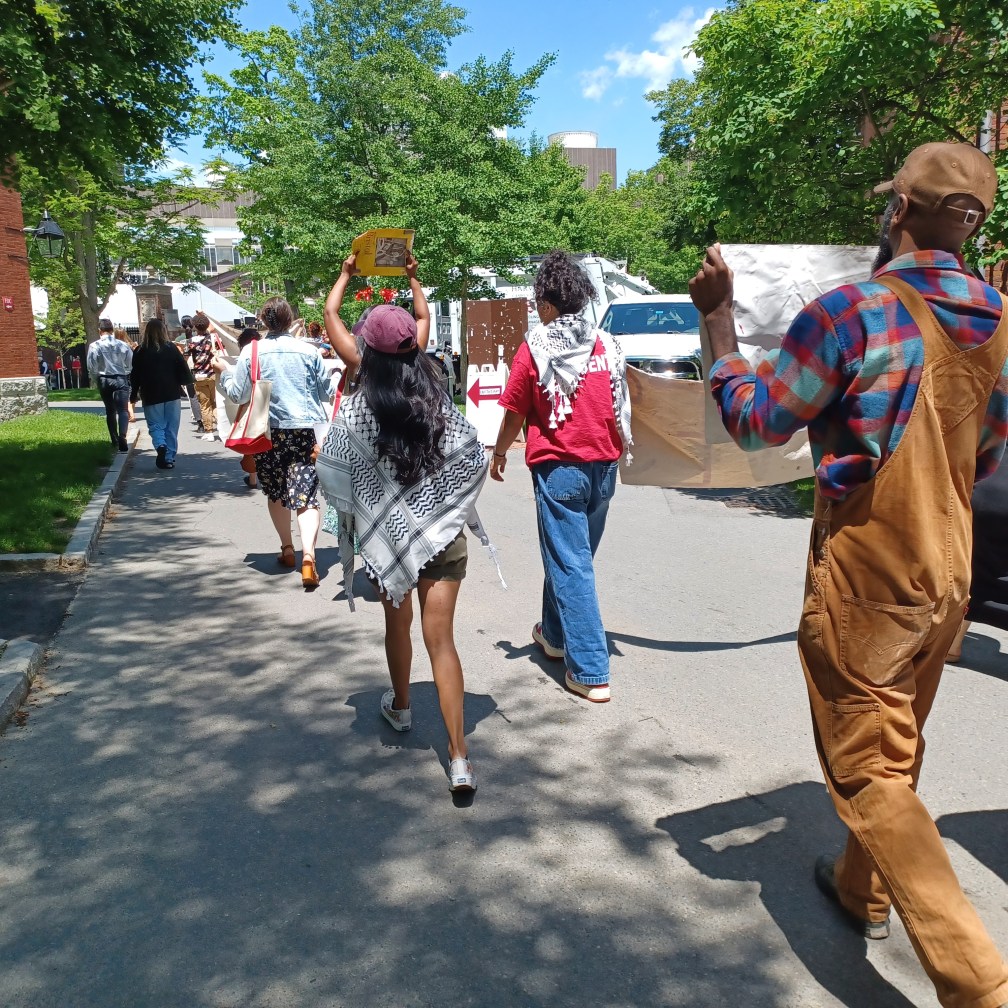
I run to catch up with the protesters. They stand in front of the Science Center for a while handing out pamphlets about the Gaza war and why Harvard should divest. Then they disperse. Nothing else seems to be happening. More student demonstrations will have to wait for this fall.

I go back to the Yard to get the free lunch.