Atheist’s Bible: Apocalypse

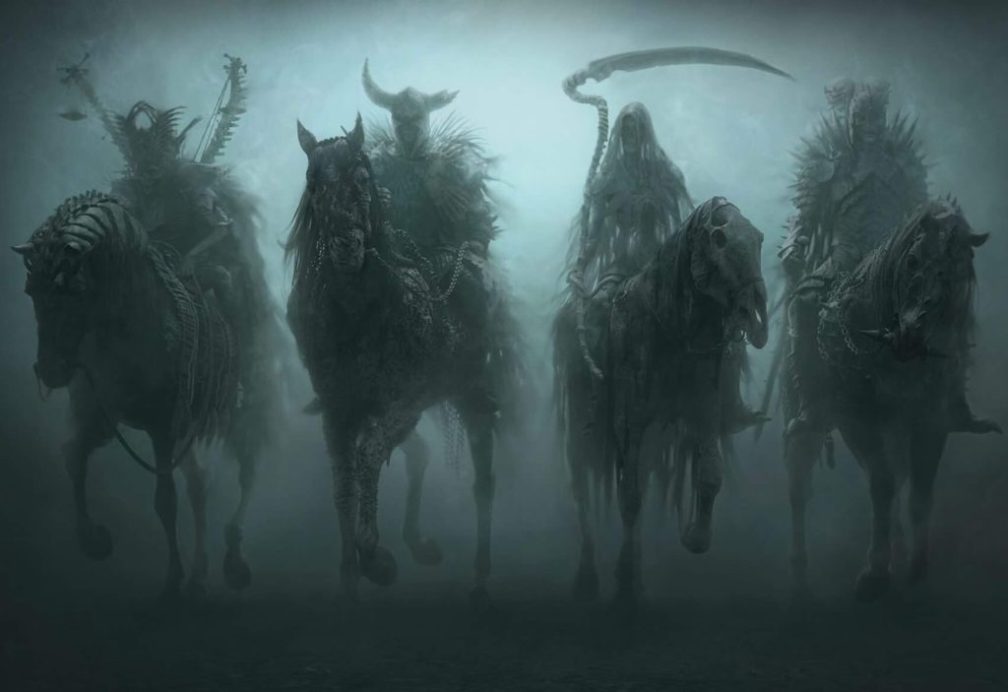
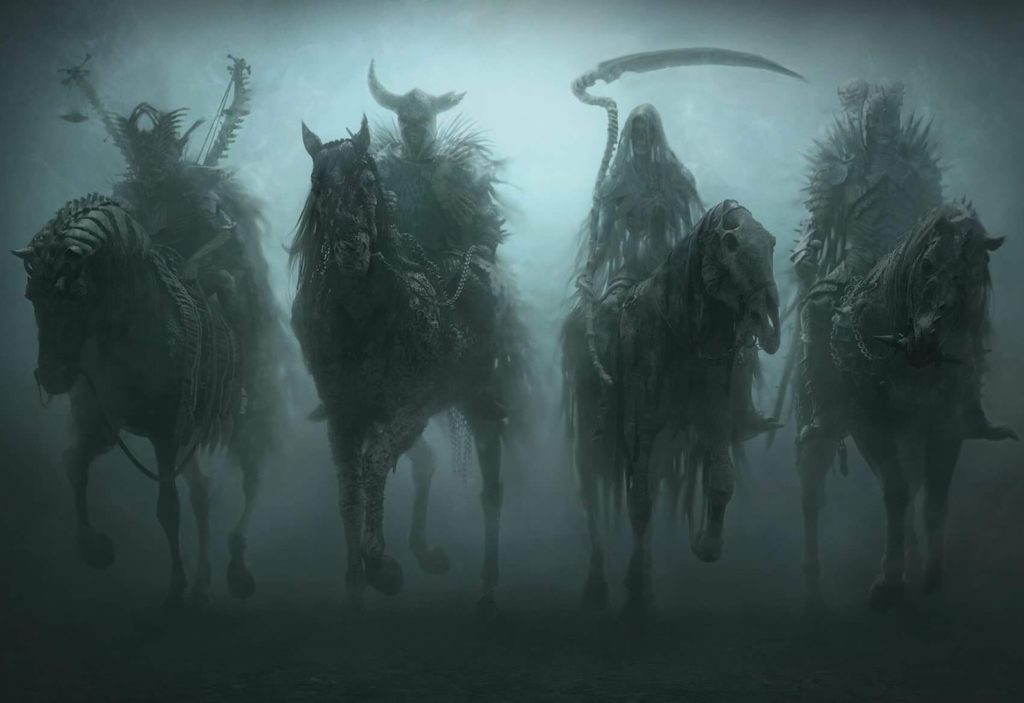
The Four Horsemen appear on the news every day: war, disease, famine, environmental catastrophe. Gee, who could have seen this coming? Whoever wrote the Book of Revelation two thousand years ago, for one. None of these things are exactly new in human experience. Since humanity decided to base our civilization on greed instead of compassion, this has been an easy prophecy to make.

The thing about prophecy is that it’s meant to scare people into changing our behavior. If it works, the direst predictions won’t come true. The prophecy makes the threat of extinction both vivid and immediate. We already know that our current path is not survivable. We just think we can keep going a little while longer, in spite of the evidence. Addicts need to “hit bottom” before they quit doing whatever is killing them. Has our society hit bottom yet?
Not the Neighborhood Watch

All our addictions – to drugs, to war, to fossil fuels, to accumulating stuff – stem from humanity’s central problem: how to keep from being ruled by the worst of us. The problem shows up in Putin’s aggression, Trump’s hatefulness, Big Oil’s continuing lies. The solution is not any single hero coming to save us. The solution is the best of us, working together.

Addicts endure going cold turkey through the love of friends and family, the encouragement of others in the same situation, and inner strength. The same things apply to all our addictions. If people can quit drinking, we can quit buying plastic junk. If one fragile, needy individual can stop smoking, this fragile, needy species can stop war.

Right now, the good guys are terribly disorganized. We’ve allowed ourselves to be separated by nationality, ethnicity, religion, gender identity. Even our do-gooder organizations are separated by the causes they support, as though peace and justice and environmental sustainability were not deeply interdependent.

National boundaries, financial wealth, and all the other barriers to our solidarity are products of human imagination. Apocalypse, on the other hand, is the furthest thing from imaginary. It will be the only reality if we remain divided behind those barriers instead of getting ourselves together.

Like it or not, this is our planet. It’s time we start owning it. Here’s another 2,000 year old prediction: the meek shall inherit the earth. If we do, it won’t be a moment too soon.

Fear is a good start

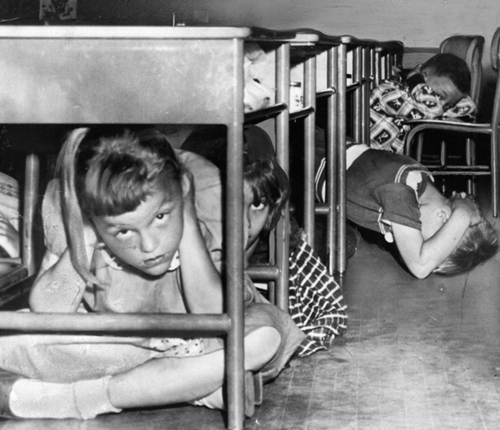
duck and cover

I’ve been scared most of my life: of nuclear war, of hateful prejudice, of environmental destruction. I always wondered why other people weren’t scared too.

Now that so many more people are afraid — of COVID-19, of poverty, of climate catastrophe — I feel better. At last, we are beginning to face the consequences of the way humanity has behaved. That means there’s a chance we can change our behavior.

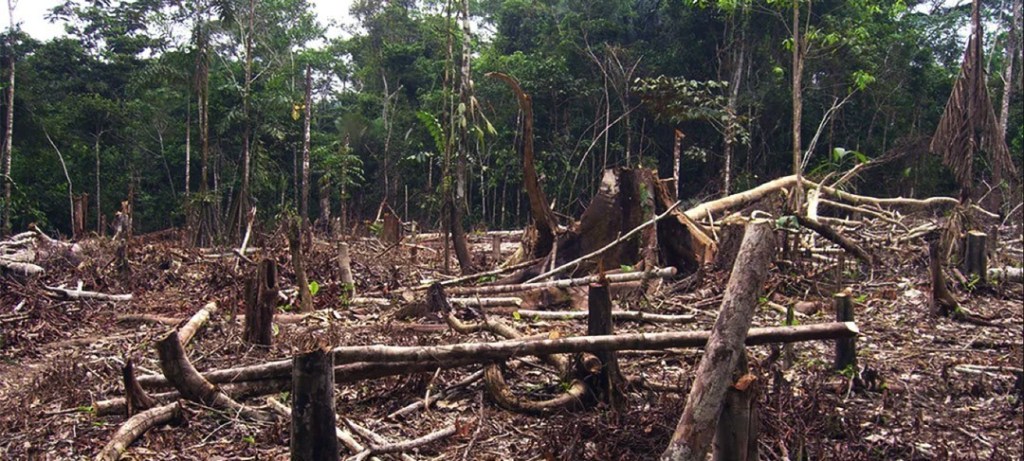
We have based our culture on greed and violence. This is no way to run a planet. We have been cutting down rainforests, the lungs of the earth, so we can have palm oil and hamburgers. Now the earth is heating up so fast, we’re afraid humanity can’t stay alive on it much longer.

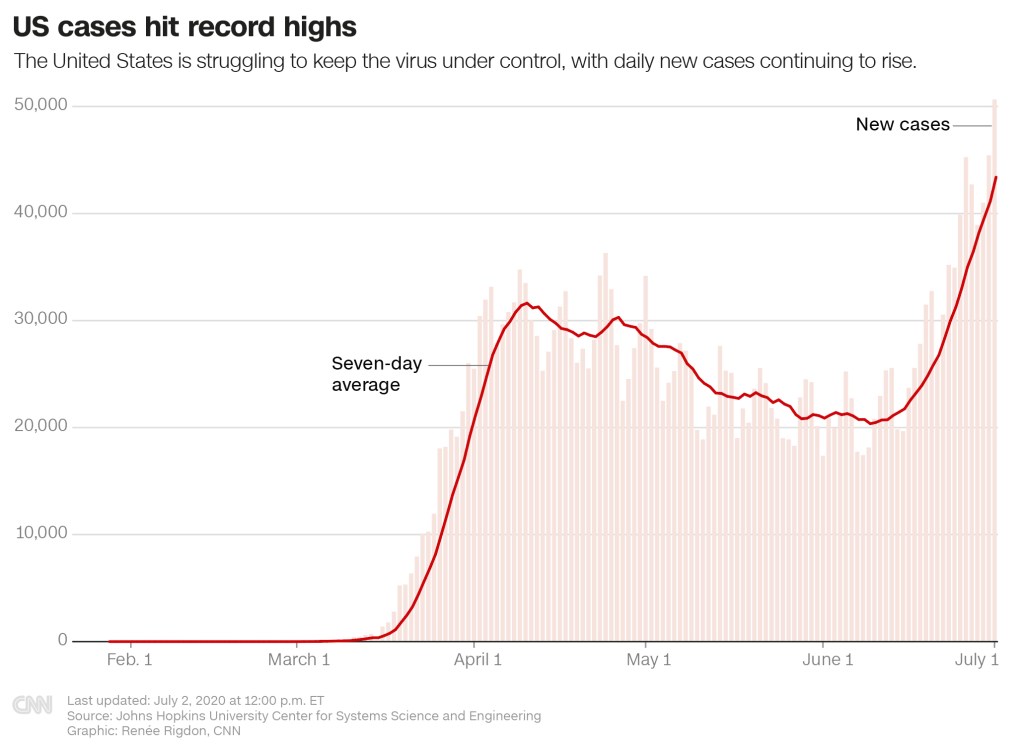
The USA is showing the rest of the world what happens when you refuse to acknowledge reality. Trump insists the virus is a hoax, and basic safety measures are an attack on our freedoms. So hundreds of thousands of Americans are dying. Eventually, we will admit the only way to save our people is to wear masks and maintain distance everywhere we go. Meanwhile we will lose far too many. But we will learn.

The USA is also showing the world how to change the culture. Thanks to huge, nonviolent protests, the Black Lives Matter movement has finally made most Americans aware that racism is another deadly virus we all must fight. Black people have moved from fear to anger, from suffering to action. They have educated and mobilized their allies. This is how we make a difference: we do it together.

So do get afraid, my friends. Just don’t stay that way. This is a beautiful world. Humanity is worth saving: people can be awesomely kind and creative. It’s not individuals who are the problem, even Trump; it’s our cruel and selfish culture. Let’s get together and change it.

When Children Ask

Recently an eight-year-old asked me, Is this the Apocalypse? I answered from six feet away, through my mask, Probably not. This self-isolation won’t last forever. It will just feel that way. Besides, I said, Apocalypse means the end of the world as we know it. Maybe when the old world ends, a new world begins.

This child is indignant because people seem to have forgotten about climate change right now. That’s what concerns her most: the oceans rising, species disappearing. I tell her, People knew we had to stop using fossil fuels so we can slow down climate change, but we didn’t know how. Then the virus came along and made us stop driving and flying so much. We found out we could do it. That’s a good start.

I wanted to reassure her with a hug, not with words. Around the world, people are feeling a kind of phantom pain from not being able to hug our loved ones when we all need those hugs so badly. We’re writing, we’re calling, we’re Zooming, sending virtual hugs and kisses until the real things are possible again. This is a feature of the new world. The child is already comfortable with it.

When it’s safer, a month or two or however many down the road, I am going to hug this child so hard her bones will creak. Now we know how much it really means to be able to touch the people we love. We’ll bring that feature of the old one with us into our new world.

Butterflies Take New York

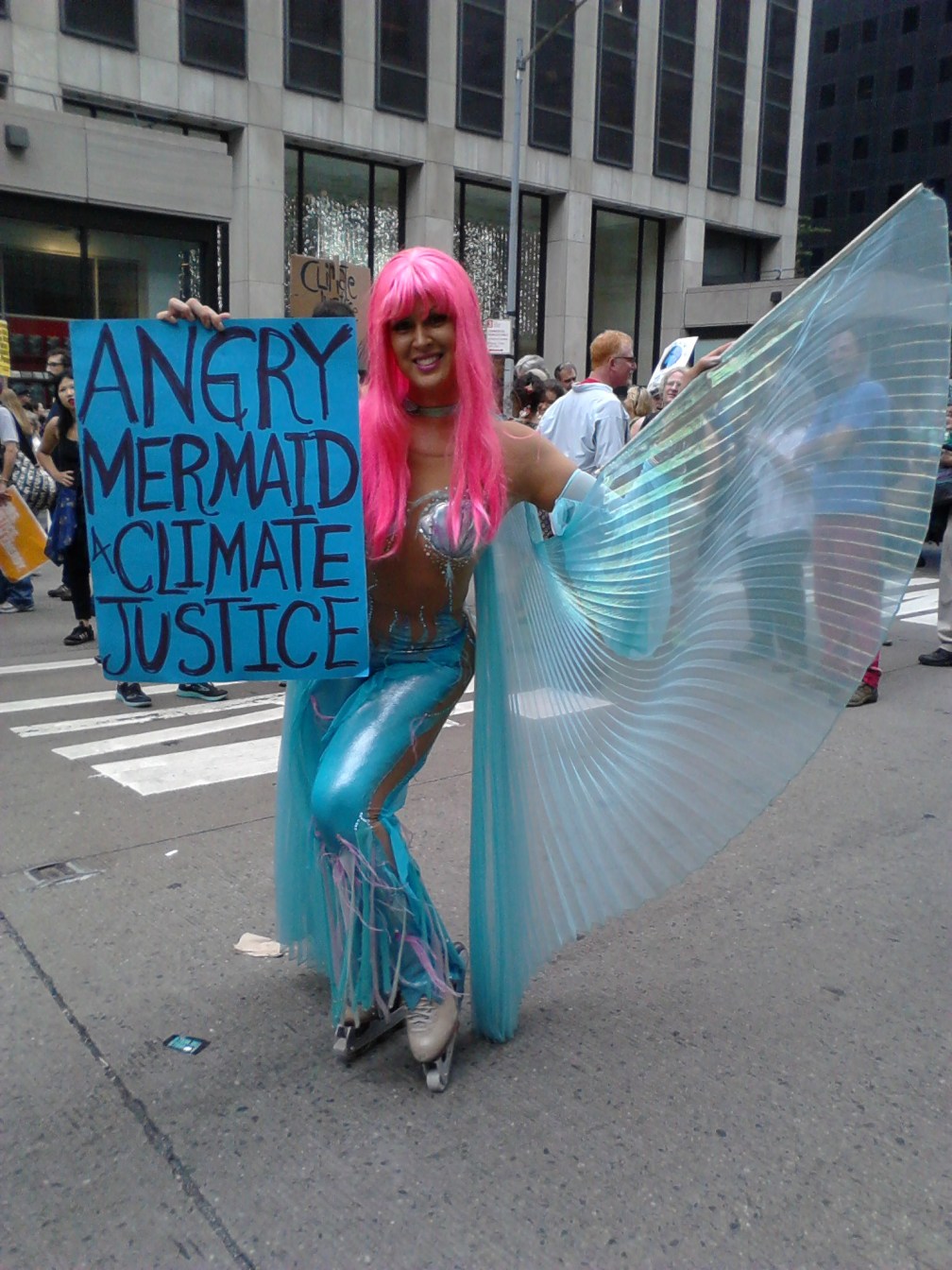
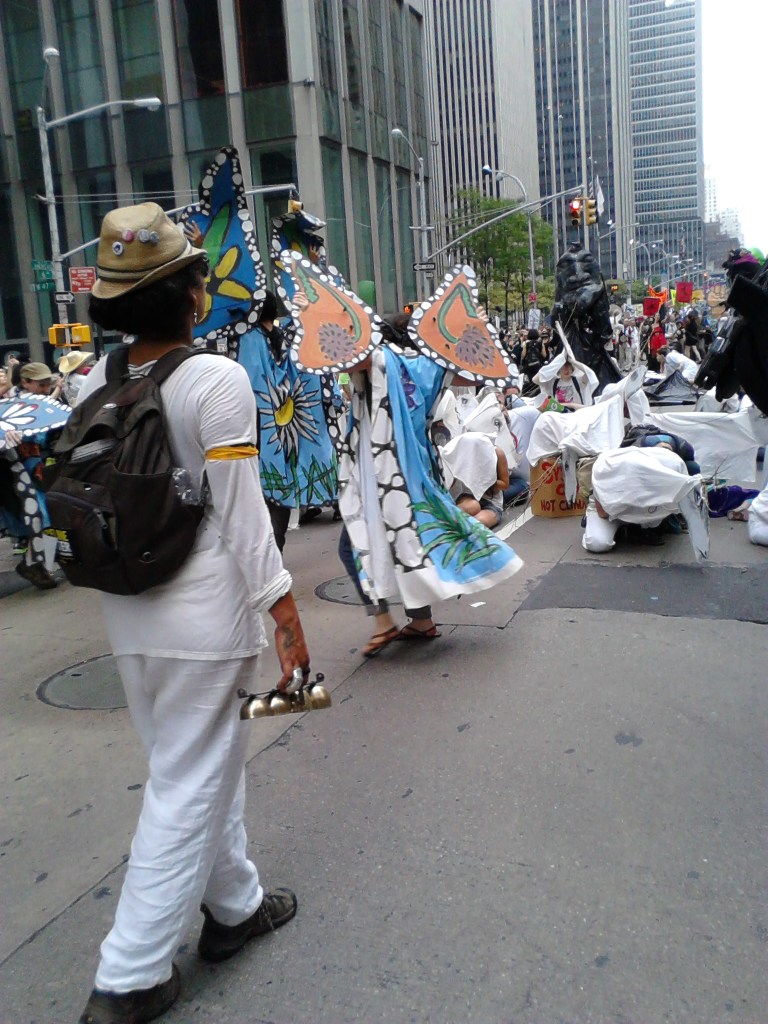
(Report from better days: September 21, 2014) The news media say 310,000 people filled the streets of New York City today, demanding action on climate change. Not all of them were human. There were birds, fish, mermaids, sunflowers, trees, and more than one Mother Earth and Mr. Death. Some species who couldn’t make it in person, like tapirs, sent human ambassadors.

The people who did look human looked like all sorts of human. Indigenous people led the march, wearing gorgeous regalia, drumming and dancing. Great numbers came in from “frontline communities” like Indonesia and poor parishes in New Orleans, the communities least responsible for climate change yet most affected by floods, droughts, and hurricanes. Young people came to fight for their futures. Old people came to fight for their grandchildren.

Some of us have been waiting 45 years to see what we saw in New York: activists for social justice, peace, and the environment joining forces. Out of countless splinter groups, the Movement has finally pulled itself back together. And not a moment too soon.

Fox “news” and Koch-funded “think tanks” might still deny the existence of catastrophic and exponentially accelerating climate change, or the fact that humans have caused it. But nearly all scientists and a growing majority of ordinary people understand what’s going on. It scares us so badly that our instinct for survival is kicking in. We are not threatened only as nations or ethnic groups. We are in danger as a species. For the first time in our history, we must identify ourselves most strongly as humans – a species as vulnerable to extinction as whales and butterflies – if we’re going to overcome our own deadly mistakes.

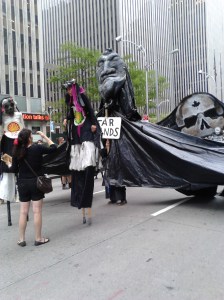
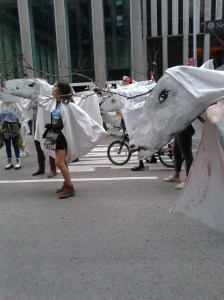
The Vermont collective Bread and Puppets performed some vivid street theater to get this point across. First came dozens of people dressed as caribou, with branches for antlers. Behind them loomed a huge Tar Sands puppet, with black wings appropriately made of garbage-bag plastic. Behind that puppet came Death.

Whenever the march stopped, the troupe blew horns to signal the advance of Tar Sands. The caribou fell cowering to the street. Death seemed triumphant; its minions danced on stilts. Then the horns blew once more, and from nowhere came the Butterflies Against Climate Change: hurrah! They flew through the crowd, revived the caribou, and defeated the forces of destruction.

So okay, butterflies aren’t going to save us. But think of them as representing creativity, the winged aspect of the human spirit, and this fable makes sense. The more we know, the more frightened we get. Our culture is so deeply rooted in greed, violence, and exploitation; so much needs to change. Our leaders get their power from the way things are, which doesn’t motivate them to change it. It’s hard not to despair.

That’s why this march was so necessary. We desperately need to believe that there is enough creativity, enough spiritual power, enough wisdom and skill in the great mass of “ordinary” people, to save humanity from the mess we have made.

On the last day of summer, hundreds of thousands of people demonstrated these qualities in New York City. Native New Yorkers – not known for their belief in unicorns – smiled and waved and flashed peace signs, hung banners from their balconies, and joined the mermaids and the sunflowers in the street.

So get in touch with your inner butterfly, and stay tuned. The struggle of our lifetimes is just beginning.

Addicted to Stuff

sung to the tune of “Addicted to Love,” by Robert Palmer

You can’t sleep
or pay your bills
You have a hole
that’s never filled
The tv ads
say what to buy
You go along
You don’t know why

We like to think it isn’t things that we love
but we might as well face it, we’re addicted to stuff

We have to buy
we can’t stop
We’ve gone broke
Still have to shop
We don’t stop
we never try
we have to shop
until we die

You might ask what has become of us all –
We’re either online shopping or we’re parked at the mall
You like to think you’re not afraid to live rough
But we might as well face it, we’re addicted to stuff

Legal Action

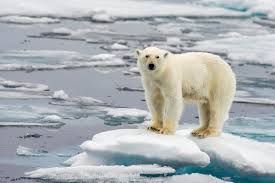
Polar bears are demanding restitution.
We melted their ice. They are homeless
and hungry. When they invade,
we shoot them. It’s time for us to pay,
they say.

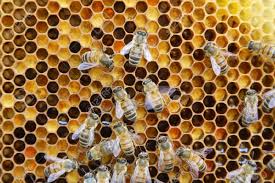
The bees are demanding restitution.
We’ve poisoned them. They can’t pollinate if they die.
For the bees, we would pay
with our lives.

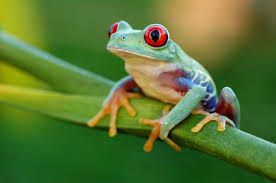
Frogs demand we replace their marshes.
They have filed a class action suit.
If we don’t pay up, they’ll unleash the bugs.
Then our best points
will be moot.

Women have filed an amicus brief
with the animals, to remind the Court
that their cause is ours, in the long run.
We can make this work for everybody
or we’re done.

The Doldrums

Becalmed for so long, we forget
the journey. We play games

of chance, succumb to trivial
pursuits, speak only gossip.

Supplies are dwindling. We can’t stay here
and we can’t leave.

Never mind. Glitter on the water and rum,
threat of the brig, chess, flying fish,

somebody always humping somebody.
We turn our thoughts from what we cannot do.

It’s been so long, we would welcome
even a storm, waves bigger than the ship,

terror. Instead we must wait, it seems,
endlessly. The dolphins pity us.

They’re free to go, and we envy them,
looking back at us with their great grave eyes.

From time to time one of us joins them,
diving ecstatically. Death is a place to go.

Lately though, something is different.
Thunder rumbling. Puffs of hot breeze,

ominous. Useless sails above us,
we wager blackly, couple without passion.

Late at night we toss and turn,
anxious, desperate for distraction,

hearing the dark sea slap at the ship.
Oh take us, move us, God of the deep!

We must have change, but we fear it.
Could life be worse than this? Much worse?

The wind of the future approaches.
It will blow away foolishness like foam.

We still might get to where we need to go,
or all dive with the dolphins, but we will move.

Trim the sails, shipmates.
The wind is rising.

Shit Piles Up

Everybody who goes through rehab knows. Everybody who has ever cleaned a toilet knows. If you don’t keep cleaning up, if you don’t deal with the ration of ugly shit we get and make every day, it piles up and gets really disgusting and harder and harder to remove. We have to keep cleaning up.
But what disappears first from government spending when people refuse to raise taxes? Maintenance. Keeping things clean and safe. So the ugly shit piles up.

Bacteria grow in uninspected food. Cars fall into sinkholes caused by ancient infrastructure. Old gas lines leak and houses explode. Lead leaches into the water and stunts the brains of thousands of children. It costs a lot to fix the damage. If we refuse to pay the price of keeping things clean and safe, eventually we will pay a much higher price. And some of the damage can never be fixed.

So let’s clean up our shit as we go. That will motivate us to create less shit to begin with. Plastic, for example: if it won’t biodegrade, we need to stop manufacturing it.

Trillions of pieces of garbage now orbit our planet, gyre on the oceans, choke the fish and poison the birds. Yet we keep making more stuff that has such a short useful life, if it gets used at all, that we might as well ship it straight from the factory to the landfill and save everybody a lot of time and trouble.

Emotional shit piles up too. Everybody who’s ever had therapy knows that. We manufacture useless crap like anger, resentment, envy, and shame, and pile it up inside. Eventually everything inside us gets disgusting and we can’t stand ourselves any more. We have to learn to clean up as we go.

Same thing with nations. We do each other dirty, and the small harms pile up. Eventually we go to war, which does more harm than anything. The residue from that damage leads to future wars. We have to clean up as we go. Notwithstanding the egos of our leaders and the pride of our ideologues, we have to apologize, make restitution, and as far as possible, repair what we have broken. Maintaining peace can be expensive, but it’s cheaper than war.

Tomorrow

We’re not flying? Good.
We’re working from home? Good.
Soon money will run low and we’ll stop shopping. Good. As long as we can get enough to eat.

There are so many not-good, very bad, seriously horrible things about this pandemic. And not much of an up-side; but it does exist, and maybe it helps a little to think about that.

We’re depending on neighbors.
We’re helping the sick. We’re sacrificing to protect others. We understand that people matter more than anything. Good.

We’re staying home, keeping physical distance, trying to save lives. We’re letting nonviolent offenders out of prison. The unsustainable economy of limitless growth is stalling. Good. Limitless growth is not health; it’s cancer.

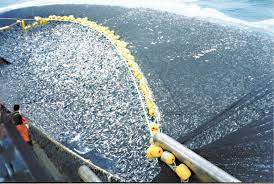
We might even stop over-fishing and let the ocean repopulate.

We’re using less fossil fuels. Pollution is dropping. We knew we had to reduce our carbon footprint to be able to moderate and survive climate change. We did not imagine this would be the way to achieve it. Maybe, though, knowing it was necessary might have prepared us to take the steps we have recently taken to moderate and survive COVID-19.

We will need to rebuild when the worse of this crisis is over. With luck and sufficient global consciousness, we will build a greener, more equitable, kinder world.

Now is the time to rethink everything.

Neo-Optimism

Anyone who pays attention to the world has got to despair.  Our dominant culture admires violence and promotes greed. We see where these values have gotten us.

I wouldn’t trust anybody who hasn’t felt that despair. Hope comes later, if it comes at all. If the world has not struck you with horror, you haven’t looked at the way it is.

If we continue on our path of greed and violence, our species clearly will not survive. The imbalance of power between the few who benefit and the many who suffer seems overwhelming. No hero has arisen who can bring about real change. We have plenty of information, but no answers.

In our greed and short-sightedness, we have used the resources of earth as though they are infinite. Our species devours everything in its path. We destroy the wild creatures and flora of the earth. We suck the earth’s juices and then crunch its bones. The losses mount exponentially.

If all we ever did was destroy, our species would not deserve to survive. In fact we could not have survived this far.  Without kindness and caring, no human would live past infancy. Loving is so much in the background of our lives that we hardly even notice it. We must remember that love – or perhaps we should think of it as common decency – is also part of ordinary human behavior, and, even in our current diseased society, it is the largest part.

We should also remember that we have changed our paths countless times, all over the world and in every era. We are finding our way through a wilderness of the spirit, and no one has been this way before.

We have always used our ingenuity to cope with changing environments. We can live under the sea and in outer space. We share ways to cope. We invent. We imagine. We merge our individual imaginings with others and make them reality.

This is the challenge: to imagine a world in which humanity can thrive, and to make it happen. We don’t seem likely to rise to this challenge. Yet the unlikely often happens.

Fresh currents continue to bubble up through the festering swamp of our culture. In recent years there have been the Occupy movement, climate change marches, peace vigils, “Black Lives Matter” die-ins, rallies for democracy and free speech. The organizers think they are fighting separate battles. But when we begin to recognize that our battlefields may be separate but our war is the same, we will find allies we never expected. We will find that we are much stronger than we thought.

That is when we will begin to be dangerous. That is why the dominant culture insists that we compete with one another, each cause fighting all the others for members, media attention, and money. Once we begin to cooperate instead, the powers that be will become the powers that used to be.

The only possible real revolution is nonviolent revolution. No other kind of movement can bring real change. Violence isn’t change. Violence is just more of the same damned thing. Nor can revolution bring change if it harms the innocent, because injustice is also more of the same damned thing. Peace and justice: now that would be a true revolution.

So go ahead and despair. Things are pretty dark right now.  Just try not to take it so personally. It isn’t you. It’s all of us. Your despair is a sign that deep inside you, a hero is waiting to be born.

The despair you feel is only natural, and you have a right to feel it, for exactly as long as you need to. Then get over it. Look for reasons to keep going and you will find them, in art, in nature, in children, in the people you love. Don’t turn away from the world because it is ugly and cruel. Keep moving, because it is also beautiful, and everything we love is in danger.

We have a lot of work to do. You have a part in this work, a part no one else can play.  We need you, exactly you, with your terrible history and your broken heart. Despair is one step on the path forward. You will like the next one better. Stick around, so you can take it.

After you realize the odds are against our survival, and after you give up hope that we can beat the forces that keep us on the path to destruction, you might one day realize that the game is not over yet. You will no longer be an optimist who thinks all will be well. You will be a neo-optimist, who has gone through despair and come out the other side understanding that all will most likely be lost. You will know this species is the darkest of dark horses. And you will bet on that horse to win.