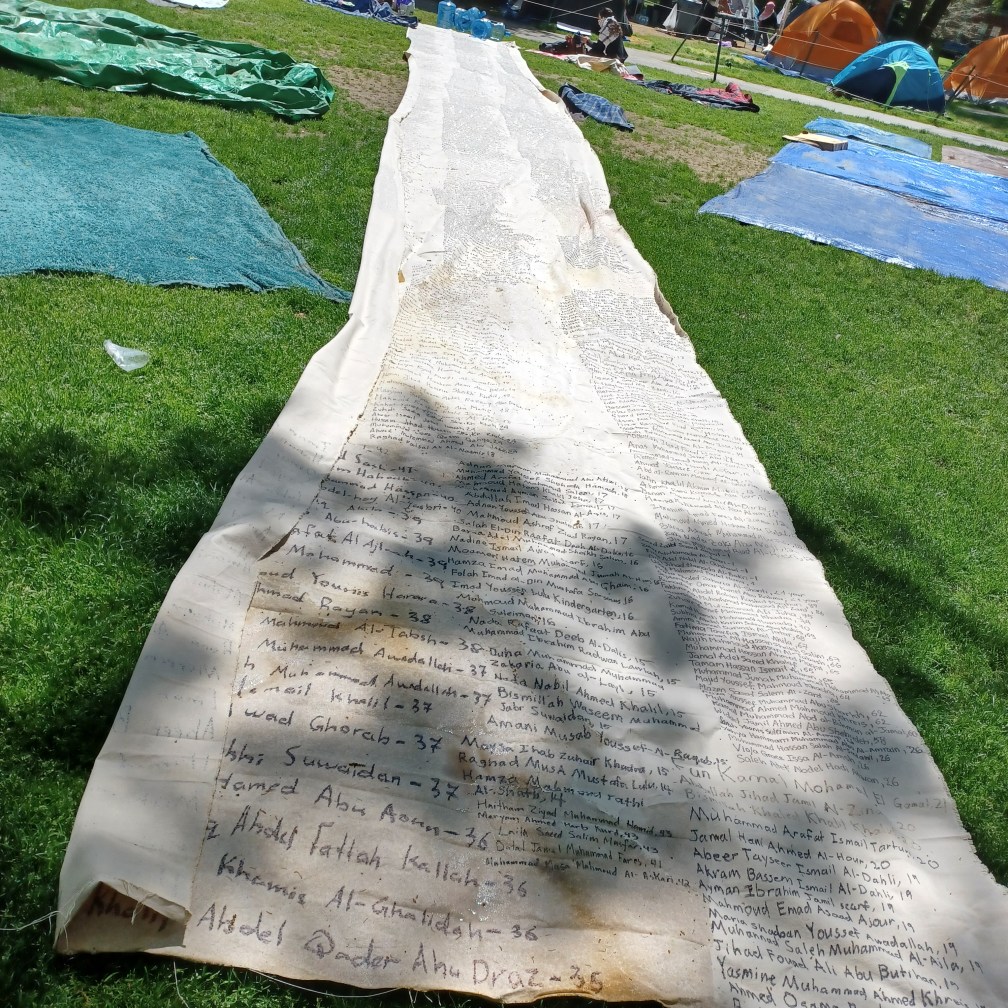
Harvard Protest part 3

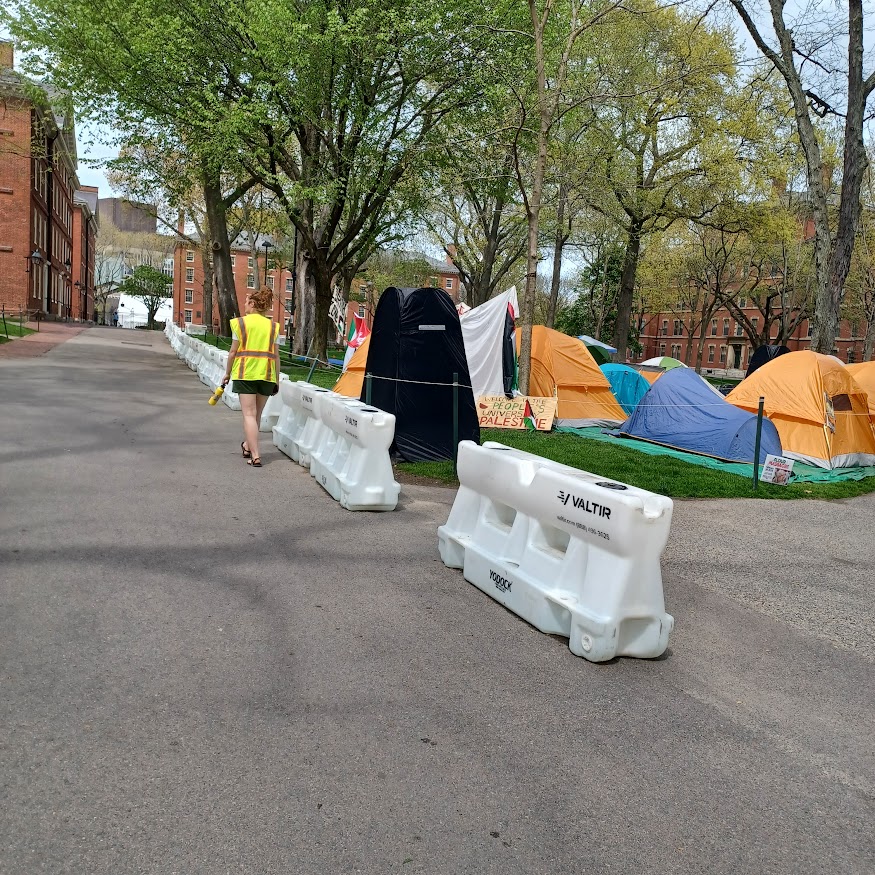
Friday, May 10, is a cool, sunny day. Rising sophomores who lived in the Yard this year are carrying mattresses, couches, and huge cardboard boxes from their dorms. Parents have only 20 minutes to park in the Yard to receive them. The protest tents are not in the way, though so many gates are closed that there is some level of inconvenience for cars coming and going.
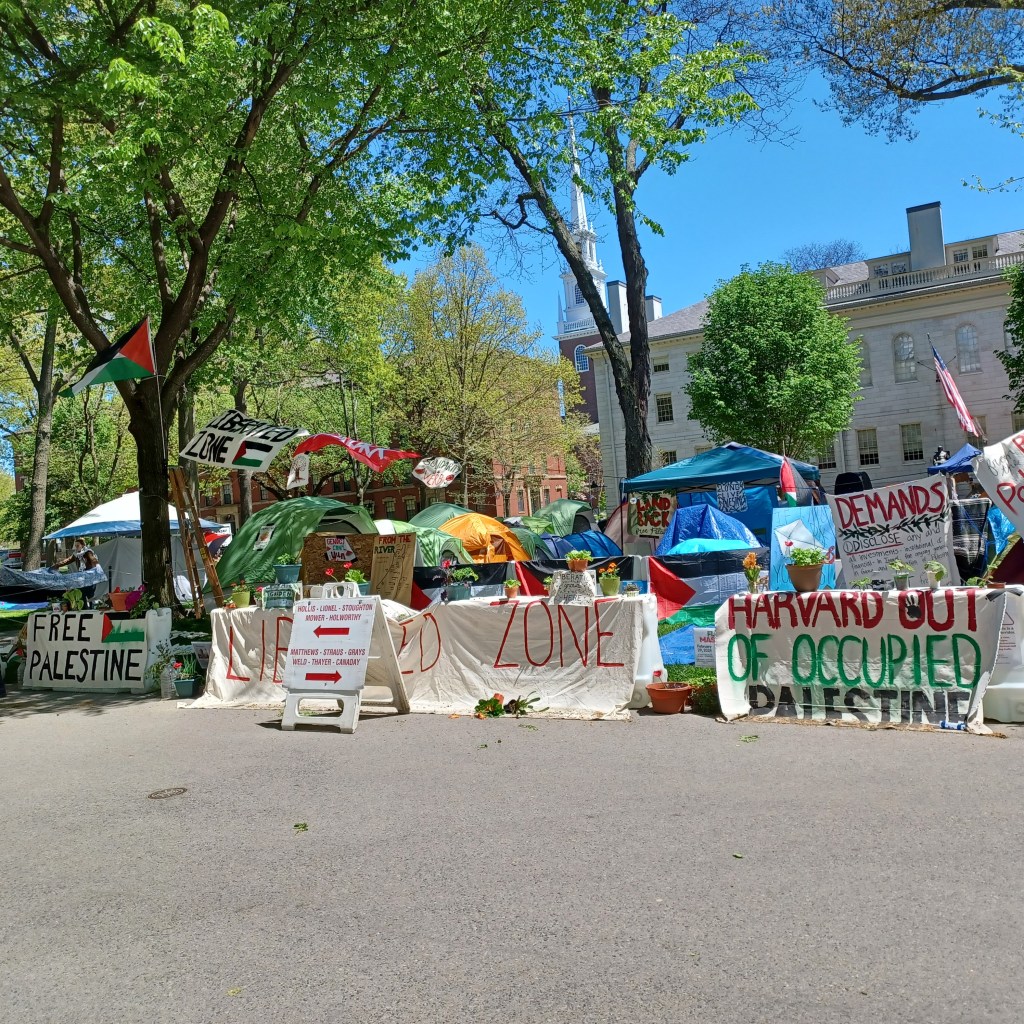
A few pro-Israel counter protesters play pop music on a radio very loudly, right next to the encampment, which is deep in discussion as usual. I don’t know why the music stops after a few minutes.

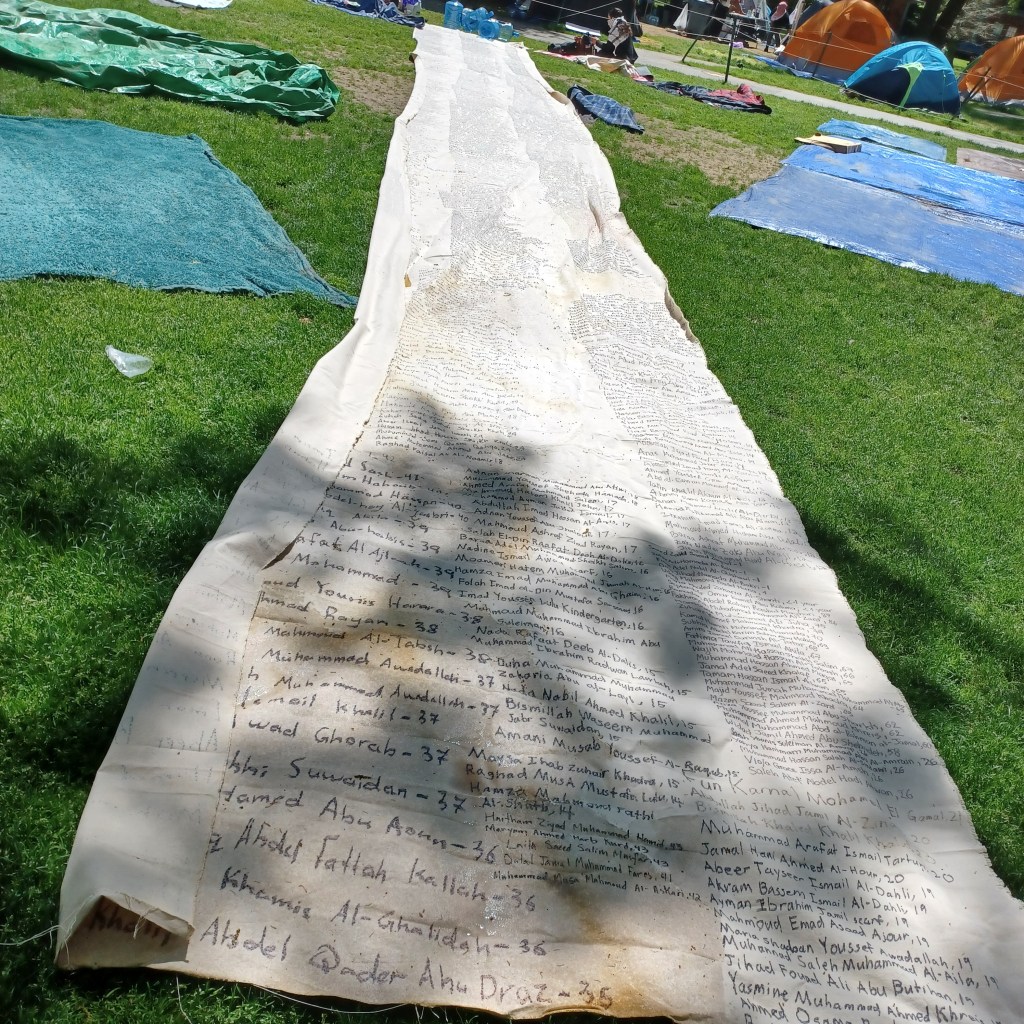
A protester asks friends on the steps of University Hall to help clean up the wet, dirty tarps on the “event space” next to the tents. Another remarks, laughing, “I haven’t had a shower in a week.”

People I knew from my campus labor union tell me that students who have been suspended or put on involuntary leave seem to have been chosen almost at random. They aren’t leaders or organizers, or even necessarily people who slept in the tents overnight. It’s more a matter of someone in the administration happening to see and recognize them, in spite of the masks or scarves many have been wearing.

Another press conference is scheduled for 2 pm. Most protesters go all the way around through the Science Center gates to get outside Johnston Gate where the press is gathering. I don’t want to walk that far, and I can’t hear the speakers anyway. Yard security and campus police are present, though not in great numbers; the tall bald guy who looks the most serious squats on his heels on a nearby path. The University’s president Garber comes out of Massachusetts Hall now and then, accompanied by a guard. I haven’t seen anyone else approach him.
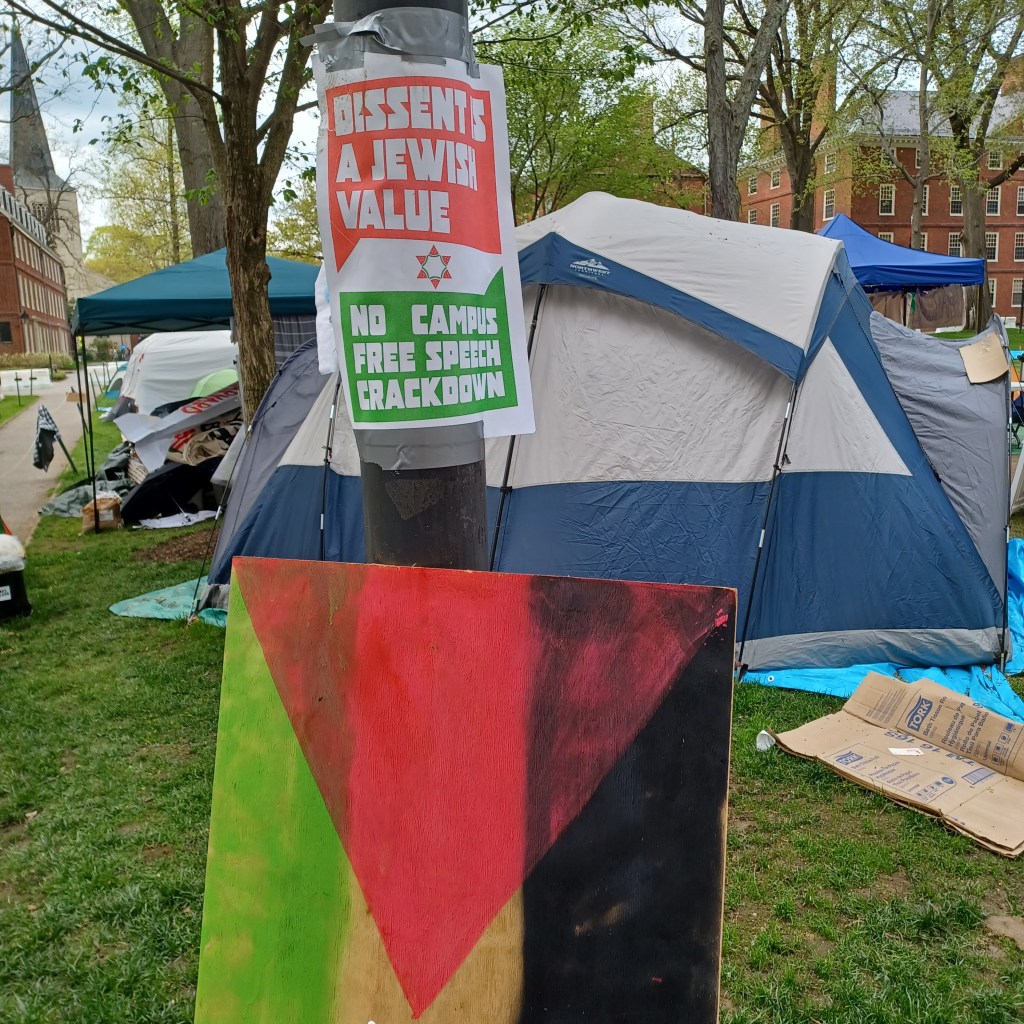
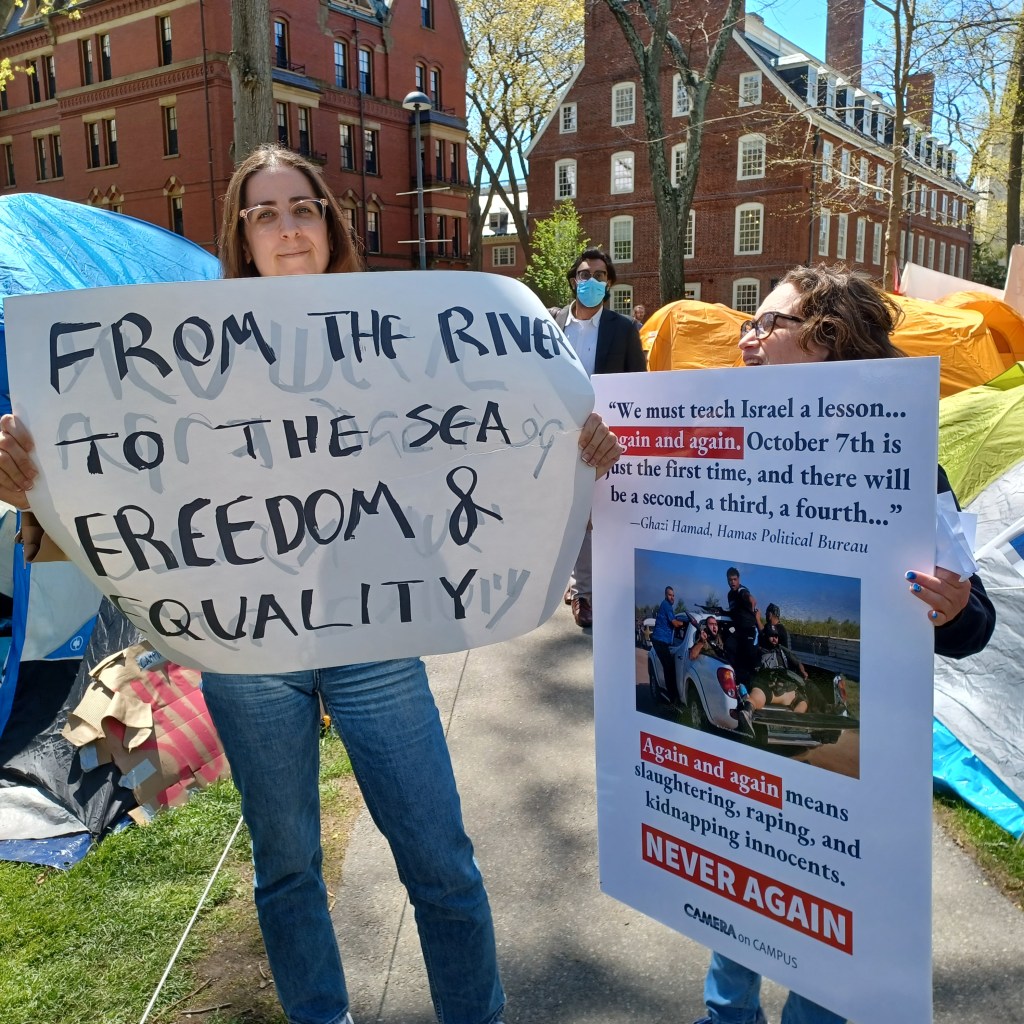
Outside the gate, the crowd is chanting “Free free Palestine! Long live Palestine!” The Harvard protesters appear to have decided not to use the inflammatory chant of “From the river to the sea, Palestine will be free” or to call for an intifada, which means uprising or resistance.

I hear one woman, annoyed at not being allowed in, ask a guard about Askwith Hall, which is blocks away from the Yard at the Harvard Graduate School of Education. She is not happy with his answer, and says to her companion, “Okay, let’s go to the media.”

My union friends and a rainbow-haired woman from the Business School think Harvard is treating this protest more harshly than previous encampments. They call it “the Palestine exception.” A student worker wonders if they lose ID access to buildings because of the disciplinary process, will that be grievable through the union.
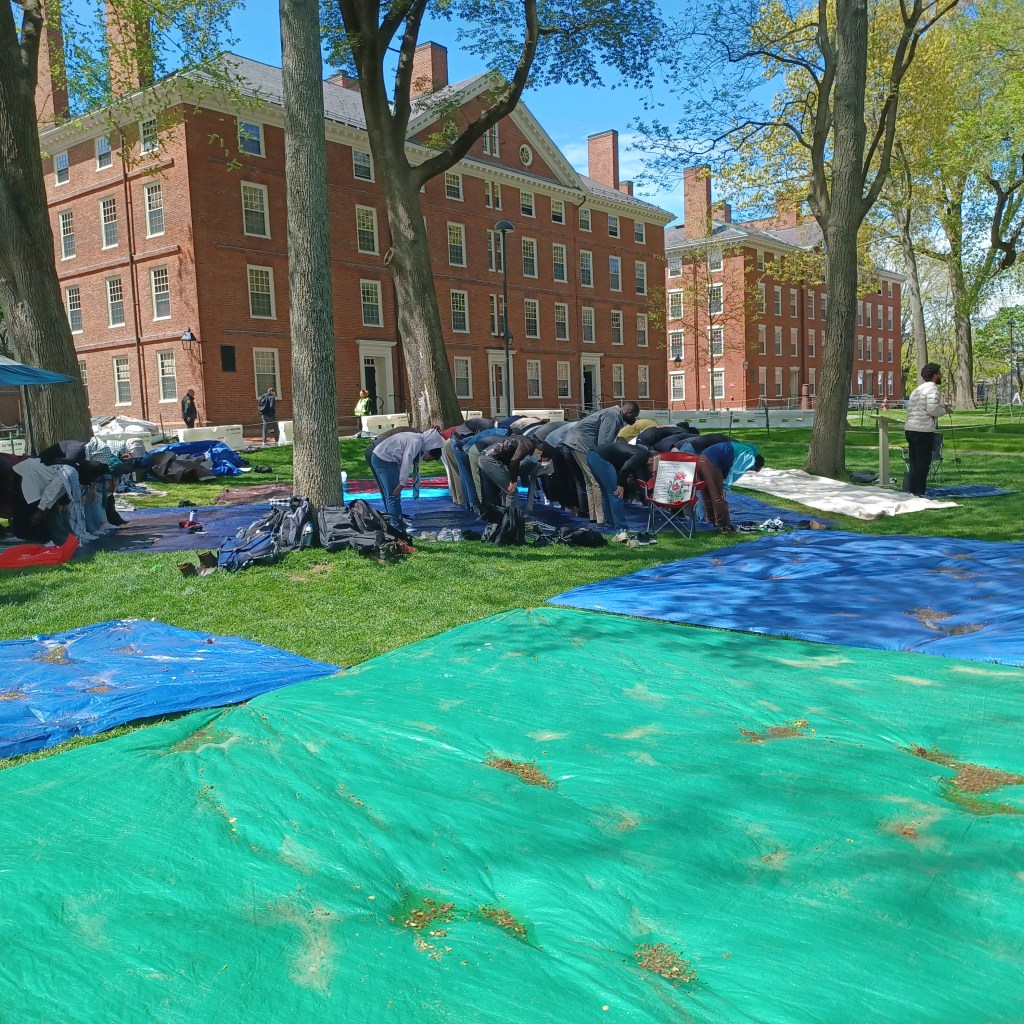
About 25 people attend a Muslim service in the “event space.” The young man leading the service often lapses into Arabic, but from what I can understand, he’s mostly talking about how we will return to the Creator after death. He talks about how many lives have been lost, and how many hospitals, homes, and schools turned to dust. He talks about “the dead earth” left behind, and “the will to destroy.” He says of the Israelis, “They built upon the imaginary [sic] that there was no one living in the land, that it was empty earth.”

The speaker says, “Somebody has taken the desires of their own heart as God,” taking for themselves the powers that should only belong to Allah. He notes that an Israeli real estate company is already trying to sell land for housing and luxury hotels in Gaza.
The most aggressive counter protester stands next to me. “Do you believe in this?” No, I say, I’m just listening. “You see they separate the women from the men.” So do orthodox Jews, I respond. “But this is 2024!” he says. Yes, I reply, and I don’t like it either, in any religion.

A helicopter hovers low overhead, evidently trying to disrupt the service. When the sermon ends and people bow and pray, I notice it sounds a lot like the davening during a Jewish service.

Supportive faculty and staff form a circle and hand out identifying pins, with the watermelon logo of these protests, and orange vests saying Faculty and Staff so they’re not taken for camp marshals. They expect the University to take the tents down soon, in the middle of the night.

A student who says he’s going to be “Ad Boarded” in a few minutes tells us about a supposedly secret meeting with President Garber. All the president did was tell the protesters how the endowment works. The student says 10 to 15 students were put on involuntary leave during the first raid this morning. Some never had their IDs checked at the protest, but most had been highly visible.

A student marshal in an orange vest speaks to a circle of others. “Don’t engage with police. Our job is to de-escalate.” She says some things I don’t understand. What is a stretchie, and how does it crack?

Later in the afternoon there’s a march and rally, attended by many more people than hang out in the camp. They go all around the Yard after surrounding Mass Hall for a while. I don’t go with them. I hate chants, and I’m tired.
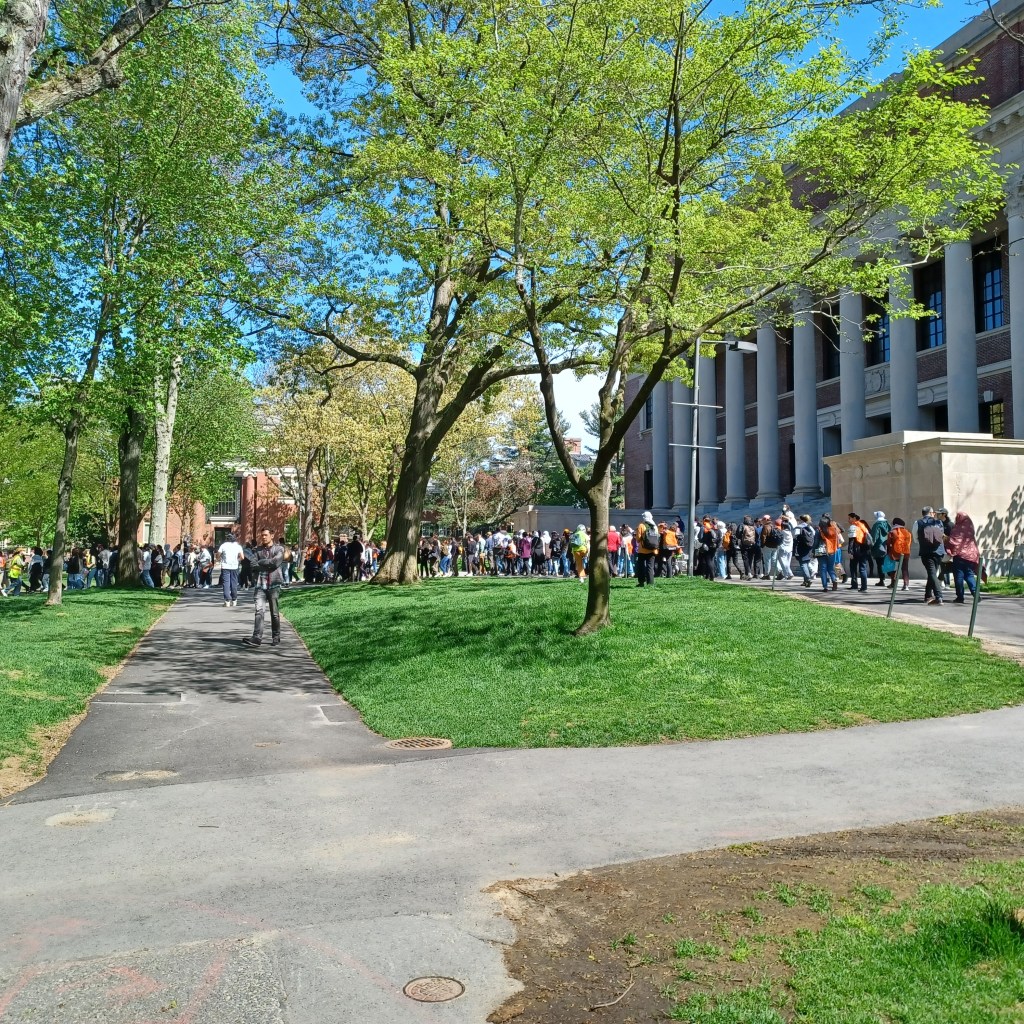
A counter protester accuses one of the protesters of removing his sign from the foot of the John Harvard statue. “Not cool!” he says. A protester points out that the sign is still there; the wind blew it over. “You’re just not looking.” The wind has strengthened so that while workers try to lower the big American flag over the statue, it twists around the pole so they have to raise it, shake it, and try lowering it again several times before they get it down.

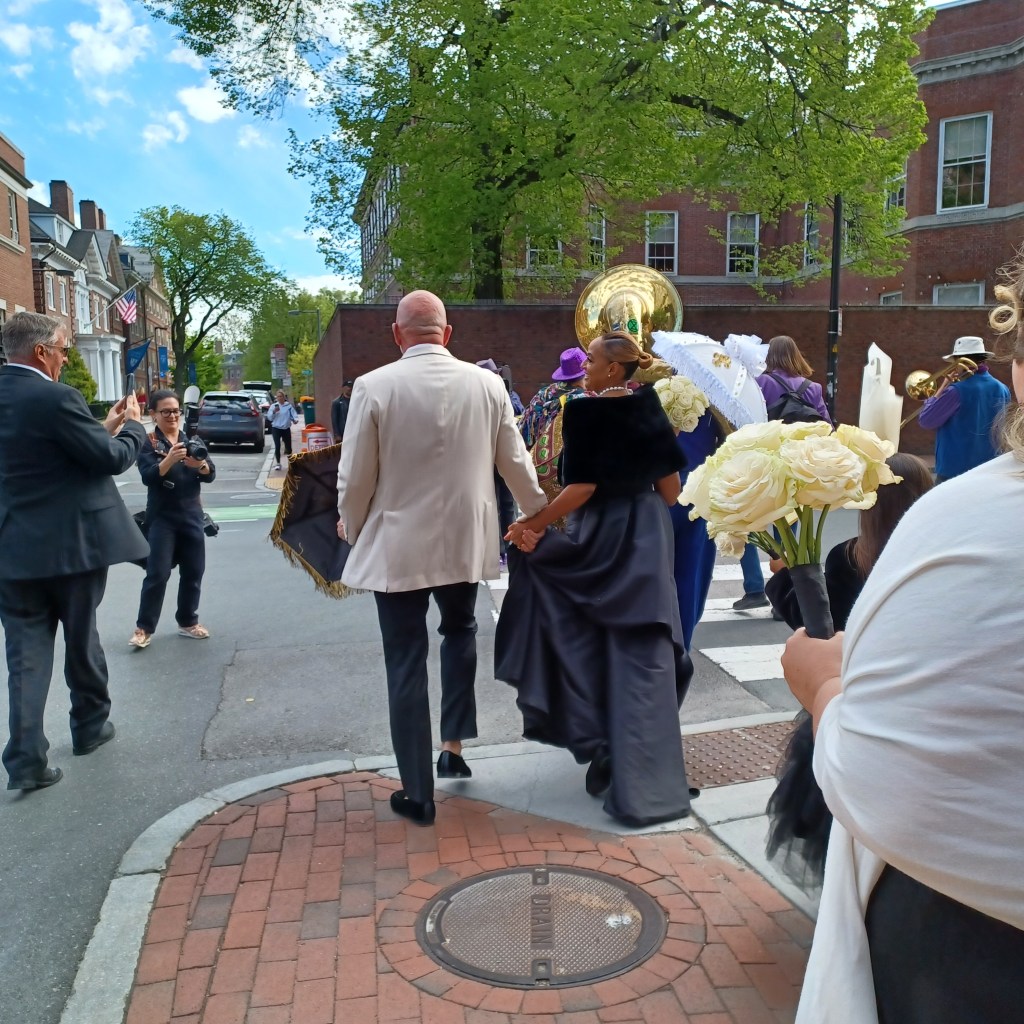
As I leave the Yard, I hear a brass band. Has somebody taken protest music to the next level? Then I spot a tuba over the head of a joyful line of people snaking down the Holyoke Street sidewalk, waving white kerchiefs. It’s not a protest. It’s a wedding. In the middle of all this difficulty and angst, life goes on.
Harvard Protest part 2

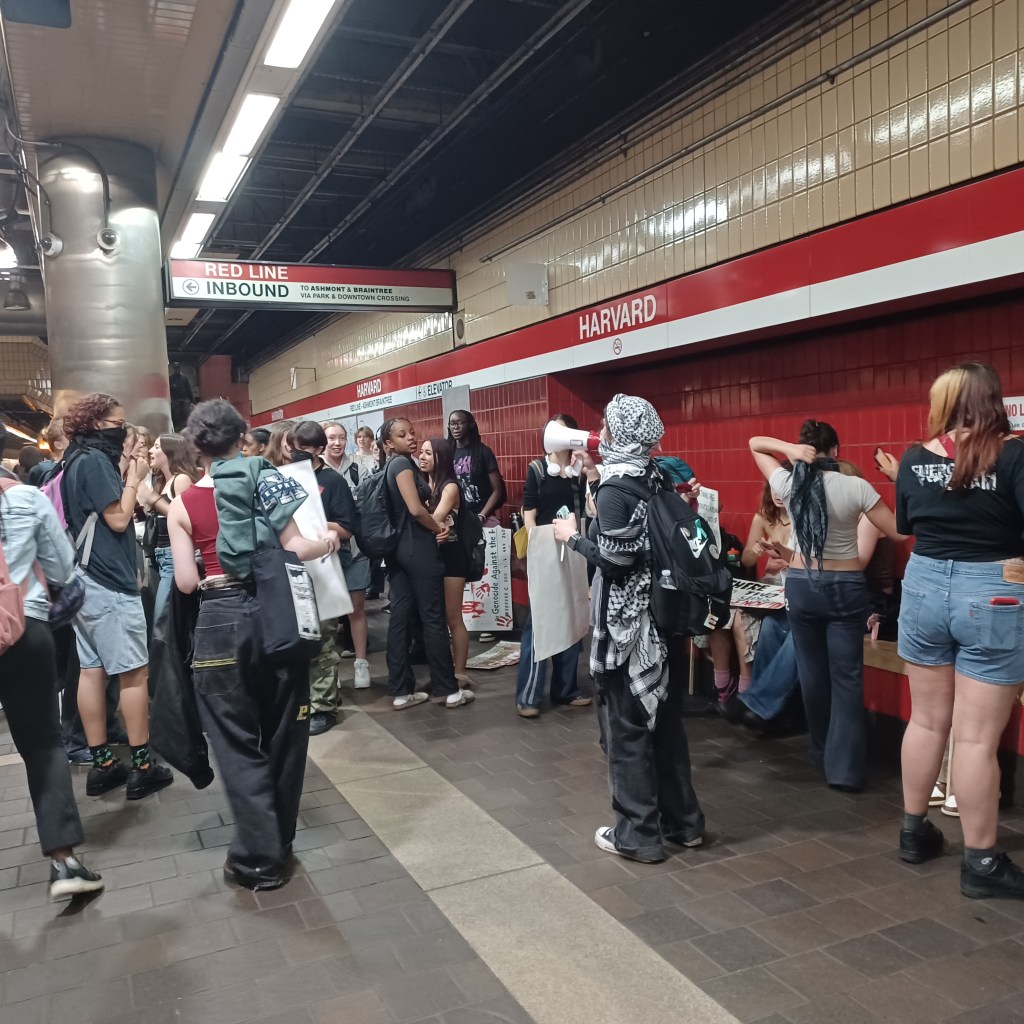
It’s Monday, May 6. At the Harvard Square T station, around 200 excited kids carrying signs, wearing kaffiyehs, or bearing small Palestinian flags are heading for a high school demonstration on Boston Commons. A girl with a megaphone reminds them, “This is NOT a confrontation. If you are approached by counter-protesters, DO NOT ENGAGE.”

The Yard entry gates are very busy. Parents are driving in to pick up freshmen who have finished final exams. Other students are rushing back and forth from their dorms to the libraries, or to take their finals. Students wait in line to get past the security personnel who are checking IDs. I thank Ali, a high-ranking member of the security staff, for their good work in keeping students safe. I’ve known him for years as sweet-tempered, friendly, but alert. He acknowledges the praise with a big smile.

The mood in the camp is much more tense than when I visited last week. Vague threats have been exchanged between the Administration and the protesters. Few campers are available to speak with the (Harvard-affiliated) public; most sit in a circle in the middle of the tents, deep in conversation for hours.

I walk the perimeter of the encampment with M, a small woman in a headscarf. I ask her if the camp would like more alumni to show up as protection, liaisons, or just moral support. She texts the organizers, but says she thinks they would appreciate it.

Students not involved with the protest are ignoring it. A few are playing frisbee in a roped-off area that only contains a few tents in one corner. I hear a girl say, “I’ve got a 20 page paper due tonight. I’d better stop putting it off.” It’s a lovely warm day. The temptation to put that paper off must be pretty severe.

Some protesters or supporters are sitting on the steps of University Hall. The doors at the top of the stairs have been locked since the protest started. I overhear a discussion of the legal ramifications of Harvard’s threatened actions. Some protesters can’t afford to lose their housing. One says she only spent three nights in the tents, worried about the consequences. There are rumors of hunger strikes.

Rakesh Khurana, the Dean of the College, won’t meet my eyes or talk with me, even though (or because) I worked for him for several years. I spot him talking with a well-dressed man in late middle age, though, or rather listening while the man speaks emphatically, gesturing toward the camp. Rakesh looks unhappy but meek, as though he’s being reprimanded by his superior. The man says “I walk through here several times a day and I’ve never seen any kind of disruption.” I wonder if the man is a professor, an alum, or a donor. Rakesh asks him, “Do you have a generous interpretation of what they’re doing?” I can’t hear his answer.

I have an unexpectedly pleasant conversation with Gid’on, the counter-demonstrator I walked rounds with last week. He says he’s a leftie on most issues. We talk about Venn diagrams of our opinions. We are both frustrated with the lack of real dialogue between moderates on both sides. I say, can’t we agree we all want the killing to stop? He says, maybe we argue and you raise three points. On the first, I’m secure in my opinion. On the second, I think, that’s interesting. The third is persuasive and I think, maybe I have to reconsider.

Gid’on is hopeful that there will be real campus discussions this fall. I suggest round tables where we can get past shouting “Nakba” and “Holocaust” at one another, where we can just talk. Gid’on says that would be a good name for a series: Let’s Just Talk. Since it’s Harvard, we’d need an acronym: LJT. We laugh and go our separate ways.

I eavesdrop on a young person in an Ironmaiden tee shirt, who I think is Israeli and trans, talking to a beautiful and sympathetic middle-aged woman. They tell her that the militarization of Israeli culture starts when kids are ten years old: chanting, marching, and singing patriotic songs. If Israelis refuse to serve in the army, it hurts their career chances. This person’s younger brother is in prison for defecting. Once his term is over he’ll go back on trial and get another 100 days. “He’ll end his puberty in prison.” His job was coordinating night-time raids on people’s homes. He soon found out he’d been lied to about what the soldiers were doing and why. “Israeli kids don’t imagine that they have counterparts on the other side of the fence. It’s all so absurd…” they say.

They go on: “If you’re forced to commit atrocities for your country, you find ways to justify it…Israel is basically a military outpost of the United States.” Their sister is a Major in aerial defense. “We disagree…I love my family, but they’ve been sold so hard on these lies…My father grew up in Toronto. His synagogue had molotov cocktails thrown through its windows.”

The camp liaisons are wearing pink vests. A passerby asks one what he can do to help. “Tell people we’re not being violent.”

M tells me there’s going to be a press conference at the Johnston Gate at 5pm. I head over there a few minutes early. Two chairs are set up near the unoccupied guardhouse, and I sit in one to rest my aging bones. I figure I’ll get up when asked, but nobody ever asks.

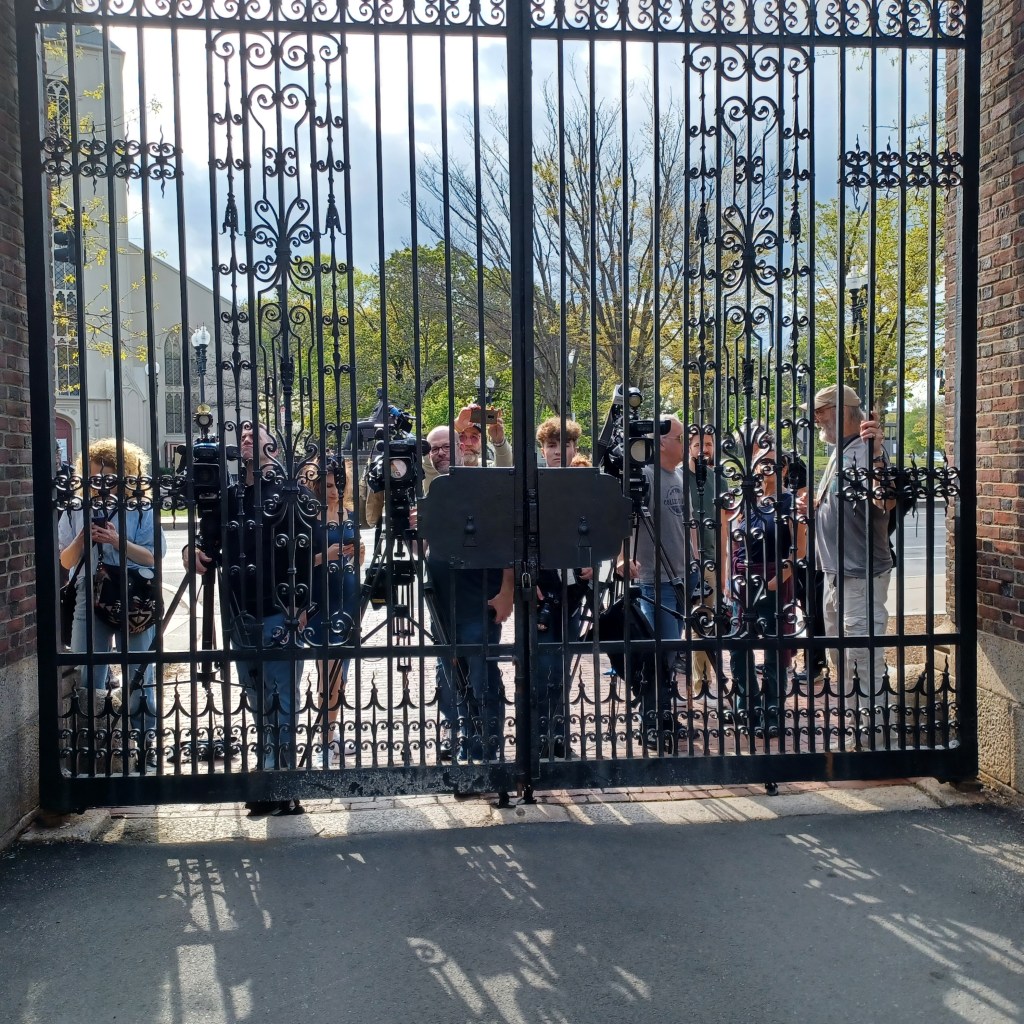
The press are already crowding outside the gate, photographers grimacing as they try to fit their lenses between the bars. One reporter calls out to me, “Would you open the gate?” Nope. I take a picture of them, which seems to amuse a few. “Are you with the Gazette?” one asks. “I’m not with anybody,” I say.

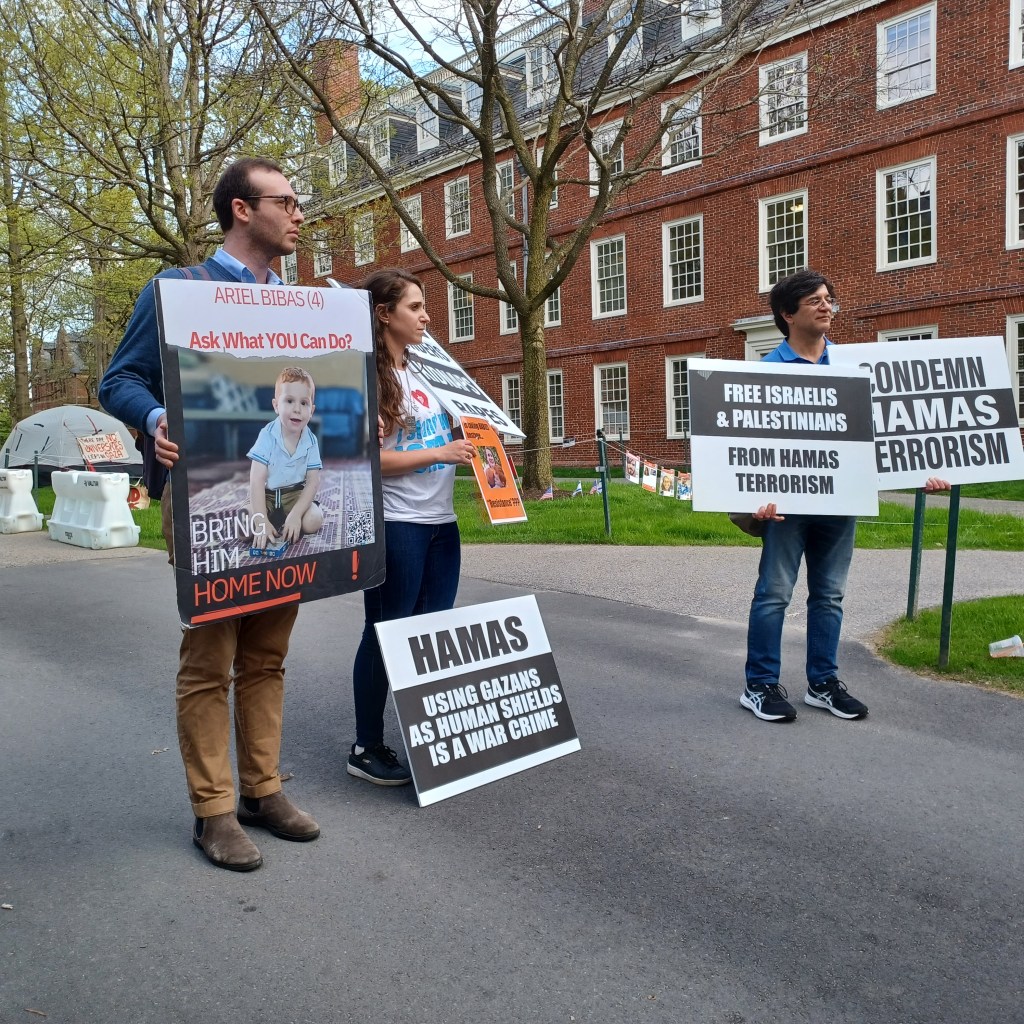
Now the counter-protesters show up. I agree with some of their (professionally printed) signs. “Free Israelis and Palestinians from Hamas terrorists.” If only. A reporter calls out, “Did Bill Ackman pay for those signs?” One responds, “No, George Soros. We scammed him.”

Someone outside the gates yells, “Shame on you! Are you Jewish? Shame on you for defending genocide!” This guy says he’s not Jewish, but he has friends whose parents survived the Warsaw ghetto.

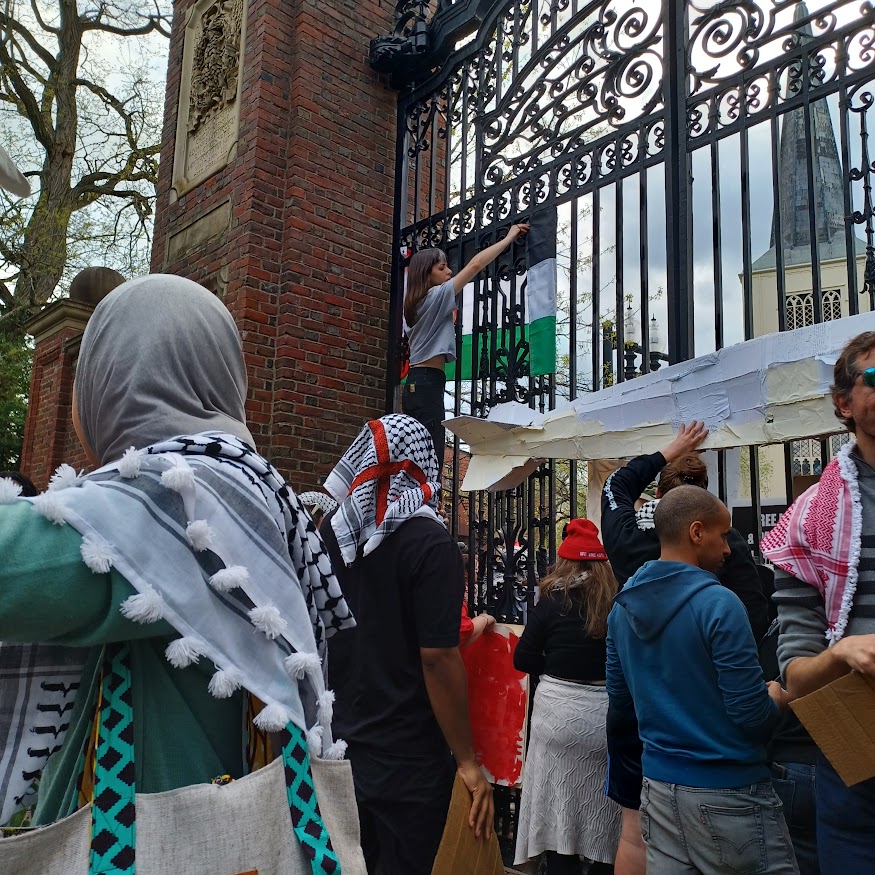
When the pro-Palestinian protesters arrive, there is some jostling while the counter protesters try to hold their signs in front. Nobody goes as far as actual shoving. I see people trying to be courteous about sharing the space. A papermache missile that must be eight feet long reading “Paid for by Harvard” gets held over my head, with apologies. One girl stands on a guy’s shoulders and leans against the iron railings to hold up her Free Palestine sign.

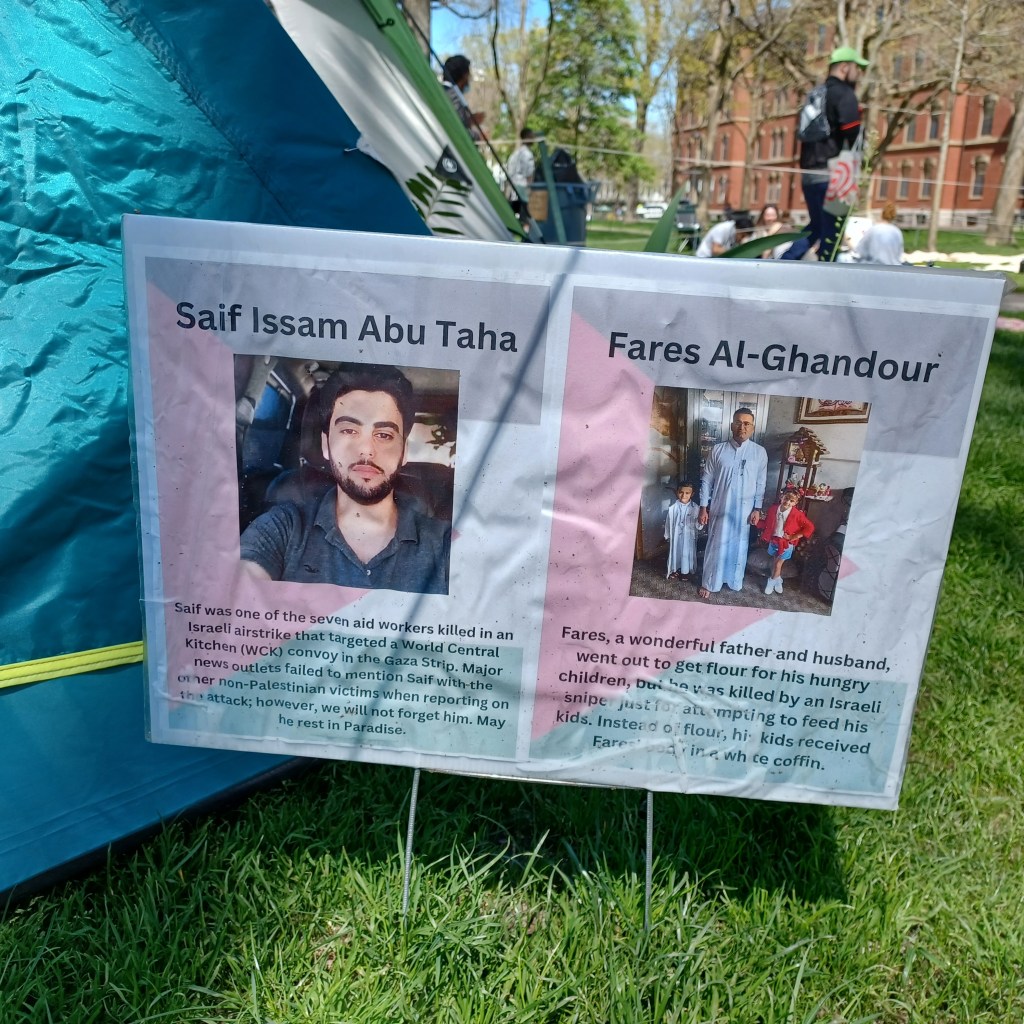
I imagine what the reporters are seeing: photos of Israeli hostages and children killed in the Hamas raid; photos of starving Palestinian children. This jumble of imagery seems only appropriate. Why is it that we can’t mourn all this suffering together?

I leave the camp while a camp spokesperson is still addressing the press. I hear they will not take questions. Outside the gate, some policemen are hanging around. Asked if they’re Harvard police, they say, “No, we’re not as cool, but we try.” One mishears me and thinks I said something about ice cream. Another says that might help the situation, if everybody got some. I say, Good idea, let’s have a party and just talk! They laugh and tell me to stay safe.

Harvard Protest part 1

When I left Medford, it was a warm sunny day. In Harvard Square, it was chilly, damp, windy, and overcast. The mood of the encampment was equally gray. The students had just received a warning from the Ad Board that if they continued to camp outside University Hall they would face serious consequences. They were busy texting their family and friends, and possibly lawyers and media as well. I was there most of the afternoon from around noon until past 4 pm, and nobody was shouting, chanting, or using a bullhorn. There was one very interesting session on Palestinian textiles, especially the kaffiyeh and embroidery (tatreez), attended by half a dozen women.

If people are concerned about a kaffiyeh being draped over the John Harvard statue, I would remind them that it is an ancient Harvard custom for frat boys to piss on it.

I tried to respect the community norms. First I spoke with a nice young woman who was patrolling the perimeter of the camp, to find out with whom I should speak, as a friend of the camp and not a member of the media. She promised to find me a member of the outreach committee. Meanwhile I took photos, careful not to include anyone’s face.

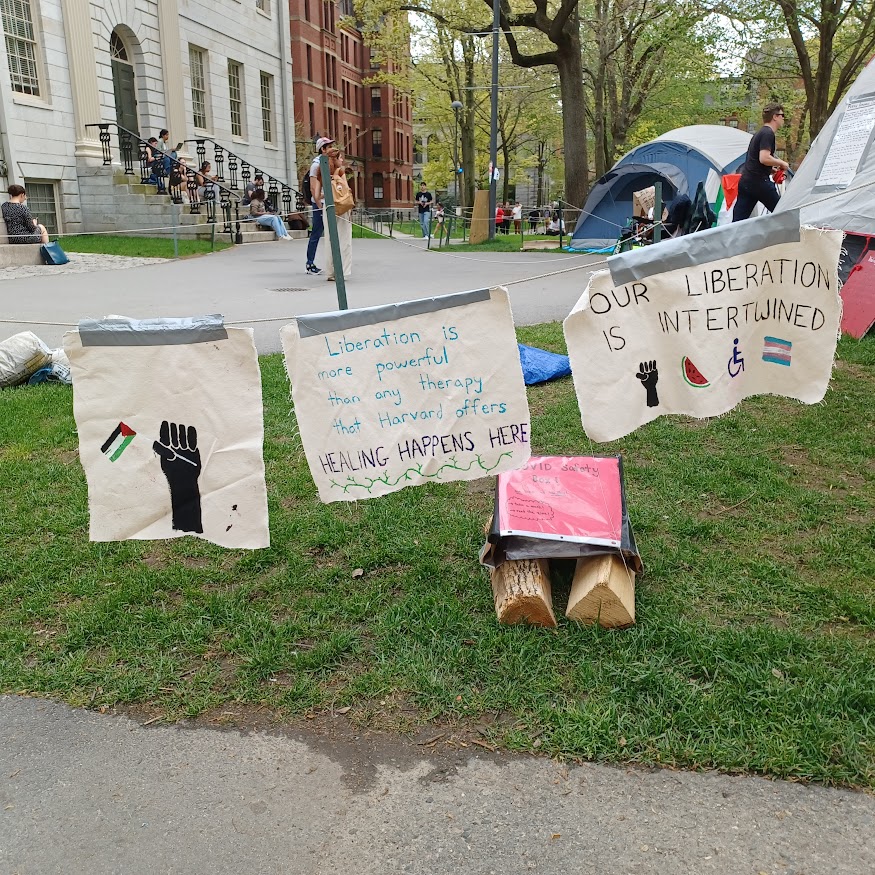
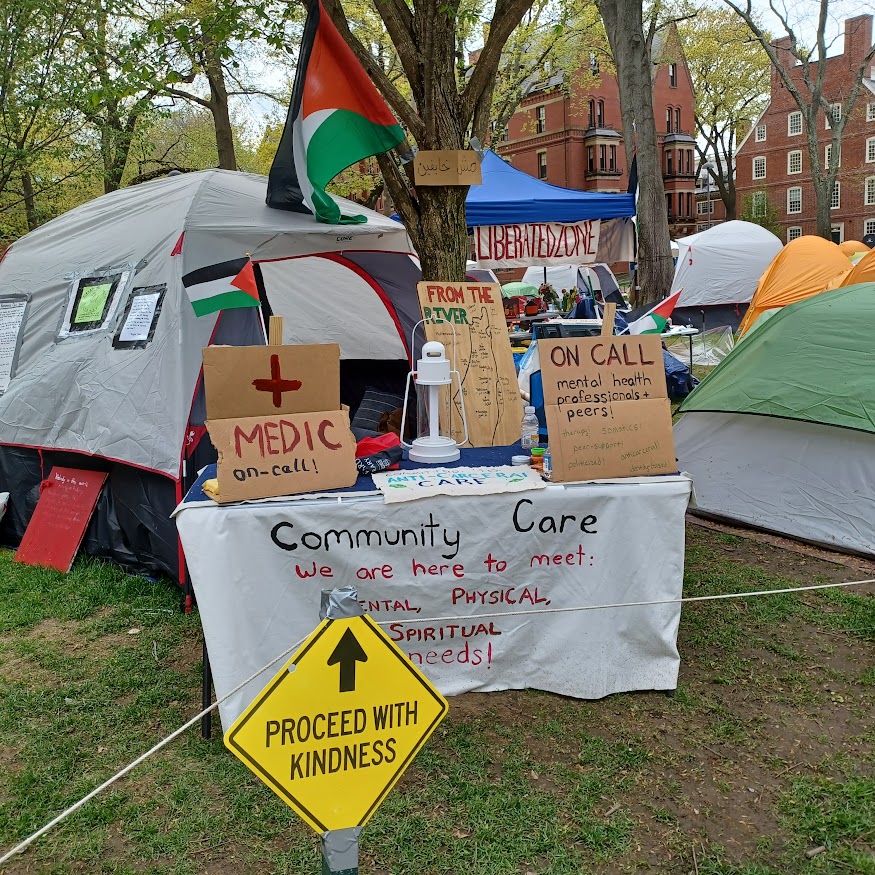
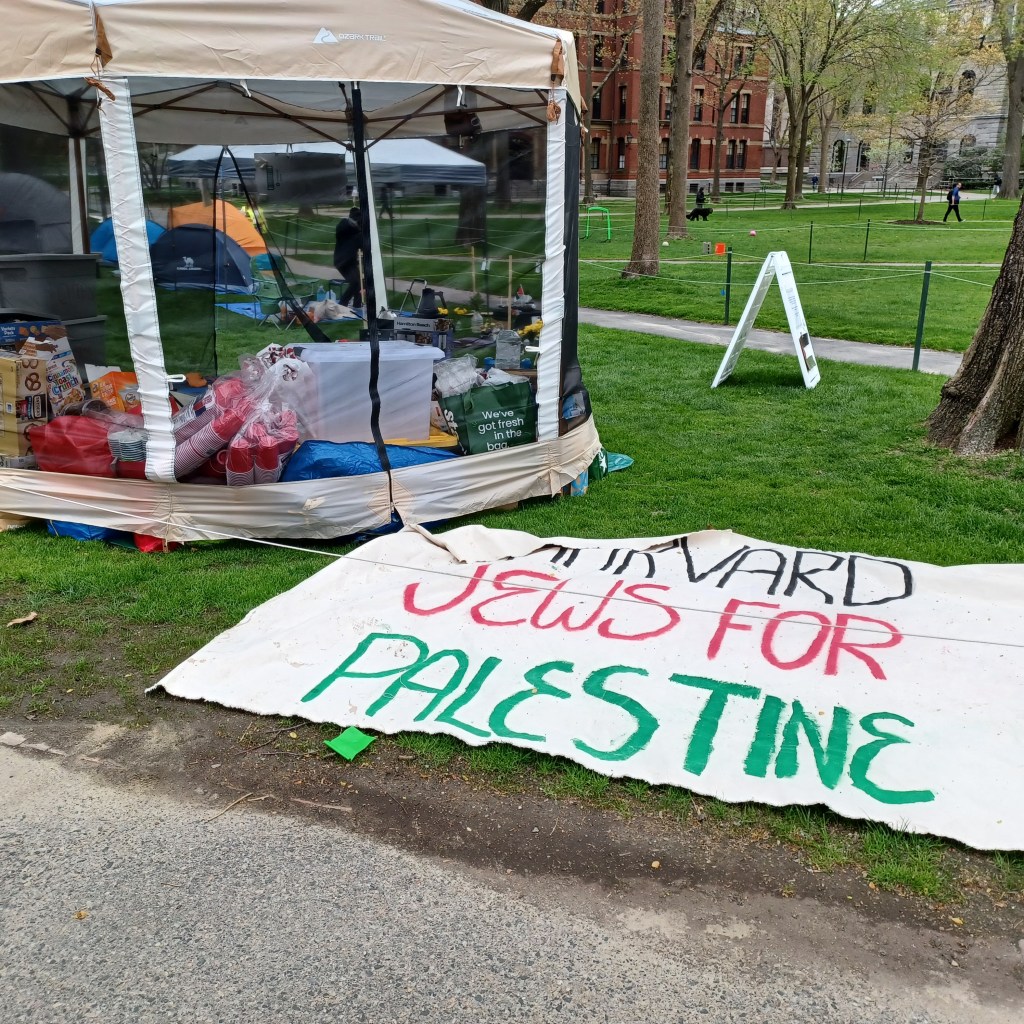
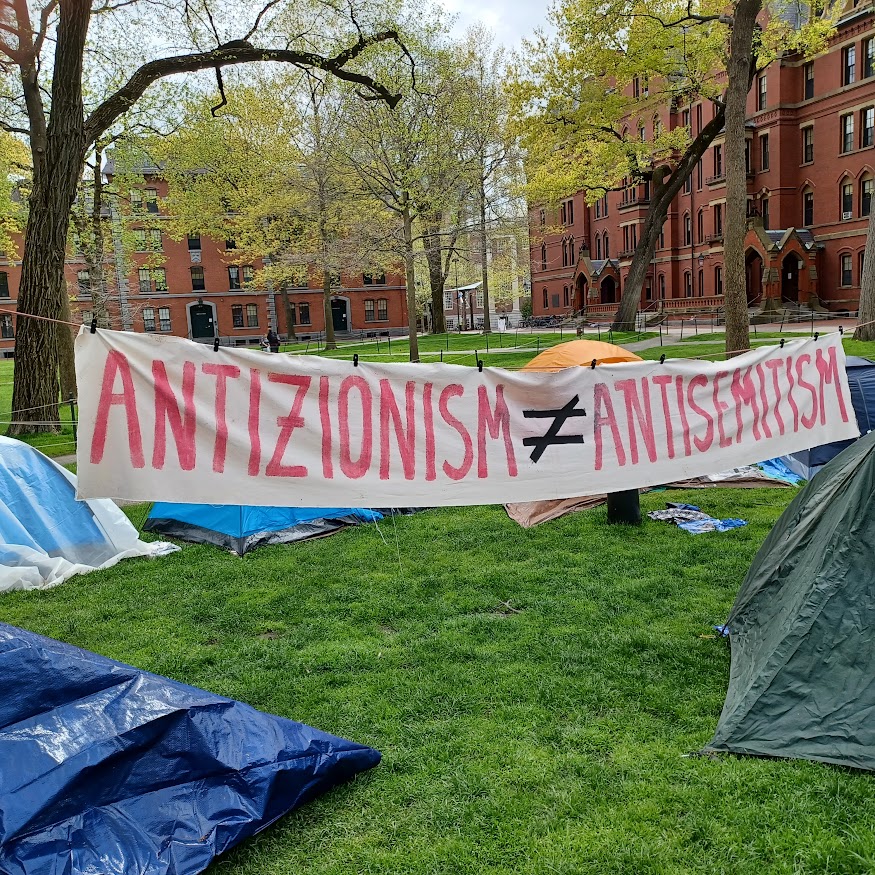
The signs outside the tents were hardly combative. Demands were posted, for HU to disclose and divest from its investments in Israel, and to drop all charges against students for their activism. I doubt any of the protesters expect these demands to be met. Other signs said: While you read, Gaza bleeds; Nationalism is Chametz (Hebrew for food prohibited on Passover); No Justice, No Peace, Palestine will never walk alone; Harvard invests in Palestinian death; and a big banner saying Harvard Jews for Palestine.

As for the slogan “From the river to the sea,” it first appeared in the original charter of Israel’s Likud party, where it did not refer to a hoped-for multi-ethnic democracy.

I chatted up several people while I waited. I asked if any administrators had opened a dialogue with them; they said not yet, but they were trying to negotiate something.

The students are risking their academic careers, and probably the wrath of their parents. As always with student protests, they are among the University’s most thoughtful, serious, and conscientious affiliates. They have a lot to lose and nothing to gain, on a personal level. What is the administration afraid of? Losing Zionist donations; and losing even more face than it has since it bumped its first Black president over…not much. Looks like somebody could go out with a handheld mic and just let people talk.

Finally I got to speak with one of the organizers, a Palestinian freshman named Mahmoud. He and many others have been protesting since Israel began its crazy over-reaction to the brutal Hamas attack in October. He said “The administration doesn’t understand that repression fuels us to fight harder.” The community is committed to non-violence, he told me.

As I started to leave, a man approached the camp wearing a kippah and a scarf with Stars of David on it. The perimeter-walker I first met was tailing him, much to his annoyance. She wouldn’t talk to him, which he thought was rude; I agreed, but I pointed out she was probably following camp protocol, and the idea was certainly to protect both him and the protesters. I made four or five rounds of the camp with this guy and the very determined young woman. She had probably never been called rude in her life. She couldn’t talk to the guy; he refused to tell me anything about himself or his opinions since he thought she was recording him; so I talked to him. As usual in such discussions, we got nowhere, but we parted on friendly terms. I walked him out the library gate.

5.2.2024

An old colleague of mine was gracious enough to meet with me for half an hour yesterday. She’s a very sweet, thoughtful person, and we were glad to see each other again. I asked her if the administration had established any dialog with the protesters. She couldn’t tell me details but said there were talks going on quietly in the background. She told me some students were feeling a lot of pressure from both peers and outside forces, and were afraid to speak out. We agreed on the nature of the encampment – nonviolent, disciplined, and committed – and on the need for the students to come up with some achievable goals.

The protesters’ three current demands, set by the national movement, can and will not be met. The University certainly will not disclose, much less divest itself of, its investments in Israel. It still hasn’t divested from fossil fuels, and many of us have been working on that for decades. It took forever to divest from South Africa during Apartheid. The third demand, for amnesty for student activists, can’t be met before they even go through the disciplinary process.

So I went back to the camp to tell them the little I had gleaned from talking with my colleague.

The weather was warm and sunny, and the mood seemed lighter accordingly. My perimeter-walking friend told me everybody was happy I had talked (and talked) with the counter-protester on my first visit, since their camp has agreed not to engage with provocateurs.

I tried to convince a few protesters to have the group consider setting goals the University might actually meet. Maybe teach-ins, or listening sessions, or moderated debates could be small steps toward spreading their understanding of the war in Gaza and the history of Israel/Palestine in general. While we were talking, I noticed Dean Khurana on the outskirts of the camp. The students said he’d visited before but wouldn’t talk with them.

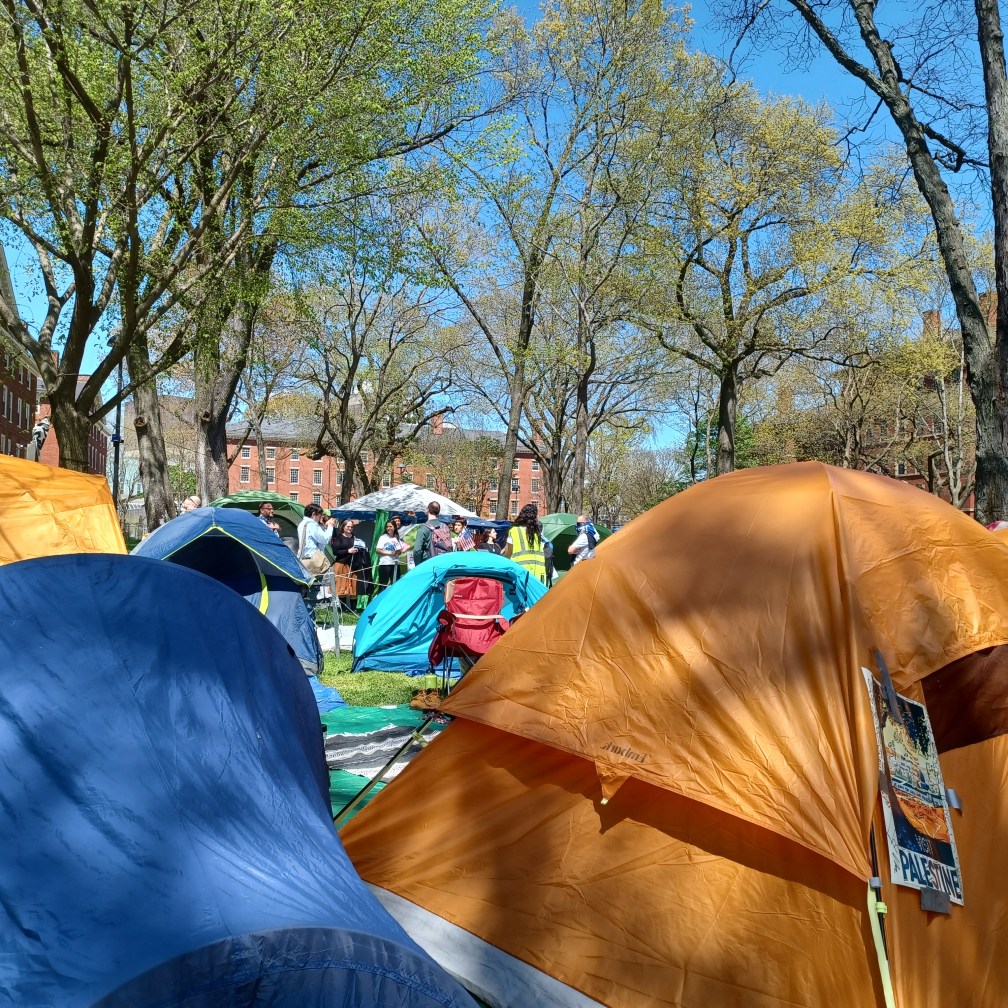
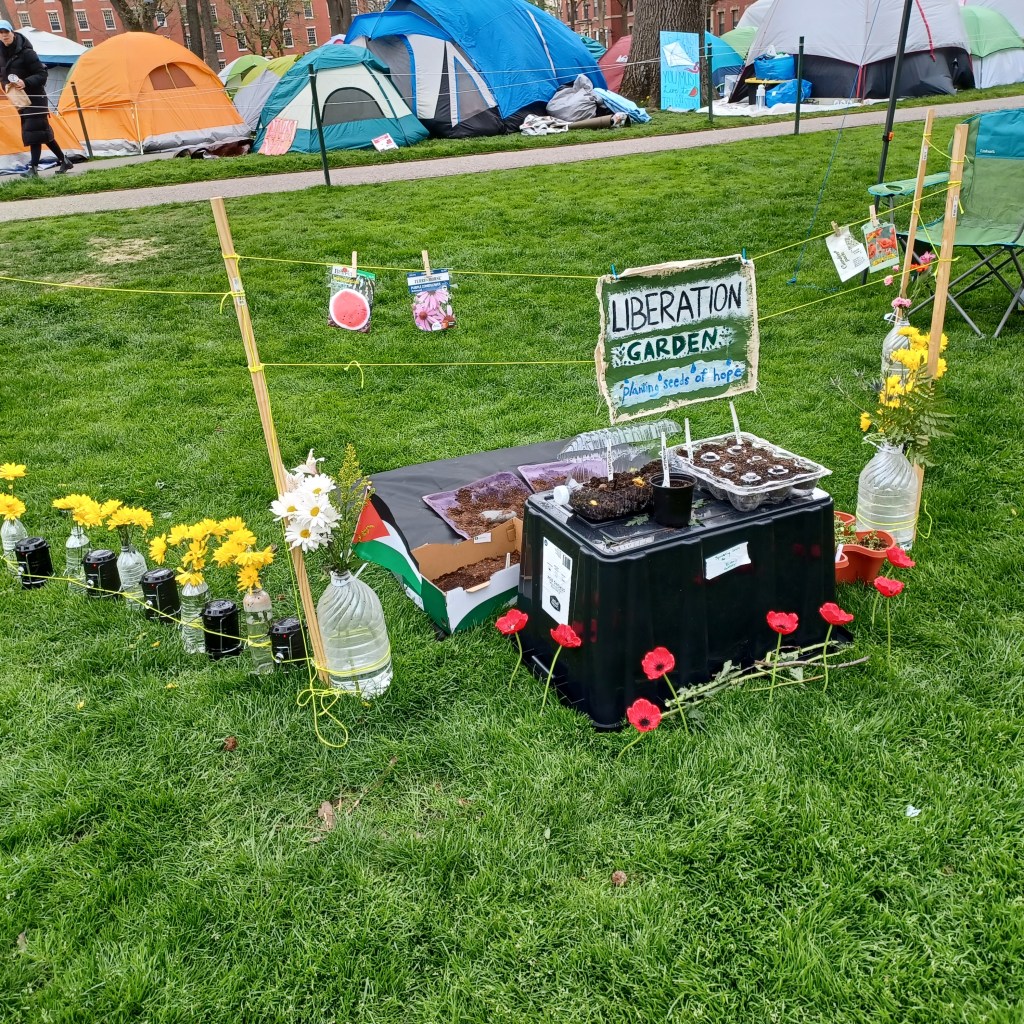
There are about 50 tents in the Yard, fewer than during the Living Wage campaign in 2001 but probably more than during Occupy Harvard in 2011. Like those encampments, this one is self-policing and keeps itself clean. Yesterday some clotheslines had been strung up between trees. Sleeping bags and coats were hung up to dry.

At this time, early afternoon, about a dozen counter-protesters showed up. I have to describe them as quite loud and aggressive. They marched right into the middle of the encampment, singing Hebrew songs, accompanied by a man with a guitar. Their signs quoted the very worst threats from Hamas (“October 7th was just the first time…”) and showed photos of some of the hostages. They stayed in the middle of the camp for around 15 or 20 minutes. The pro-Palestinian campers did not engage with them at all. While the singing and shouting was going on, the campers quietly rearranged the perimeter ropes so the Zionist group had its own little peninsula open to the paths.

The counter-protest moved out of the camp itself to the lawn outside Mass Hall, where it could be more easily seen and heard by the media outside the gates. One man shouted: “Jews on this campus will not be intimidated, and we will not be silent.” I noticed my walking buddy from Monday in the group, and waved to him; he smiled and waved back to me.

I overheard a counter-protester say “Stop them from using the name Harvard, it’s a violation of trademark rules. Call Meta.”

A man from CAMERA, the Committee for Accuracy in Middle East Reporting and Analysis, a decades-old pro-Israel group, told passersby that they had planted 1200 Israeli flags on the HLS campus. I didn’t go to see and can’t find any reports confirming this. He expected they would soon be taken out. He also told a Globe reporter hovering outside the gates that this encampment was an unprecedented disruption at Harvard. I joined their conversation to correct that statement. As for noise, the encampment schedule for some days lists about an hour at dinner time to “make noise for liberation.” I haven’t stayed late enough to determine just how much noise that comes to. Most of the time the camp seems extremely quiet.

The camp was treated to a show of more than 100 bare backsides late last night during the annual Primal Scream event. The Crimson asserts that the streaking was nonpartisan and nonpolitical. Nobody seems to object to the primal screaming.