More Adventures with Homeless People

Talk radio is a tough medium. Hosts can be hostile; callers are often abusive. Liberal pundits avoid these venues, where they come under attack with no one to defend them. Facts turn out to be puny weapons against ignorance and prejudice. But the guests on this particular show were as tough as the medium. And they came armed with more than facts. They had stories to tell.

More than 30 years ago, I sat in the green room at WRKO in Boston, watching four women battle with host Gene Burns and his right-wing audience. These women were homeless along with their children. They were living in welfare motels and time was running out on their stays. If they couldn’t find anywhere to move when their time was up, the state would put their kids in foster care and they’d be on the street. They had nowhere to move; if they hadn’t already run through all their options, they wouldn’t have been in the motels. They were desperate. They were angry. They had nothing left to lose.

Burns expected these women to be victims, or leeches. He had no idea who he’d be dealing with. These women were warriors.

TriCap, a local anti-poverty agency, had hired me to organize people on welfare, scraping my poverty-level salary from the dregs of federal and state programs. I got to know dozens of homeless parents over a year of meetings. These four women were among the most articulate and clear-minded people I had met. They had been training for this show one day a week for a month.
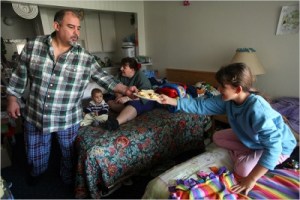
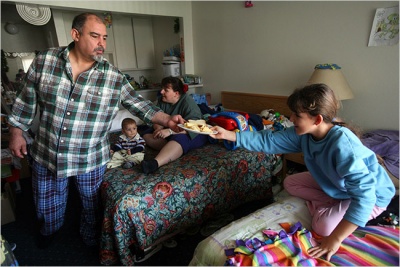
In Massachusetts, families can only get shelter if they go through the whole eviction process, waiting until the Sheriff throws all their belongings out on the street.
photo from Bread of Life in Malden, MA

At our first training, the women told their stories. One survived a serious illness but lost her job. Another one’s husband disappeared with their car and their life savings. Another fled a man who had raped her daughter. The fourth had been trying to escape dependency by going to college, until the state raised the fees so she could no longer afford rent. The women critiqued one another’s stories: be sure to tell that part, maybe leave those details out.

At the second training, we brainstormed how to respond to the worst calls they might get on the show. They came up with witty rejoinders to every ugly assumption, corrections for each common misunderstanding. They practiced responding calmly to name-calling. We laughed a lot that day.

The Massachusetts Coalition for the Homeless sent a policy wonk to our third meeting. She handed out one-page fact sheets and the women quizzed her on state policies. That was a serious discussion. We had pizza, and they brought leftover slices back to the motels where volunteers had been taking care of their kids.

Our fourth meeting wasn’t really a training. The only thing we did was tell our birthing stories. Only mothers can stand all the gory details, and even relish them, if mother and baby survived. By the end of that day we were sisters.

Burns had booked the women for the first hour of his four-hour show. After that hour, he called me in the green room to see if they could stay another hour. He did that twice more. When they started talking, he was skeptical and condescending. But as they answered his questions honestly, and met his listeners’ nasty comments with humor and understanding, his attitude shifted. Eventually he started saying things like “I can’t believe this is happening in America” and “This is such a cruel system, we have to change it.” Even his callers began to show some respect.

The show ended at 2pm. Burns thanked the women, praised their intelligence and courage, and then told them the station wanted to treat them to lunch at a nearby Italian restaurant. That was the first hot food some of them had eaten in months. They weren’t allowed to cook in the motels. Everyone got boxes for the leftovers, to give their kids.

We had to take three trains back to our ride in Revere. An old man was playing guitar in the Park Street subway station where we waited for the first train. He began to sing “Dream a Little Dream of Me,” a standard by Doris Day that everyone seemed to know. We sang along.

Sweet dreams till sunbeams find you
Sweet dreams that leave all worries behind you
But in your dreams whatever they be
Dream a little dream of me

When our train came in, I gave him my box of leftover lasagna. After we got on board, he blew us kisses while we waved and smiled.

Burns told us that his show reached 100,000 people. Two weeks after the women’s show ran live, he played the whole thing again, on Mother’s Day. Who knows how many minds the women changed. Maybe the strength they showed that day was enough to bear them through whatever came next. But I don’t know what happened to them. Their time at the motels ran out, and in those years before cell phones and email, we had no way to stay in touch.

Today, the US is about to experience a new wave of homelessness, worse than the one Reagan caused when he destroyed affordable housing programs in the 1980s. There have been eviction moratoriums during the pandemic, but they don’t cover everybody and they can’t last forever. Sooner or later, the rent will come due. Many renters won’t be able to pay. Some will find new, cheaper housing. Some won’t.

There are still talk radio shows people listen to while they drive to work, and podcasts galore. Pundits will share what they think about homelessness. I hope somebody remembers to ask the homeless.
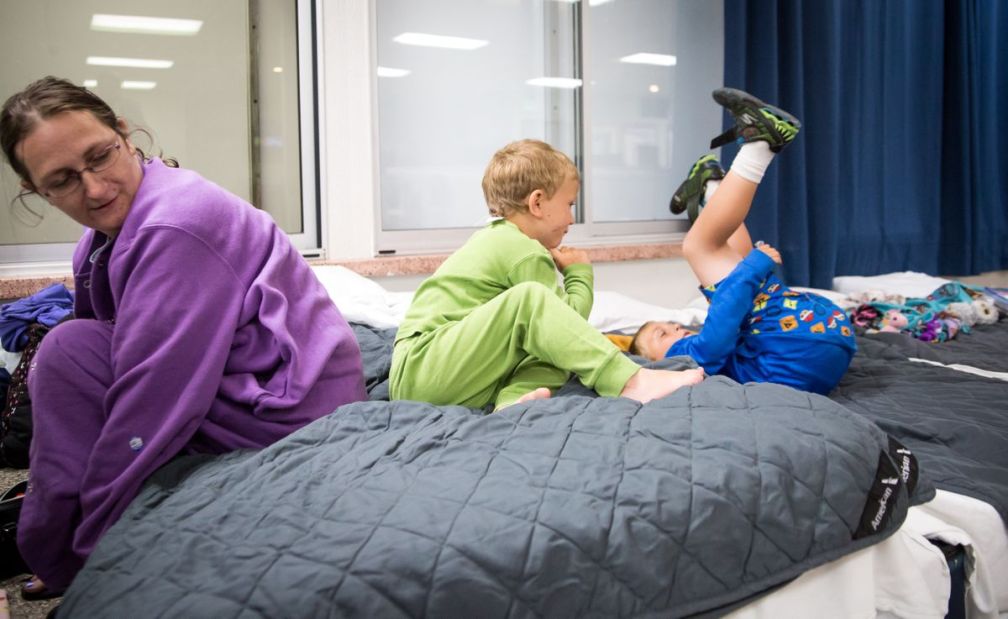
Adventures with Homeless People

The women were nervous when we entered the Statehouse. They had chatted excitedly all the way from the welfare motel in Everett, where two volunteers with vans had picked us up. But now the sight of the enormous gold dome, the series of broad granite steps, and the lofty, echoing marble entryway intimidated them into silence. I handed out the information packets we had written together. Before they split up to go to various legislators’ offices, I reminded them that they were the experts. They were here to educate their elected representatives about family homelessness.

I was here as a baby-walker for one mother who couldn’t keep her infant quiet while she was sitting still. He slept on my shoulder as I wandered the halls. I was also responsible for a four-year-old, antsy from months of confinement in one room, who darted around touching things but came when I called her. I consulted my hand-drawn map to find the offices where we had made appointments. Sometimes the doors were open, and I could see the women talking calmly to the men behind the desks. During our training sessions, I tried to build their confidence by assuring them that they had built-in advantages communicating with the reps, since they were women and the reps were, well, men.

At one point, the elevator doors opened near me and my small charges. In the elevator stood that redheaded scourge, Barbara Anderson, then head of Citizens for Limited Taxation, and her coterie of tall white men in suits. While the doors stayed open, I blurted: “You’re kicking families out of their housing! You’re hurting old people and sick people! Shame on you!” Everyone in the elevator looked over my head, stone-faced. The little girl asked me why I yelled at that woman. “She’s part of the reason you and your mom had to leave home, honey.”

This was an emergency situation, even for people whose whole lives were one long emergency. Massachusetts was planning to kick hundreds of families out of shelters and motels when the federal funds ran out, refusing to pick up the tab for their stays with state money. That deadline was approaching for many in the following week. These were women and children, and a few men, with absolutely nowhere else to go.

It was the late 1980s. Reagan was tough on poor people and all the programs ever designed to help them. I had been hired by an anti-poverty agency with the dregs of state and federal funding to organize people on welfare. People on welfare, I soon discovered, did not want to stick their heads up for fear of losing the little they had. They were happy to meet once a week and eat free doughnuts and complain about the system. They provided good support for one another. But they were not going to speak out in public and risk coming to the attention of the authorities, which could cut off their benefits for any reason at any time.

Families in the welfare motels, however, were facing eviction from their last housing option. They had nothing left to lose. They were angry, and scared, and they were ready to fight.

The welfare motels were terrible housing, but better than nothing. Several kids could be crowded into one room with their parent. There was mold; there was falling plaster; there was broken plumbing; there were cockroaches. The hotels would not allow hotplates so all their meals were cold. Children had no place to play, and often could not reach the schools in their home communities.

Parents were already traumatized. Some had suffered an accident or illness that made them unable to work for a time. They lost their jobs, then their housing. Some had gotten the short end of the stick in a divorce. One married her high school sweetheart and soon got pregnant. When the baby was born, her husband left her, disappearing with their car and all the money in their bank account. Some women had children with medical problems, and the only way to get health care for them was to leave their jobs and go on welfare. Many of these families had suffered actual eviction, where they watched as sheriff’s deputies carried their belongings out to the street.

The women told their stories to the legislators. They also dispelled some myths. Most people on welfare were white. Less than half of all families on welfare had access to any public or subsidized housing. The majority had worked full time until they no longer could, often because they couldn’t afford childcare and refused to leave their children alone. Some had worked part time, under the table, because every dime they admitted to making came out of their welfare check, which was about half what they needed to survive. Sooner or later they couldn’t make the rent. They and their children couch surfed with friends and family members until they got kicked out. Some had already lost a child to the foster care system because they had no safe place to stay.

We met up at the agreed-upon place and time. The women were exhausted. On the way home, they talked about the legislators’ reactions, or their lack of reaction. None of the legislators had known about the planned evictions until the women told them. Some of the moms said they had spoken with a reporter for a local news radio station, the only media person who responded to the press release I had sent to so many.

Back at the hotel, we all crammed into one room to watch the six o’clock news on tv. We were astounded to see the state welfare commissioner make a statement, in the midst of camera flashes and boom mics. The state had never planned to evict homeless families from the hotels, she said; that was all a misunderstanding.

In the motel room, there were screams and laughter and hugs and tears. These women were warriors. They were fighting a war against impossible odds. But today, on this battlefield, they had won.

No profit in it

Do you work for or support a non-profit organization? You want to help people, or the environment, or otherwise contribute something positive to life on earth. You probably care about a number of worthwhile causes. But most non-profits concentrate on single issues. They compete with all the other non-profits for donations, media attention, and government resources.

Apples, oranges, peaches. We want them all.
Apples, oranges, peaches. We need them all.

Non-profits don’t tend to collaborate. They struggle for top billing on the national or global agenda. Yet all their good causes are separate battlefronts in the same war. Each organization fighting for racial justice or economic fairness, against fossil fuels or against war, is trying to shape a future that reaches all these goals. They seem like separate causes, but they depend on one another for success. How can we achieve economic justice, for example, while the poorest communities are most threatened by climate change?

Urge the organizations you support to find ways to work together. Form coalitions. Publicize one another’s campaigns. Explore links between issues. As long as we allow the single-issue groups to ignore everything else we care about, we won’t have a movement for positive change. We’ll only have “special interests.” And there’s no profit in that.

Boston: 1, Fascists: 0

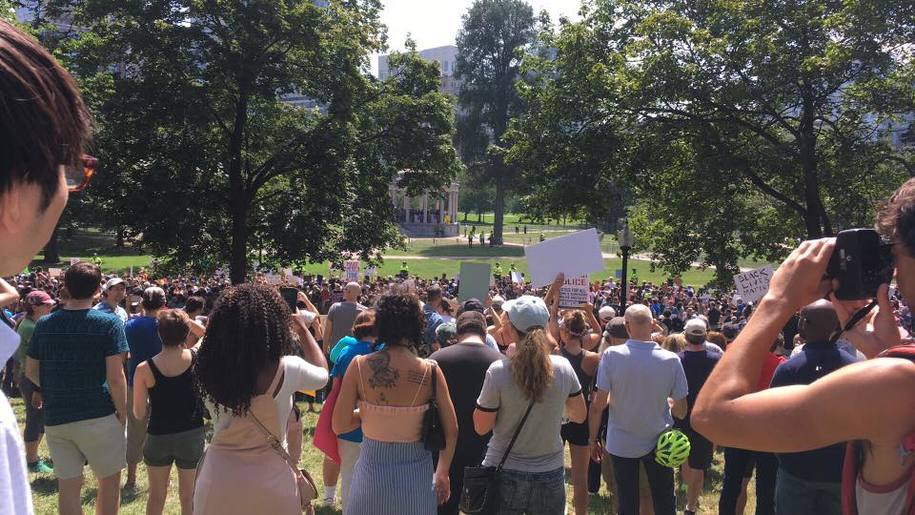
In August 2017, I attended one of my favorite events ever, in the big public park called Boston Common. I came home loving Boston, loving Antifa, loving Black Lives Matter. I loved all the random peaceniks and fighters for justice who showed up en masse. We were protesting a “free speech” demonstration designed to promote extreme right-wing ideology — in other words, fascism. That day, I even loved the Boston Police Department.

Boston showed up to support Black Lives Matter, and to face down the fascists who planned to rally.
photo by Kathleen Gillespie

In spite of organizers’ boasts, only about 50 Nazis came for the planned rally, so few they could all fit on the bandstand. They were surrounded by about 40,000 people on the anti-Nazi side. The crowd was peaceful, diverse, friendly, and happy. The signs were passionate and clever. The police did their job, and they did it well as far as I could see.

I watched some coverage of the demonstration after it was over and was puzzled to see how the news focused on the few arrests and some scuffles where the paths of Nazis and protesters came too close together. How did they miss the monster party that the rest of us experienced? They described the atmosphere as “tense,” but 99% of us weren’t tense at all. We felt fantastic. Boston showed up to boo the haters out of our town, and we did it in style.

A few memorable moments: one or two of the fascists somehow got past the police barricades and were walking among the main crowd, some of whom as you might predict were following the guys and yelling at them. But other anti-Nazis kept them surrounded and safe until they could rejoin their pathetic little herd. That was a beautiful thing to see.

People handed out bottles of cold water. Others shared cake. It had been suggested by some that lefties should stay home, avoid making any trouble. But if you don’t show up to protest Nazis, when are you going to show up?

Another moment: when the tens of thousands who started marching in Roxbury arrived at Boston Common, the tens of thousands of anti-fascists already there raised a huge cheer and chanted “Black Lives Matter” as they joined us. There was no tension. There was joy and celebration.

Finally the Nazis gave up their platform and slunk offstage and out of the Common with their police escort. A few voices lifted from the surrounding crowd, then more and more joined in, until all of us were singing together, over and over: Na na, na na na na, hey hey, goodbye.

Butterflies Take New York

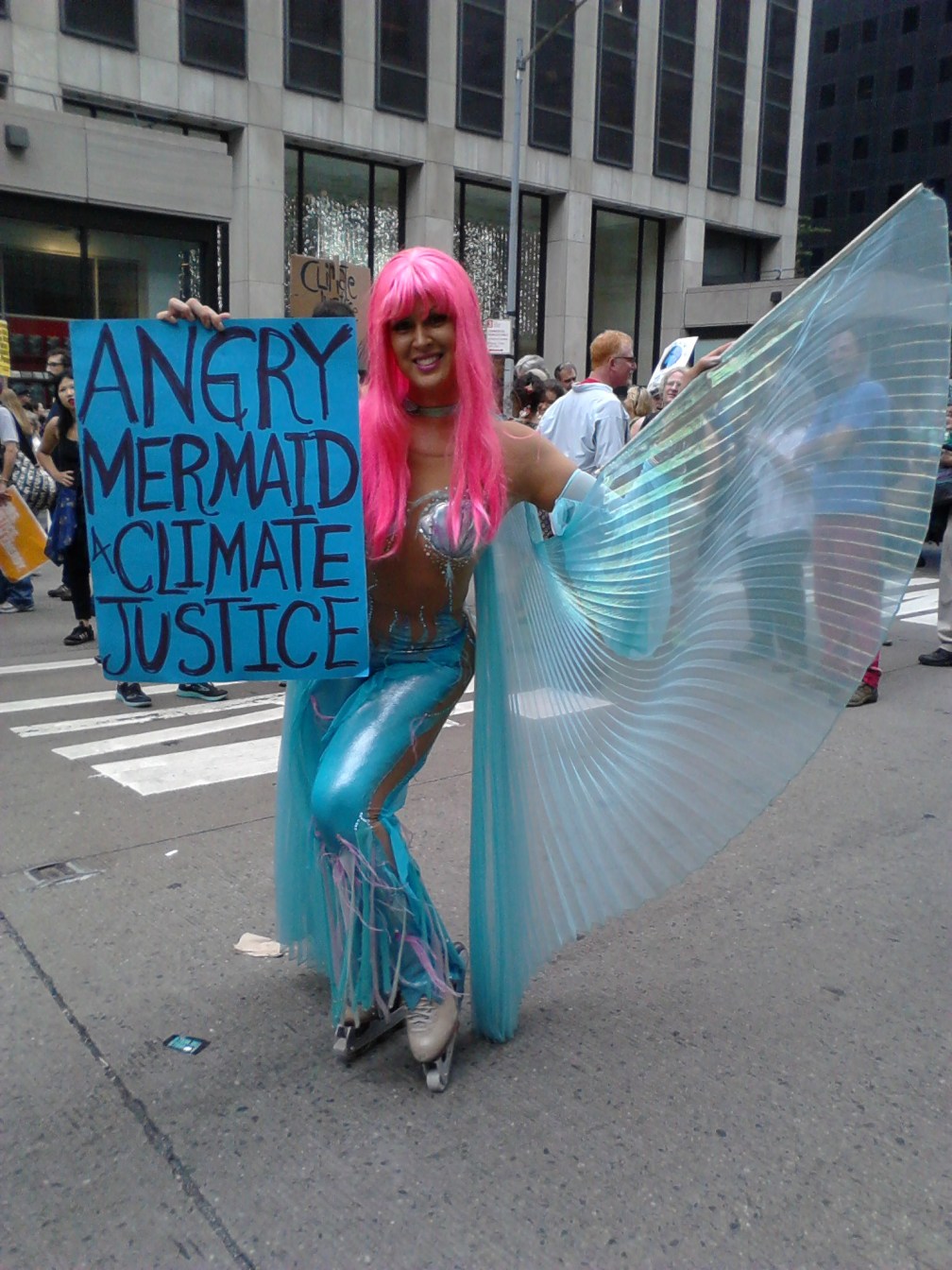
(Report from better days: September 21, 2014) The news media say 310,000 people filled the streets of New York City today, demanding action on climate change. Not all of them were human. There were birds, fish, mermaids, sunflowers, trees, and more than one Mother Earth and Mr. Death. Some species who couldn’t make it in person, like tapirs, sent human ambassadors.

The people who did look human looked like all sorts of human. Indigenous people led the march, wearing gorgeous regalia, drumming and dancing. Great numbers came in from “frontline communities” like Indonesia and poor parishes in New Orleans, the communities least responsible for climate change yet most affected by floods, droughts, and hurricanes. Young people came to fight for their futures. Old people came to fight for their grandchildren.

Some of us have been waiting 45 years to see what we saw in New York: activists for social justice, peace, and the environment joining forces. Out of countless splinter groups, the Movement has finally pulled itself back together. And not a moment too soon.

Fox “news” and Koch-funded “think tanks” might still deny the existence of catastrophic and exponentially accelerating climate change, or the fact that humans have caused it. But nearly all scientists and a growing majority of ordinary people understand what’s going on. It scares us so badly that our instinct for survival is kicking in. We are not threatened only as nations or ethnic groups. We are in danger as a species. For the first time in our history, we must identify ourselves most strongly as humans – a species as vulnerable to extinction as whales and butterflies – if we’re going to overcome our own deadly mistakes.

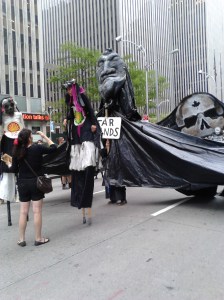
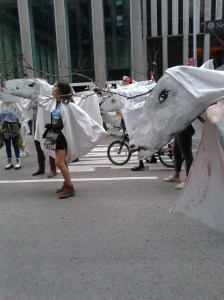
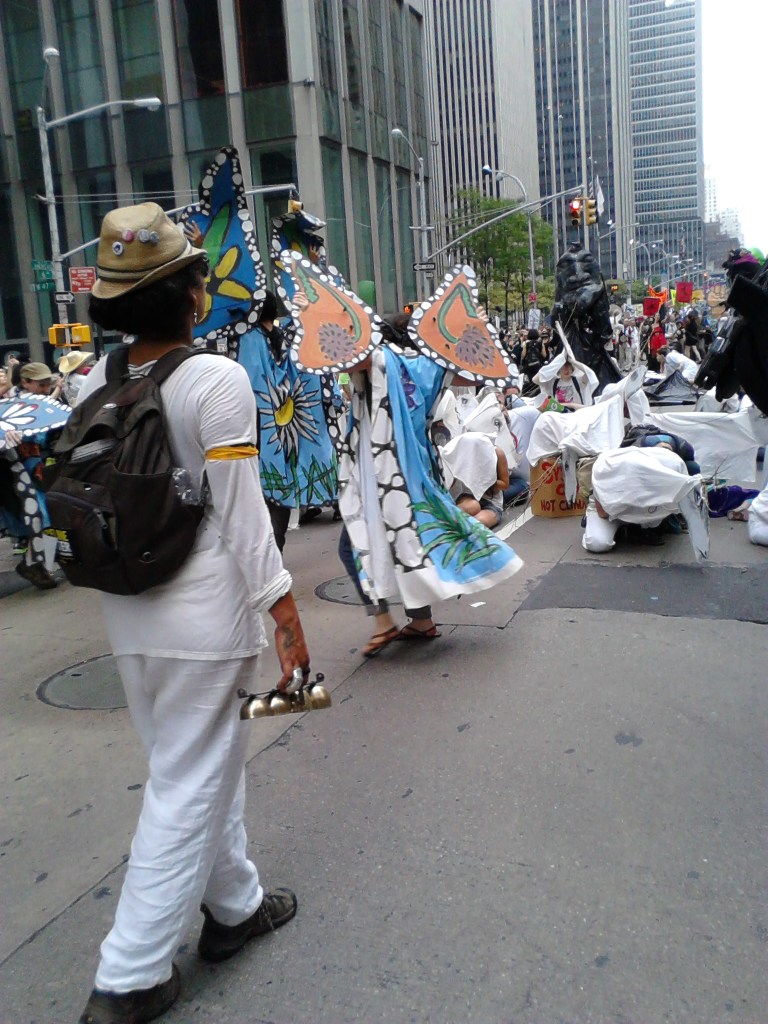
The Vermont collective Bread and Puppets performed some vivid street theater to get this point across. First came dozens of people dressed as caribou, with branches for antlers. Behind them loomed a huge Tar Sands puppet, with black wings appropriately made of garbage-bag plastic. Behind that puppet came Death.

Whenever the march stopped, the troupe blew horns to signal the advance of Tar Sands. The caribou fell cowering to the street. Death seemed triumphant; its minions danced on stilts. Then the horns blew once more, and from nowhere came the Butterflies Against Climate Change: hurrah! They flew through the crowd, revived the caribou, and defeated the forces of destruction.

So okay, butterflies aren’t going to save us. But think of them as representing creativity, the winged aspect of the human spirit, and this fable makes sense. The more we know, the more frightened we get. Our culture is so deeply rooted in greed, violence, and exploitation; so much needs to change. Our leaders get their power from the way things are, which doesn’t motivate them to change it. It’s hard not to despair.

That’s why this march was so necessary. We desperately need to believe that there is enough creativity, enough spiritual power, enough wisdom and skill in the great mass of “ordinary” people, to save humanity from the mess we have made.

On the last day of summer, hundreds of thousands of people demonstrated these qualities in New York City. Native New Yorkers – not known for their belief in unicorns – smiled and waved and flashed peace signs, hung banners from their balconies, and joined the mermaids and the sunflowers in the street.

So get in touch with your inner butterfly, and stay tuned. The struggle of our lifetimes is just beginning.

What we do now.

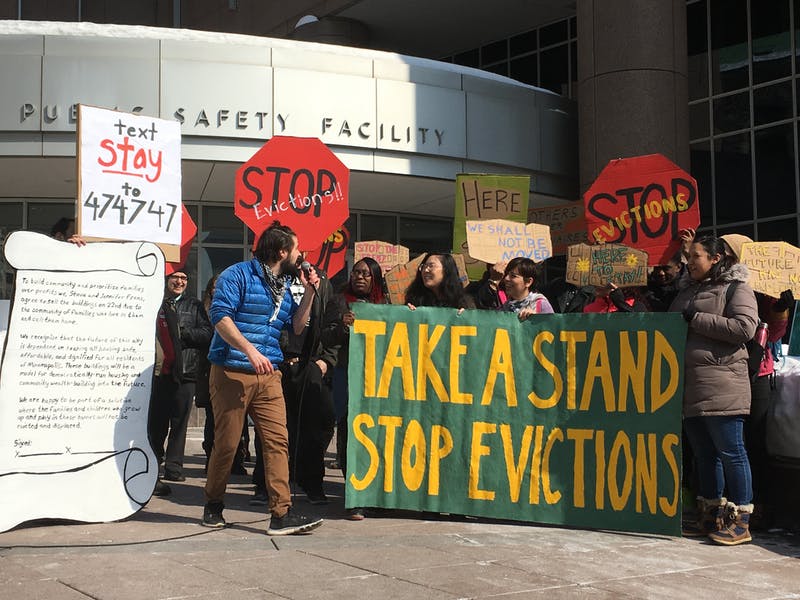
Stay put. If you can’t pay the rent or the mortgage, don’t let anybody make you move out. Stay connected. There are free internet services available now; find one. Stay safe. Make yourself a mask and wear it whenever you leave your home.

American society has been run by money. What do we do when we run out of money? Since the Reagan era, we have been told poverty is the fault of poor people. We felt ashamed to need help. Government has provided less and less help to poor people over the last four decades, and most of us were too busy or too selfish to care. Now millions of us are becoming poor for the first time. It’s quite clear that this new poverty is not our fault. We’re just trying to survive, which in many cases means staying home from non-essential jobs.

As long as middle class people felt relatively secure, many of us assumed that non-profit organizations like food banks would take care of the needs not being met by government programs. These days, we’re learning that the non-profit sector is far too small and poorly funded to meet those needs. Food banks help. There are just not enough of them to feed every hungry family.

We have to stand our ground. Housing, food, health care, basic utilities including internet connections — these are human rights. Now is the time to claim those rights. We know money isn’t everything. Let’s prove it.

Red White and Blues

America’s got the world on a string
We’ve got a little bit of everything
A little bit of freedom
A little bit of peace
A little bit of time living on our knees

We’ve got the red white & blues…oh baby, hang on

They say that the truth’s gonna make us free
If we just stay tuned to cable tv
A little bit of pagan
A little bit of Pope
But ever since Reagan, not a whole lot of hope

We have an election in the year 2020
When a few have taken what belongs to the many.
Afraid we’ve seen it again and again:
two more clueless old white men

We can’t seem to make our system work
Got a president who’s the world’s worst jerk
Gotta keep movin’
We just gotta try
Keep on tellin’ the whole world why
we got the red white & blues…ah, baby, hang on

For Occupy

We are the meek
and we’re here
to inherit the earth.
The rich have got richer
the poor have got poorer
for too long.
That must change.
Violence and greed
have ruled us
for too long.
That must change.
Violence and greed
are what we’re fighting
the whole world over
for our children
and our children’s children
so that we can live
like human beings
in peace together
on this beautiful planet.
We occupy
the place where we live.
We take only
what belongs to us.
We are the meek
and we’ve come
to inherit the earth.
Just in time, too!

Shit Piles Up

Everybody who goes through rehab knows. Everybody who has ever cleaned a toilet knows. If you don’t keep cleaning up, if you don’t deal with the ration of ugly shit we get and make every day, it piles up and gets really disgusting and harder and harder to remove. We have to keep cleaning up.
But what disappears first from government spending when people refuse to raise taxes? Maintenance. Keeping things clean and safe. So the ugly shit piles up.

Bacteria grow in uninspected food. Cars fall into sinkholes caused by ancient infrastructure. Old gas lines leak and houses explode. Lead leaches into the water and stunts the brains of thousands of children. It costs a lot to fix the damage. If we refuse to pay the price of keeping things clean and safe, eventually we will pay a much higher price. And some of the damage can never be fixed.

So let’s clean up our shit as we go. That will motivate us to create less shit to begin with. Plastic, for example: if it won’t biodegrade, we need to stop manufacturing it.

Trillions of pieces of garbage now orbit our planet, gyre on the oceans, choke the fish and poison the birds. Yet we keep making more stuff that has such a short useful life, if it gets used at all, that we might as well ship it straight from the factory to the landfill and save everybody a lot of time and trouble.

Emotional shit piles up too. Everybody who’s ever had therapy knows that. We manufacture useless crap like anger, resentment, envy, and shame, and pile it up inside. Eventually everything inside us gets disgusting and we can’t stand ourselves any more. We have to learn to clean up as we go.

Same thing with nations. We do each other dirty, and the small harms pile up. Eventually we go to war, which does more harm than anything. The residue from that damage leads to future wars. We have to clean up as we go. Notwithstanding the egos of our leaders and the pride of our ideologues, we have to apologize, make restitution, and as far as possible, repair what we have broken. Maintaining peace can be expensive, but it’s cheaper than war.

The Dark Years

Thomas Smith, accompanied by pianist/composer Leonard Lehrman

My mind was going a mile a minute
but I didn’t say a word
Everything that I was thinking about
started seeming so absurd
Every day I was filled with outrage
till it almost made me cry
Didn’t seem I could do much about it
but to watch it all go by

None of my friends are sleeping well
The pills don’t work any more
It feels like we’ve drifted out to sea
and we can’t get back to shore
Where are the superheroes
who will come to save the day
Nothing we do is working
and it does no good to pray

The dark years are upon us
Hold on

I went to some demonstrations
and I saved them on my phone
We felt so strong together
then we all went home alone
I want that beautiful feeling
when the people speak as one
telling the dreadful powers
that we see what they have done

The dark years are upon us (etc)

We can shout online, we can make some noise
but the ones in power won’t hear
They will threaten our lives and freedom
They will punish us with fear
But we never will let them stop us
from trying to make things right
We are magical, we are many,
and we know we are the light
We are magical, we are many,
and we’ve just begun to fight
We are magical, we are many
We are all of us the light

Though the dark years are upon us

Hold on

Bad Behavior

We worry a lot about bad behavior. Kids ignoring social distancing during a pandemic. White cops killing unarmed black people; people frying their brains on drugs or alcohol; families torn apart by domestic violence; destruction of the environment by greed-driven corporations: we have no end of bad behavior to concern us. But is there a common thread?

Until the pandemic began, people gathered in the streets to protest historic levels of economic inequality, or catastrophic climate change. People demonstrated against killings motivated by racism or fanaticism, the surveillance state, cuts to poor people’s programs, or bombing campaigns in countries we can barely find on a map. Were these protests connected?

Something is brewing beneath the surface of our society. We have spent too many years on a path toward self-destruction, sometimes making progress but more often sliding backwards. Racism still hurts and kills people of color every day. Poverty makes hellish the lives of billions. Male aggression wounds and kills women. Our news media tell us lies or partial truths, and all our media conspire to distract us with trivia. And we continue to pollute our air and water, level forests, and strangle fellow-species with our trash, in spite of all our green intentions. Is it any wonder so many people are angry?

Is this the way we are doomed to behave? Do we have any other options? Or are we just greedy, curious, violent primates who will soon poison ourselves with our own waste? Many voices tell us that war is inevitable. They tell us that big corporations and rich people get their own way, that’s just how it is. But is that how it has to be?

We need to look around for examples of people doing things right. If we look, we will find them. In fact most people, most of the time, are doing things as right as our culture will let them. They work. In a lock-down, they stay home. They pay their bills. They wait patiently in line. They try to meet their responsibilities. They are kind. You can think they are suckers. Or maybe they are the meek who are supposed to inherit the earth.

If it were not for other people’s good behavior, meaning decent, helpful behavior, none of us would survive infancy. Good behavior is the ground against which bad behavior stands out. We take it for granted, just as we used to take our health for granted unless we got sick. For most of us, if we know the right thing to do, we will try to do it.

The problem with most people, the problem with the meek, is that we think we have no power. If we don’t have money or celebrity, we think we’re nobody. Yet most of the people in the world want only to be able to live life in peace. What if all of us nobodies decided to act together to make that possible?

But before we can even think about what we have to do to survive, we have to believe that humanity deserves to survive. We have reason to think otherwise — far too many reasons to think we are only a plague on the planet. Give the earth a few million years without us and she will generate millions of new life forms, every bit as marvelous and exuberant and weird as the life forms we are annihilating today. We will be gone, and no one will miss us. Why fight it?

Because the majority of us, the meek, deserve better than to go extinct. Our monstrous world system is run by a cynical few who refuse to allow any changes that would threaten their power, even if we need to make those changes in order for the species to survive. The idea that humanity is not worth saving is the most dangerous weapon in their arsenal. This is a sword that strikes down many good people, strikes them so they choose to sit and watch the carnage, strikes them so they choose not to intervene. They are among the walking wounded of this civilization. Their hearts have been crippled.

There are many reasons to feel the earth would be better off without us. They are all reasons to make peace with Apocalypse, the end of all human hopes. But spend some time around very young humans, and all those reasons come to nothing. We are born beautiful. We are as innocent and as lovely as any species on the planet. It is the culture based on greed and violence that is ugly and deserves to die.